

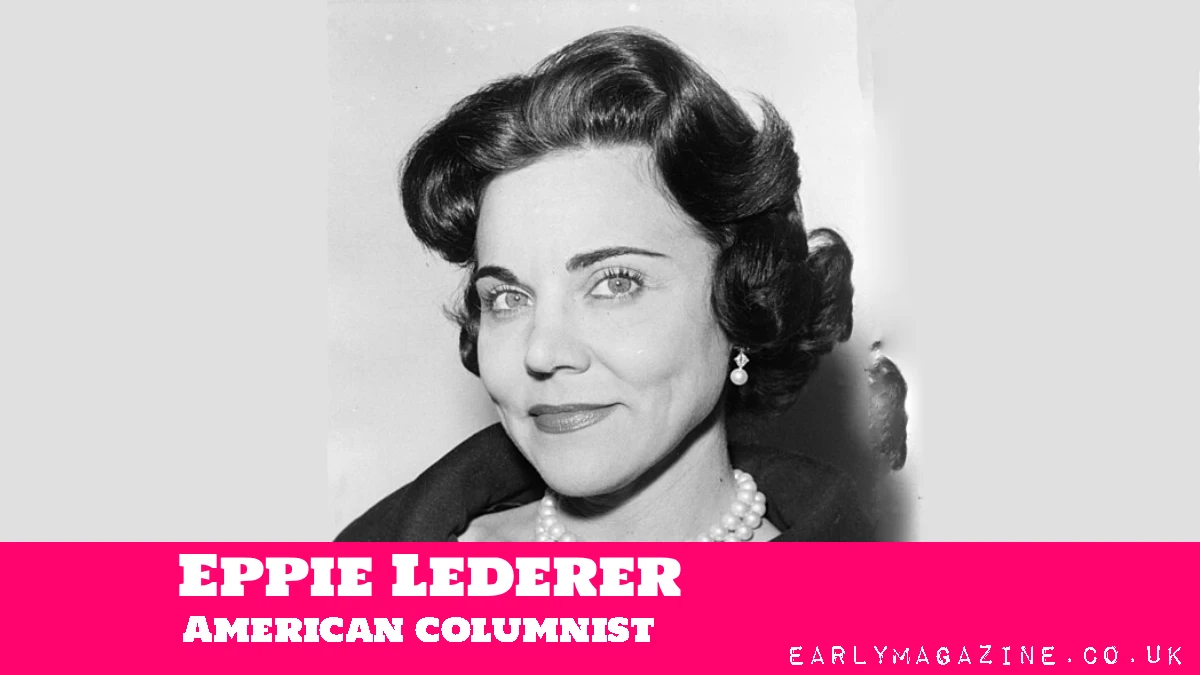
Ann Landers was an American advice columnist born Esther Pauline Friedman on July 4, 1918, in Sioux City, Iowa. She wrote the Ann Landers column from 1955 until her death in 2002, reaching an estimated 90 million readers at her peak. She was the twin sister of Pauline Phillips, better known as Dear Abby.
Some names become bigger than the people who carry them. Ann Landers is one of those names. For nearly five decades, she answered the questions millions of Americans were too embarrassed to ask anyone else — questions about marriage, grief, jealousy, addiction, and family secrets. She did it with clarity, warmth, and an occasional dose of bluntness that readers came to love.
But behind the column was a real woman with her own complicated story. She was a daughter of immigrants, a college dropout, a wife, a mother, and the twin sister of another iconic advice columnist. Her life was as layered as the letters she answered every day.
| Attribute | Details |
|---|---|
| Full Name | Esther Pauline Lederer (born Friedman) |
| Date of Birth | July 4, 1918 |
| Age at Death | 83 |
| Place of Birth | Sioux City, Iowa, USA |
| Nationality | American |
| Profession | Advice Columnist, Journalist |
| Famous For | Writing the nationally syndicated Ann Landers advice column |
| Father | Abraham Friedman |
| Mother | Rebecca Rushall Friedman |
| Siblings | Pauline Phillips (twin, a.k.a. Dear Abby), Helen Brodkey, Dorothy Rosenbaum |
| Marital Status | Divorced (Jules Lederer, m. 1939, div. 1975) |
| Known Traits | Direct, warm, principled, witty |
| Social Media Presence | None (pre-social media era) |
Early Life and Family Background
Esther Pauline Friedman came into the world on July 4, 1918, seventeen minutes before her twin sister, Pauline. The two girls were born in Sioux City, Iowa, to a Jewish immigrant family with modest roots and big ambitions. Growing up in a bustling household with two older sisters, Esther and Pauline were inseparable from the start. They dressed alike, attended the same schools, and shared nearly every childhood experience.
Sioux City in the 1920s was a working-class city built on the Missouri River. The Friedman family was well-regarded in their community. Their father ran a small business, and their mother kept the household together with discipline and warmth. The twins absorbed both qualities.
From early on, Esther had an opinion about everything — and she was not shy about sharing it. Friends and family recalled her as the more assertive of the two twins, confident in her views and unafraid to defend them. That instinct would serve her well decades later.
Education and Academic Journey
Ann attended Sioux City Central High School alongside her twin sister, where both girls were active and popular. After graduating in 1936, she enrolled at Morningside College in Sioux City. She and Pauline were practically a package deal on campus, too.
Ann left college before completing her degree, a detail she addressed openly in later years. She never held it against herself. Formal education, she believed, was only one kind of learning. Life, she said, taught her far more — and the letters that flooded her mailbox every week proved she was right about that.
Physical Appearance and Personality
Ann Landers was known for her polished appearance. She had dark hair, sharp eyes, and the kind of posture that made her look at home in any room. She dressed well and carried herself with confidence without crossing into arrogance.
Her personality was her greatest asset. She was direct without being cold. She could disagree with a reader and still make them feel respected. She had a gift for cutting through the emotion of a letter and finding the practical question underneath it. Colleagues described her as intellectually curious, socially engaged, and deeply loyal to the people she cared about.
Parents
Father: Abraham Friedman
Abraham Friedman emigrated from Russia and built a life in Sioux City, where he eventually owned a chain of movie theaters. He was a self-made man in the truest sense — resourceful, community-minded, and proud of his family. Ann credited her father with giving her a sense of humor and a practical view of the world. He died in 1959, long before the Ann Landers column had reached its full national reach, but he lived to see his daughter step into the spotlight.
Mother: Rebecca Rushall Friedman
Rebecca was the emotional center of the Friedman home. She was known for her warmth and her commitment to Jewish traditions and family life. Ann often spoke of her mother as someone who modeled steadiness under pressure. Rebecca died in 1938, just before Ann married, and that loss stayed with Ann throughout her life. She wrote and spoke about grief with a personal understanding that readers recognized immediately.
Siblings and Extended Family
Ann had three sisters in total: her twin Pauline and two older sisters, Helen Brodkey and Dorothy Rosenbaum. The family was close-knit, and the four sisters maintained relationships throughout their adult lives.
The most famous sibling connection, of course, was with Pauline, who became Abigail Van Buren — Dear Abby. In 1956, just a year after Ann took over the Ann Landers column at the Chicago Sun-Times, Pauline launched her own advice column with the San Francisco Chronicle. The timing raised eyebrows and led to a public rivalry that both sisters downplayed and acknowledged at different moments over the years.
Their relationship was complicated by professional competition, but friends of both women said the bond between them never broke entirely. They were twins, after all — and that is a connection that runs deeper than any column.
Career and Professional Life
Ann Landers began her career in the advice column world almost by accident. In 1955, the Chicago Sun-Times needed someone to take over the Ann Landers column after the original writer, Ruth Crowley, died. The paper held a competition. Ann entered and won.
She had no journalism degree and no prior column experience. What she had was instinct, intelligence, and a vast network of experts she could call for guidance. She built a team of advisors — doctors, lawyers, psychiatrists, clergy — and she used them rigorously. When she didn’t know something, she found someone who did.
The column ran six days a week. At its height, it appeared in more than 1,200 newspapers and reached an estimated 90 million readers. She received up to 2,000 letters per day. Her staff helped manage the volume, but Ann personally read an enormous number of them. She took the responsibility seriously.
Over the decades, she tackled subjects that mainstream media avoided: domestic violence, mental illness, sexual abuse, drug addiction, and AIDS at a time when the disease carried enormous stigma. She evolved with her readers. Positions she held in the 1950s sometimes changed by the 1980s — and she said so openly. That willingness to grow earned her a loyalty that outlasted trends.
She continued writing the column until the very end of her life. Her last column was published in July 2002, just weeks after her death from multiple myeloma on June 22, 2002, in Chicago.
Personal Life and Privacy
Ann married Jules Lederer on July 2, 1939, just two days before her 21st birthday. Jules was a businessman who later co-founded Budget Rent a Car. They had one daughter together, Margo Howard, who became a writer herself.
The marriage lasted 36 years. In 1975, Ann announced in her own column that she and Jules were divorcing — a moment of striking personal transparency that surprised readers and editors alike. She wrote about it plainly, without self-pity, because she believed her readers deserved honesty.
After the divorce, Ann did not remarry. She remained close to her daughter and became a grandmother. She maintained a full social life in Chicago and traveled often. Privacy was something she guarded in practice even while sharing so much of herself in print.
Media Presence and Public Perception
Ann Landers was one of the most recognized names in American media throughout the second half of the twentieth century. She appeared on television programs, gave commencement addresses, and was cited regularly in political and academic discussions about American social values.
The public saw her as trustworthy. She did not sell products or chase celebrity. She answered letters. That consistency built a kind of credibility that most public figures never achieve. Polls in the 1970s and 1980s repeatedly named her among the most influential women in the United States.
Her reputation was not without criticism. Some felt her advice was too conventional in her early years. Others pushed back on specific columns. But the volume and loyalty of her readership spoke for itself. She earned that audience over decades of showing up.
Net Worth and Lifestyle
Ann Landers earned a strong income from her syndicated column over her career. Estimates of her net worth at the time of her death ranged from $10 million to $15 million, though exact figures were never confirmed publicly.
She lived well but not extravagantly. Her Chicago apartment was her base for most of her adult life. She wore quality clothing, traveled internationally, and moved in influential social circles — but she was not known for flashy consumption. Her lifestyle reflected her personality: purposeful and grounded.
Legacy and Influence
Ann Landers changed what Americans thought an advice column could be. Before her, many such columns leaned toward etiquette and propriety. She expanded the conversation to include real, difficult human problems. She treated her readers as adults capable of handling honest answers.
Her influence on American journalism and social culture is hard to separate from the column itself. She gave millions of people permission to talk about things they had kept hidden. That is not a small thing.
Her daughter Margo Howard has written about her mother’s life and continued her own career in journalism and commentary. The Ann Landers name retired with its creator, which is appropriate. No one else was going to fill it the same way.
Conclusion
Ann Landers spent nearly half a century listening to strangers and telling them the truth as best she could. She was not a therapist or a saint. She was a woman with good judgment, wide curiosity, and an unusual willingness to keep learning. She built something rare — a public voice that people actually trusted. That is the measure of her life.
FAQs
1. What was Ann Landers’ real name?
Her birth name was Esther Pauline Friedman. After her marriage to Jules Lederer, she became Esther Pauline Lederer. She used “Ann Landers” as her professional pen name, which she inherited with the column in 1955.
2. Was Ann Landers related to Dear Abby?
Yes. Ann Landers and Dear Abby — whose real name was Pauline Phillips — were identical twin sisters, born seventeen minutes apart on July 4, 1918, in Sioux City, Iowa.
3. Did Ann Landers and Dear Abby get along?
heir relationship was complicated by professional rivalry after Pauline launched her own advice column in 1956, just a year after Ann began hers. Reports over the years suggested periods of estrangement, but the two maintained a connection throughout their lives. Both spoke publicly about the complexity of their bond.
4. How long did Ann Landers write her column?
She wrote the Ann Landers column from November 1955 until her death in June 2002 — nearly 47 years.
5. How many readers did Ann Landers reach?
At the peak of her popularity, the column appeared in more than 1,200 newspapers and reached an estimated 90 million readers worldwide.
6. Why did Ann Landers divorce her husband?
Ann announced her divorce from Jules Lederer in 1975 through her own column. She did not offer detailed reasons, saying only that the marriage had run its course. The announcement was notable for its candor and for the fact that she chose to share it with readers directly.
7. Did Ann Landers have children?
She had one daughter, Margo Howard, who went on to become a journalist and writer in her own right.
8. When did Ann Landers die?
Ann Landers died on June 22, 2002, in Chicago, Illinois, from multiple myeloma. She was 83 years old. Her final column was published posthumously in July 2002.
For more stories about the real lives behind iconic American names, visit Early Magazine UK — where the history, family ties, and lasting impact of public figures come together in one place.
