

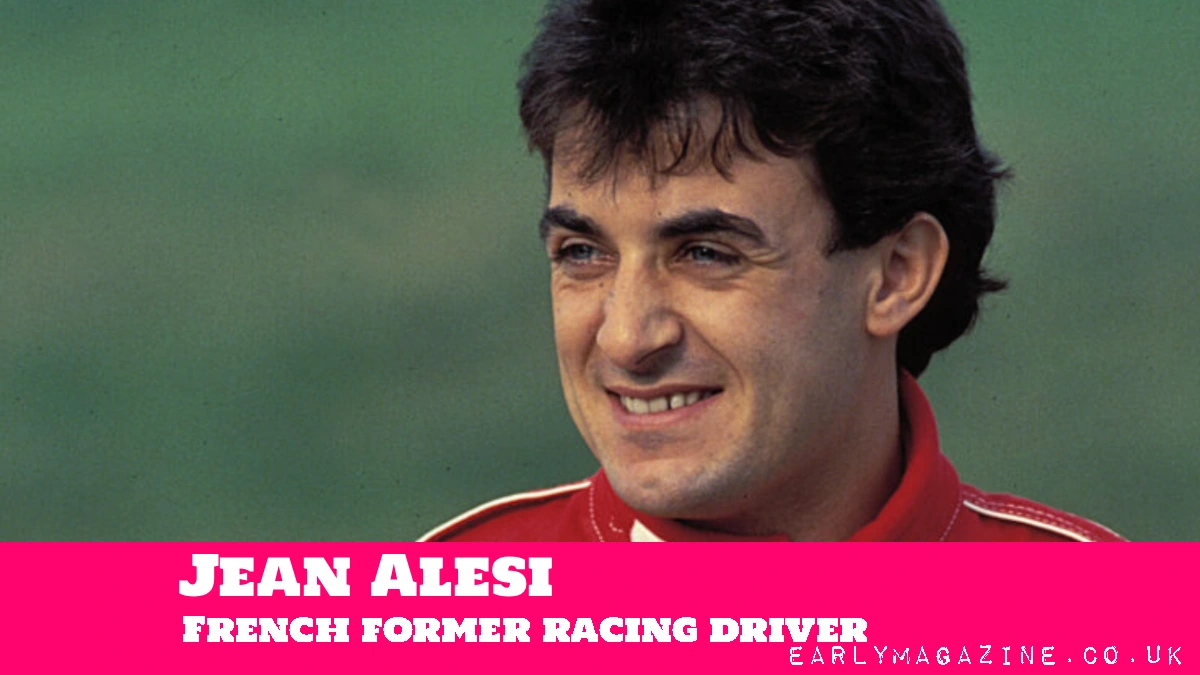
Jean Alesi net worth is estimated at $50 million, built through a 12-year Formula One career spanning 201 races, five seasons at Ferrari, endorsement deals, post-retirement racing in DTM, a Pirelli ambassadorship since 2013, and ownership of a vineyard near Avignon, France.
Few drivers in Formula One history stirred more passion than Jean Alesi. The French-Italian racer with Sicilian roots became one of the sport’s most beloved figures, not just for his speed but for the emotion he wore on his sleeve every single lap. Today, fans still search for the Jean Alesi net worth figure because his story is about more than prize money — it is about a man who built lasting wealth from a career that never quite delivered a world championship.
So how did Alesi translate one Grand Prix win, 32 podiums, and a fiercely loyal fanbase into a $50 million fortune? The answer lies in decades of consistent racing income, smart business moves after retirement, and a personal brand that has never lost its shine. This article breaks down exactly where Alesi’s money came from, what his career paid him at its peak, and what he does today to maintain his wealth.
Here is what you will find below: a breakdown of Alesi’s career earnings by team, his post-F1 income sources, how his net worth compares to F1 peers, and answers to the questions fans ask most.
Jean Alesi Net Worth: The $50 Million Figure Explained
The most widely cited and reliable estimate for Jean Alesi net worth is $50 million, according to Celebrity Net Worth. Some sources float higher figures, including one that puts him near $185 million, but these numbers are not supported by credible financial data and appear to be outliers. The $50 million estimate, cross-referenced across multiple sports finance publications as recently as February 2025, is the most grounded figure available.
This wealth did not come from a single source. Alesi raced professionally from 1989 to 2012 across multiple series, collected driver fees from some of the sport’s biggest teams, and built income streams that survived long after he parked his helmet.
What His F1 Career Actually Paid
Alesi competed in Formula One from 1989 to 2001, starting 201 races and earning 241 championship points. His career took him through six different constructors: Tyrrell, Ferrari, Benetton, Sauber, Prost, and Jordan.
His biggest paychecks came during his time at Ferrari (1991–1995) and Benetton (1996–1997). At Ferrari, Alesi was the team’s star driver for much of his tenure, commanding the kind of salary that came with the Scuderia’s prestige. By 2000, even during a difficult spell at the struggling Prost team, a European business salary report cited his annual F1 pay at approximately £1.9 million — a significant figure for a mid-grid driver at that time.
Over a 12-year F1 career, his cumulative racing income alone, across base salaries, bonuses, and performance incentives, is estimated to have reached somewhere between $20 million and $30 million in today’s terms.
Post-F1 Racing Income
Retirement from Formula One in 2001 did not mean Alesi stopped earning from motorsport. He made a full-time switch to the Deutsche Tourenwagen Masters (DTM), competing from 2002 to 2006. He won five races in the series and maintained a credible professional income during those years.
In 2010, he returned to sports car racing with an appearance at the 24 Hours of Le Mans. Two years later, in 2012, he entered the Indianapolis 500 with Fan Force United, marking a brief foray into American open-wheel racing.
These post-F1 appearances kept Alesi’s profile high and his income active. They were not his biggest earners, but they extended the window during which sponsors and teams were willing to pay for his name.
Jean Alesi’s Income Sources Beyond Racing
The Pirelli Ambassador Role
Since 2013, Alesi has served as a brand ambassador for Pirelli, Formula One’s official tyre supplier. This role is one of his most stable and visible income sources in retirement. Ambassadors at this level typically command six-figure annual fees, and Alesi’s status as an F1 icon with strong ties to Ferrari makes him particularly valuable to the Italian brand.
The partnership keeps him firmly inside the F1 paddock, giving him access to events, media appearances, and the commercial ecosystem of the sport he helped build.
The Vineyard and Property Holdings
Alesi and his wife, Japanese actress and model Kumiko Goto (whom he married in 1995), live near Avignon in the south of France. They own a vineyard in the region and are, by multiple accounts, serious wine enthusiasts.
A French vineyard of any quality is not just a lifestyle choice — it is a real asset. Premium wine estates in Provence and the surrounding Vaucluse region can be worth anywhere from several hundred thousand euros to multiple millions, depending on size and output. For Alesi, the vineyard represents both personal passion and a tangible piece of his overall wealth.
He also reportedly holds property assets, adding another layer to a financial picture that extends well beyond his driving career.
Endorsements and Media Appearances
Alesi has remained active in the media landscape long after his racing days. He appears regularly at F1 events, gives interviews to French and international sports outlets, and comments on current F1 affairs. As recently as February 2025, he was a guest at the Ferrari F175 Launch event at the O2 Arena in London, where he spoke to Sky Sports about Lewis Hamilton’s arrival at Ferrari.
This kind of visibility keeps his personal brand relevant and opens doors to paid media partnerships, speaking engagements, and endorsement deals — none of which are individually enormous, but collectively contribute to sustained income.
Jean Alesi’s Career Earnings at a Glance
| Period | Team/Series | Key Financial Note |
|---|---|---|
| 1989–1990 | Tyrrell (F1) | Entry-level F1 salary; breakthrough season |
| 1991–1995 | Ferrari (F1) | Peak earning years; top-tier driver fees |
| 1996–1997 | Benetton (F1) | Swapped seats with Schumacher; strong salary |
| 1998–1999 | Sauber (F1) | Competitive pay, experienced driver premium |
| 2000–2001 | Prost / Jordan (F1) | Declining team budgets; ~£1.9M reported in 2000 |
| 2002–2006 | DTM | Five race wins; professional-level earnings |
| 2010 | Le Mans (AF Corse) | One-off appearance fee |
| 2012 | Indy 500 (Fan Force United) | Guest appearance; commercial value |
| 2013–present | Pirelli Ambassador | Ongoing annual retainer |
How Alesi’s Net Worth Compares to F1 Peers
To put Jean Alesi net worth in context, consider where he sits against contemporaries from the same era.
Drivers who won world championships in the 1990s, like Michael Schumacher and Damon Hill, built significantly larger fortunes. Schumacher’s net worth is estimated at over $600 million, reflecting his record seven titles and decade of peak F1 salaries that dwarfed everyone else on the grid. Hill’s net worth sits around $40 million — actually slightly below Alesi’s estimate.
Mika Hakkinen, the two-time champion, is estimated at around $40 million. Rubens Barrichello, who raced even longer than Alesi, sits around $60 million.
This places Alesi firmly in a respected tier of retired F1 drivers — wealthier than many of his peers despite never winning a title. His Ferrari connection, strong European media profile, and ongoing business activity explain why his net worth holds up well.
Why One Win Still Made Him Rich
It might seem surprising that a driver with only one Grand Prix victory could accumulate $50 million. But Formula One wealth is not purely about winning championships.
What matters is team prestige, duration, and marketability. Alesi spent five years at Ferrari, the most storied team in the sport’s history. He was a beloved figure among the Tifosi, Ferrari’s passionate fanbase. That emotional connection had real commercial value.
He also raced for over two decades across multiple series. Long careers generate compounding income. His face, his helmet — the iconic white, black, and red design that later became silver in 1999 — was known across Europe. That recognition translated to endorsement opportunities that many quicker but less famous drivers never accessed.
His 2006 appointment as a Knight of the Legion of Honour, France’s highest civilian distinction, cemented his status as a national sporting figure. Cultural capital of that kind has financial consequences.
FAQs About Jean Alesi Net Worth
Did Jean Alesi earn a lot from Ferrari?
Yes. His five seasons at Ferrari from 1991 to 1995 represented his peak earning years in F1, where he commanded top-tier driver fees as the team’s primary star.
What does Jean Alesi do now for income?
He serves as a Pirelli brand ambassador since 2013, owns a vineyard near Avignon, and maintains income through media appearances, speaking engagements, and F1 event participation.
Is Jean Alesi’s $185 million net worth figure accurate?
No. That figure appears on entertainment tabloid sites and is not supported by credible financial sources. The most reliable estimate, cited across multiple sports publications, is $50 million.
How does Jean Alesi net worth compare to other F1 legends?
He sits in a solid mid-tier of retired F1 drivers. His $50 million estimate is above Damon Hill’s ~$40 million but well below Michael Schumacher’s $600+ million, reflecting the championship gap.
The Legacy Behind the Number
Jean Alesi built $50 million through longevity, brand power, and a connection to Ferrari that outlasted his racing career by decades. He never became a world champion, but he became something arguably rarer in business terms: a driver people genuinely love, decades after his last race.
His story is a reminder that sporting wealth does not follow trophies alone. The racers who stay visible, stay relevant, and invest wisely can build fortunes that rivals with better results never managed. Alesi turned passion into a career, a career into a brand, and a brand into lasting financial security.
If you follow Formula One, understanding how drivers like Alesi built their wealth gives you a clearer picture of the sport’s true economics — one that goes far beyond race-day prize money and into the business of being a motorsport icon.
For more insights into how motorsport legends and modern icons navigate fame and fortune, visit EarlyMagazine UK — where boundary-breaking careers and financial wisdom come together.
