

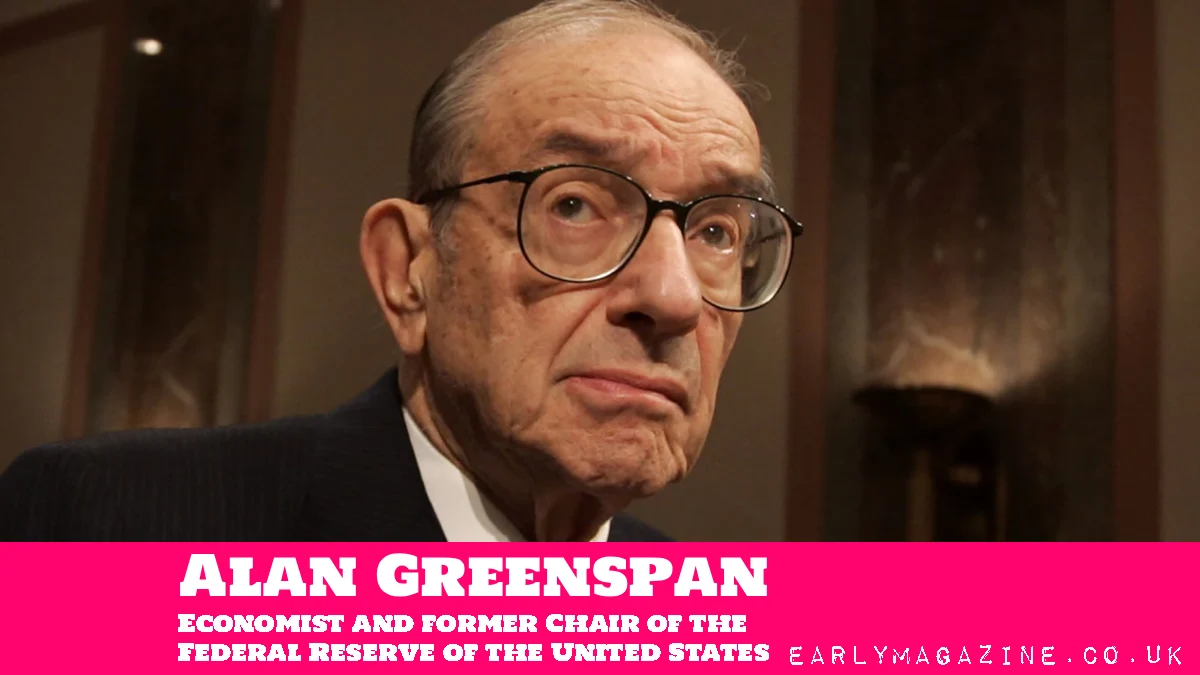
Alan Greenspan had an estimated net worth of $20 million at his death in June 2026. His wealth came mainly from consulting fees through Greenspan Associates LLC, an $8.5 million advance for his 2007 memoir, paid speaking engagements, and conservative personal investments built over a career spanning Wall Street, the White House, and the Federal Reserve.
Alan Greenspan ran the Federal Reserve for almost 19 years, yet most people have no idea what he was actually paid or how much he was worth. Alan Greenspan’s net worth stood at an estimated $20 million at the time of his death on June 22, 2026, at age 100. That number surprises a lot of people. The man who steered the world’s largest economy through Black Monday, the dot-com bubble, and the run-up to the 2008 crisis never came close to billionaire status, and he never tried to.
His fortune came from a government salary that topped out at $180,000 a year, a record-setting book advance, and decades of consulting fees earned after he left public office. Greenspan Associates LLC, his private advisory firm, became his real moneymaker once he stepped down in 2006. This article breaks down exactly where his wealth came from, how it compares to other Fed chairs, and what his financial story actually teaches you about building wealth through expertise instead of speculation.
What You’ll Learn
This article covers how Greenspan built his $20 million net worth across a 70-year career. You’ll see his income breakdown by source, a direct comparison with other Federal Reserve chairs, and the key decisions that shaped his finances. We’ll also answer the most common questions people search about his wealth and legacy.
Who Was Alan Greenspan
Greenspan was born March 6, 1926, in the Washington Heights neighborhood of New York City. He served as the 13th chairman of the Federal Reserve from 1987 to 2006, appointed by President Ronald Reagan and reappointed by three more presidents from both parties.
Before the Fed, he ran his own economic consulting firm, Townsend-Greenspan & Co., for over two decades. He also chaired the Council of Economic Advisers under President Gerald Ford. He died Monday, June 22, 2026, from complications of Parkinson’s disease, according to his wife, NBC News correspondent Andrea Mitchell.
Early Career and Fed Salary
Greenspan’s government pay never matched his public profile. During his 18.5-year tenure at the Federal Reserve, his salary was relatively modest. In his final year, he earned about $180,000. Compare that to a typical Wall Street managing director today, and the gap is striking.
A Fed chairman’s salary is fixed by Congress, not market rates. Greenspan never used his position for personal financial gain. He kept his own investments deliberately boring, mostly Treasury securities, to avoid any appearance of conflict while setting national interest-rate policy.
How Alan Greenspan Built His $20 Million Net Worth
Greenspan’s real wealth-building started after he left the Fed in 2006. Here’s the breakdown.
| Income Source | Approximate Value | Notes |
|---|---|---|
| Federal Reserve salary | $180,000/year (final year) | Fixed government pay, 1987–2006 |
| Book advance | $8.5 million | The Age of Turbulence, Penguin Press, 2007 |
| Consulting (Greenspan Associates LLC) | Multi-million, ongoing | Clients included PIMCO and Deutsche Bank |
| Speaking engagements | Substantial, undisclosed | High demand into his 80s and 90s |
| Personal investments | Conservative, steady | Primarily fixed-income, low-risk holdings |
The Memoir That Changed Everything
In 2007, Greenspan published The Age of Turbulence: Adventures in a New World. Penguin Press paid him an $8.5 million advance, one of the largest nonfiction book advances in publishing history at the time. The book became a bestseller, adding royalties on top of that advance.
For perspective on how rare that deal was, his successor Ben Bernanke earned around $1 million for his own memoir years later. Greenspan’s name alone commanded roughly eight times that figure. He followed up with a second book, Capitalism in America: A History, in 2018, which kept his profile and his income active well into his 90s.
Greenspan Associates and Consulting Income
After leaving the Fed, Greenspan founded Greenspan Associates LLC, his private consulting firm. He advised major financial institutions, including PIMCO and Deutsche Bank, on economic strategy and market risk. This consulting work became his primary income stream for nearly two decades.
Unlike a salaried role, consulting income scales with reputation. Few people on earth had Greenspan’s combination of insider Fed experience and public credibility, and clients paid accordingly. He kept working in this capacity into his late 90s, a detail that explains why his net worth held steady rather than declining in retirement.
Greenspan vs. Other Fed Chairs: A Wealth Comparison
Greenspan’s post-Fed earning power stands out even among his peers. Most Fed chairs see a bump in income after leaving office through books, speeches, and board seats, but the size of that bump varies enormously.
- Alan Greenspan: $8.5 million book advance, decades of high-fee consulting, estimated $20 million net worth.
- Ben Bernanke: Around $1 million for his memoir, plus academic and think-tank roles.
- Janet Yellen: Reportedly earned over $7 million in speaking fees in the two years after leaving the Fed, before returning to government as Treasury Secretary.
- Paul Volcker: Took a far quieter post-Fed path, focused on financial reform advocacy rather than high-fee consulting.
The pattern is clear. Fed chairs who lean into the private consulting and lecture circuit build wealth fast. Those who stay closer to academia or public service see smaller bumps. Greenspan picked the first path and stuck with it for nearly twenty years.
What Greenspan’s Wealth Says About Building Money the Slow Way
Greenspan’s financial story runs against the modern idea of getting rich fast. He spent over 70 years working, much of it in roles that paid government-scale salaries, not Wall Street bonuses. His wealth came from stacking expertise on top of expertise until that expertise itself became valuable enough to charge for directly.
Financial planner and author Suze Orman has often pointed out that consistent, specialized expertise tends to outpace flashy short-term bets over a full career. Greenspan’s case backs that up. He never held founder equity in a unicorn startup or rode a single winning stock pick. He built a brand around judgment, and judgment, it turns out, is billable for decades.
There’s also a lesson in restraint. Greenspan kept his personal portfolio deliberately conservative during his Fed years specifically to avoid conflicts of interest. That discipline likely cost him some upside compared to a more aggressive investor, but it protected his reputation, which turned out to be his most valuable asset once he left office.
Honors and Recognition Beyond the Dollar Figure
Money was never the full measure of Greenspan’s influence. He received the Presidential Medal of Freedom, the highest civilian award in the United States, from President George W. Bush in November 2005. He also received the Commander of the Legion of Honour from France in 2000 and was made a Knight Commander of the Order of the British Empire by Queen Elizabeth II in 2002.
Those honors don’t show up on a balance sheet, but they fed directly into his post-Fed earning power. Institutions paid premium consulting fees partly because of the credibility those honors represented.
Frequently Asked Questions
How did Alan Greenspan make his money?
He earned income through his Federal Reserve salary, an $8.5 million book advance for his 2007 memoir, ongoing consulting through Greenspan Associates LLC, and paid speaking engagements.
What was Alan Greenspan’s salary as Fed chairman?
In his final year at the Federal Reserve, Greenspan earned approximately $180,000 annually, a fixed government salary set by Congress, not by market performance.
Did Alan Greenspan get rich from being Fed chairman?
Not directly. His Fed salary was modest. Most of his wealth came after he left the position in 2006, through consulting, book deals, and speaking fees built on his reputation.
How does Greenspan’s net worth compare to Ben Bernanke’s?
Greenspan’s estimated $20 million net worth significantly outpaces Bernanke’s public earnings, largely because Greenspan’s memoir advance was roughly eight times larger than Bernanke’s.
Final Thoughts
Alan Greenspan’s $20 million net worth tells a story that has little to do with luck and everything to do with leverage built through decades of credibility. He never chased speculative wealth, even when his position gave him insider knowledge that could have made him far richer. Instead, he built a long career on judgment, discipline, and timing, then cashed in that reputation once he was free to do so.
His financial path offers a clear lesson for anyone building a career rather than chasing a windfall. Reputation compounds slowly, but it pays out for decades once it’s established. Whether you study economics, run a business, or simply want to understand how influence translates into income, Greenspan’s $20 million legacy proves that staying power often beats speed.
For more insights into how modern icons navigate fame and fortune, visit EarlyMagazine UK—where boundary-breaking careers and financial wisdom come together.
