

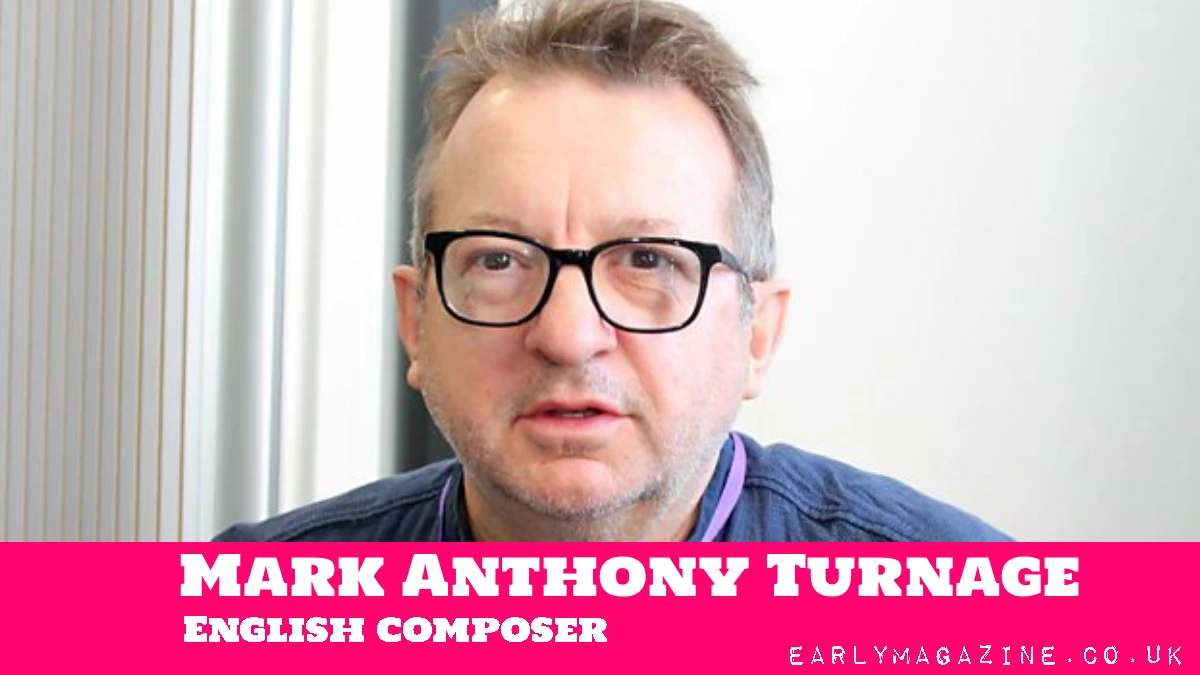
Mark Anthony Turnage, born June 10, 1960, in Corringham, Essex, is an English composer who revolutionized classical music by blending jazz and contemporary styles. Known for operas like “Greek” and “Anna Nicole,” he’s earned international recognition and a CBE for transforming modern classical composition.
Who is Mark Anthony Turnage?
Mark Anthony Turnage stands as one of Britain’s most significant contemporary classical composers, earning recognition as a creative force who dared to break traditional boundaries. His unique approach combines classical orchestration with jazz rhythms, creating music that speaks directly to modern audiences. Since his breakthrough opera “Greek” in 1988, Turnage has established himself as an artist unafraid to tackle controversial subjects and push musical limits.
Unlike many of his peers from privileged backgrounds, Turnage emerged from Essex’s working-class industrial area, bringing a fresh perspective to the classical music world. His compositions often explore dark themes like urban alienation, drug addiction, and social issues that resonate with contemporary life. Today, he serves as Research Fellow in Composition at the Royal College of Music and continues creating groundbreaking works for leading orchestras worldwide.
This rebellious composer has held prestigious residencies with major orchestras including the Chicago Symphony Orchestra, BBC Symphony Orchestra, and London Philharmonic Orchestra. His music attracts both traditional classical audiences and younger listeners drawn to his innovative sound. In 2015, he received a Commander of the Order of the British Empire (CBE) for his outstanding contributions to music.
Early Life and Musical Awakening
Mark Anthony Turnage was born on June 10, 1960, in Corringham, Essex, as the eldest of three children to music-loving parents who were also enthusiastic Pentecostal Christians. His father worked as a clerk for Mobil Oil and could sing beautifully, while his mother played both piano and cornet in a brass band, filling their home with the sounds of Beethoven and classical music. This musical environment would shape young Mark’s destiny in ways nobody could have predicted.
From age six, Mark began piano lessons and quickly became obsessed with the instrument, using it as an escape from his strict religious household where popular music was considered “evil.” He spent hours listening to classical radio stations, memorizing composers’ birth and death dates and ranking them in order of preference like a young music scholar. His dedication to music was so obvious that classmates nicknamed him “Wolfgang,” recognizing his natural compositional talents.
At just nine years old, Mark seriously began composing his own music, rapidly developing his skills through improvisation and piano technique exercises. He would recite composers’ biographical details for entertainment and spent days absorbing classical music, though he also secretly discovered jazz through artists like Miles Davis and groups like Weather Report, plus rock music from performers like Prince. These diverse influences would later become crucial elements in his distinctive compositional style.
Education and Musical Development
At fourteen, Turnage’s exceptional talent earned him acceptance into the junior section of the Royal College of Music in London, where he began studying with renowned composers Oliver Knussen and John Lambert. This acceptance provided a crucial boost to his self-confidence after an early music teacher had failed to recognize his potential. The Royal College became his musical laboratory where he could explore composition seriously under expert guidance.
During his college years, Turnage lived what he called a “schizophrenic” musical life, composing atonal music during the day to meet academic expectations while secretly listening to jazz at night. The college atmosphere discouraged melody and rhythmic music like Stravinsky’s, pushing students toward complex atonal compositions that used all twelve chromatic notes without tonal centers. This created internal conflict for young Mark, who felt naturally drawn to more accessible musical languages.
With Oliver Knussen’s encouragement, Turnage gradually found his authentic compositional voice, breaking free from academic constraints that had made him afraid to write simple, direct rhythms. Later, he won a Mendelssohn Scholarship that enabled him to attend the prestigious Tanglewood Summer School, where he studied with Gunther Schuller and informally with Hans Werner Henze. These experiences exposed him to diverse compositional approaches that would influence his mature style.
The discovery of jazz opened entirely new musical worlds for Turnage, who realized there was “a bigger world out there” beyond his classical training. He began integrating jazz elements into his classical compositions, creating the unique fusion style that would define his career. His grandfather’s stories about World War I horrors also profoundly impacted him, inspiring multiple works exploring war themes that would become recurring subjects in his mature compositions.
Breaking Through with “Greek”
In 1985, the influential composer Hans Werner Henze commissioned Turnage to write an opera for the Munich Biennale Festival, resulting in “Greek,” which premiered triumphantly in 1988. Based on Steven Berkoff’s adaptation of the Oedipus Rex myth, this opera established Turnage’s international reputation as an artist willing to forge his own path between modernism and tradition. The success of “Greek” launched his career and demonstrated that contemporary opera could address modern themes with accessible musical language.
This breakthrough work showcased Turnage’s unique ability to blend jazz and classical styles, creating music that felt both sophisticated and emotionally direct. The opera’s success proved that audiences were hungry for contemporary classical music that spoke to modern experiences rather than retreating into academic complexity. Critics praised its energy, vivid orchestration, and ability to communicate with diverse audiences.
Following “Greek’s” success, Turnage created several major works during his residency as Composer in Association with the City of Birmingham Symphony Orchestra under Simon Rattle from 1989 to 1993. These included “Three Screaming Popes,” “Kai,” “Momentum,” and “Drowned Out,” each exploring different aspects of his evolving compositional voice. Working with Rattle and the Birmingham orchestra provided invaluable experience and exposure that established him as a major force in British music.
Major Works and Artistic Maturity
“Blood on the Floor,” completed in 1996, represents one of Turnage’s most personal and powerful compositions, written for distinguished jazz musicians John Scofield, Peter Erskine, and Martin Robertson. This nine-section work deals with drug addiction themes, with one movement titled “Elegy for Andy” inspired by his brother’s overdose death, demonstrating how personal tragedy fueled his artistic expression. The piece brilliantly integrates improvisation with composed sections, creating unique dialogue between jazz and classical traditions.
Turnage’s second opera, “The Silver Tassie,” premiered at English National Opera in 2000, winning both the South Bank Show and Olivier Awards for Opera. Based on Sean O’Casey’s play about a footballer before, during, and after World War I, the opera reflected his lifelong interest in war’s devastating effects, inspired by his grandfather’s stories about the trenches. The work includes folk dancing elements and Irish jigs, showing his ability to incorporate traditional elements into contemporary compositions.
“Anna Nicole,” premiered at the Royal Opera House in 2011, caused international sensations with its controversial subject matter about Anna Nicole Smith’s life. The opera played to sold-out houses at Covent Garden and has since been staged in Dortmund, New York, and Nuremberg, proving that contemporary opera could achieve both artistic merit and popular appeal. His family opera “Coraline” followed in 2018, touring internationally to cities including Freiburg, Lille, Stockholm, and Melbourne.
Recent works include his latest opera “Festen,” adapted from the 1998 Danish film, which premiered at the Royal Opera House in 2024 and won the Tait Award for Best New Opera Production at the 2025 Olivier Awards. This achievement demonstrates his continued relevance and ability to create compelling contemporary operas that resonate with modern audiences.
Prestigious Residencies and Collaborations
Turnage’s exceptional talent led to prestigious residencies with major orchestras worldwide, beginning with his groundbreaking position as the first Radcliffe Composer in Association with the City of Birmingham Symphony Orchestra from 1989 to 1993. Between 2000 and 2003, he served as the BBC Symphony Orchestra’s first Associate Composer, followed by a residency with the London Philharmonic Orchestra from 2005 to 2010. These positions provided platforms for creating major orchestral works and establishing his international reputation.
From 2006 to 2010, Turnage held the prestigious Mead Composer in Residence position with the Chicago Symphony Orchestra alongside Argentinian composer Osvaldo Golijov. This residency resulted in two significant new works: “From All Sides” and “Chicago Remains,” conducted by renowned maestros Esa-Pekka Salonen and Bernard Haitink respectively. Working with these world-class orchestras and conductors elevated his compositional skills and global recognition.
His residency with the London Philharmonic Orchestra was celebrated with the premiere of his first violin concerto, “Mambo, Blues and Tarantella,” written for Christian Tetzlaff and performed with Vladimir Jurowski at the Southbank Centre in 2008. The residency concluded with “Texan Tenebrae” in 2010, and three Turnage albums were released on the LPO’s own label, documenting this productive collaboration. These recordings helped spread his music to international audiences and established his commercial viability.
Throughout his career, Turnage has worked with leading conductors including Simon Rattle, Andrew Davis, Vladimir Jurowski, Daniel Harding, Antonio Pappano, and Leonard Slatkin. He has also collaborated with celebrated soloists like Håkan Hardenberger, Christian Lindberg, and Marc-André Hamelin, plus ensembles including Ensemble Modern, London Sinfonietta, and the Nash Ensemble.
Recognition and Personal Life
In 2015, Turnage received one of Britain’s highest honors when he was appointed Commander of the Order of the British Empire (CBE) for his outstanding services to music. In autumn 2005, he was appointed the Royal College of Music’s Research Fellow in Composition, a position that allows him to continue developing young composers while pursuing his own creative work. These appointments recognize both his artistic achievements and his commitment to nurturing the next generation of musical talent.
Turnage’s partner is director Rachael Hewer, who founded the Virtual Opera Project (VOPERA) in 2020, connecting their shared interests in innovative musical theater. In January 2025, he appeared as the castaway on BBC Radio 4’s prestigious “Desert Island Discs,” choosing music by Oliver Knussen, Miles Davis, and Stevie Wonder that reflects his diverse musical influences. During this interview, he revealed his regular volunteer work at food banks and music projects with prisoners, showing his commitment to social causes.
Despite his achievements and establishment position, Turnage maintains his outsider perspective, saying he grew up in industrial Essex and would likely be working at Ford’s in Dagenham if he hadn’t become a composer. This working-class background has provided him with perspectives and stories unknown to many contemporaries from affluent backgrounds, enriching his compositional voice with authentic social experiences. His music continues attracting young audiences who connect with his honest emotional expression and contemporary themes.
Turnage’s extensive discography includes recordings on major labels like Decca, Warner Classics, Chandos, and Deutsche Grammophon, with “Scorched” receiving a Grammy nomination. His continuing productivity includes recent orchestral works like “Time Flies,” “Last Song for Olly,” and “Up for It,” proving that his creative powers remain strong as he approaches his mid-sixties.
Mark Anthony Turnage’s remarkable journey from working-class Essex to international classical music stardom demonstrates how authentic artistic vision can transcend social boundaries and transform musical traditions. His fearless exploration of contemporary themes through innovative musical language continues inspiring new generations of composers and audiences worldwide.
For more inspiring stories like Mark Anthony Turnage’s journey from working-class roots to classical music stardom, visit us at EarlyMagazine, where we explore the lives of visionary artists who dare to break boundaries and forge their own creative paths.
