

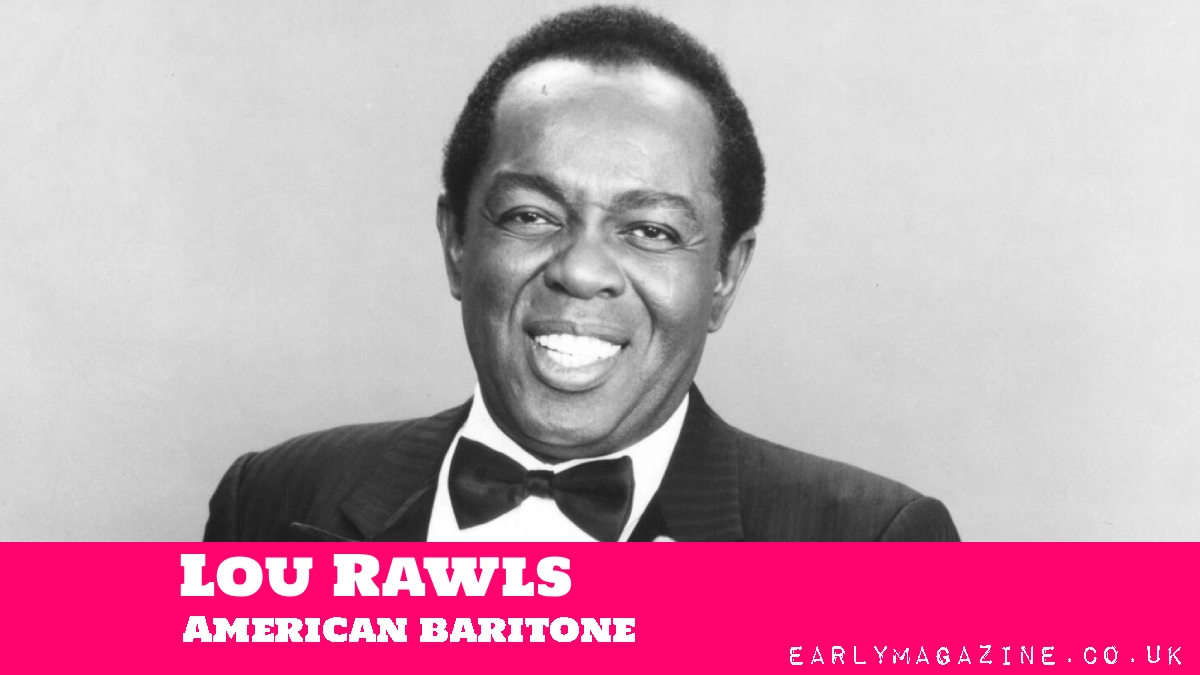
Lou Rawls was an American soul, jazz, and blues singer known for his smooth baritone voice. Born in 1933 in Chicago, he rose from gospel roots to become a Grammy-winning artist with hits like “You’ll Never Find Another Love Like Mine.” His six-decade career earned him three Grammy Awards and a star on the Hollywood Walk of Fame.
Who is Lou Rawls?
Lou Rawls was one of the most distinctive voices in American music history. His rich baritone could shift from powerful gospel shouts to intimate jazz whispers in seconds. He mastered multiple genres during his career, moving between soul, blues, jazz, and pop with remarkable ease.
Born Louis Allen Rawls, he became famous not just for singing but for his unique style of speaking before songs. These spoken introductions became his trademark and set him apart from other performers. Fans would gather at concerts just to hear him tell stories before launching into his smooth vocals.
His career spanned more than 60 years and included over 60 albums. Rawls earned three Grammy Awards and sold more than 40 million records worldwide. He represented a bridge between traditional gospel music and modern soul, influencing countless artists who came after him.
Beyond music, Rawls became a familiar face on television and in films. He appeared on numerous talk shows and sitcoms throughout the 1970s and 1980s. His warm personality made him a natural entertainer both on stage and on screen.
Early Life and Gospel Beginnings
Lou Rawls was born on December 1, 1933, in Chicago, Illinois. His childhood was difficult from the start because his mother died when he was just a baby. His grandmother Mary Ann Rawls raised him in the tough neighborhoods of Chicago’s South Side, where music filled the churches and streets.
Church became young Lou’s second home. He started singing in the Greater Mount Olive Baptist Church choir when he was seven years old. The power and emotion of gospel music captured his heart completely, shaping the vocal style he would carry throughout his life.
At Englewood High School, Rawls joined a group called the Teenage Kings of Harmony. This experience taught him how to harmonize and perform with other singers. He also sang with the Holy Wonders and the Pilgrim Travelers, gaining valuable experience in the gospel circuit.
The streets of Chicago in the 1940s were alive with music. Blues clubs, jazz joints, and gospel churches all contributed to the rich musical education Rawls received. He absorbed everything he heard, from the raw emotion of blues singers to the sophisticated arrangements of jazz musicians.
His grandmother worked hard to keep him focused on school and church. She knew music could provide a path out of poverty, but she also worried about the dangers of the entertainment business. Her strong faith and discipline kept young Lou grounded during his formative years.
The Sam Cooke Connection and Early Career
In 1951, Rawls joined the Pilgrim Travelers, a respected gospel group. This is where he met Sam Cooke, who was singing with a rival group called the Soul Stirrers. The two became close friends, and Cooke’s smooth style influenced Rawls deeply.
After serving in the U.S. Army as a paratrooper from 1952 to 1956, Rawls returned to music. He reconnected with Sam Cooke, who was now pursuing a secular career. Cooke invited Rawls to join him on tour, and suddenly the gospel singer was performing pop and soul music.
In 1958, a terrible car accident nearly ended both their lives. The crash in Mississippi left Rawls in a coma for five and a half days. Doctors weren’t sure he would survive, and his family gathered at his bedside praying for recovery.
When Rawls finally woke up, he faced a long recovery period. He had to relearn basic functions and worried his singing voice might be permanently damaged. But slowly, his strength returned, and his voice came back even richer than before.
The accident changed Rawls’ perspective on life and music. He decided to pursue his own career more seriously instead of staying in the background. By 1959, he was ready to step into the spotlight and make his mark as a solo artist.
Breakthrough Success in the 1960s
Rawls signed with Capitol Records in 1962, marking the beginning of his professional recording career. His first albums mixed jazz standards with blues and soul, showcasing the versatility that would define his sound. Critics noticed his ability to tell stories through song, making each performance feel personal and intimate.
His 1966 album “Live!” became a turning point in his career. Recorded at a nightclub, it captured his rapport with audiences and his gift for spoken introductions. The album went gold and established Rawls as a major talent in American music.
The same year, he released “Lou Rawls Soulin’,” which featured the hit “Love Is a Hurtin’ Thing.” The song climbed to number 13 on the Billboard Hot 100 and number one on the R&B charts. Rawls had arrived as a mainstream star, and radio stations couldn’t get enough of his smooth delivery.
His deep voice and clear diction made him stand out from other soul singers of the era. While many artists were singing with raw emotion and grit, Rawls brought a polished, sophisticated sound. He could perform at upscale jazz clubs one night and soul revues the next.
Television appearances on shows like “The Dick Cavett Show” and “The Tonight Show” introduced him to millions of viewers. His charm and wit made him a favorite guest. Producers loved booking him because he always entertained audiences with both his music and his personality.
Peak Years and Biggest Hits
The 1970s brought Rawls his biggest commercial success. In 1976, he released “You’ll Never Find Another Love Like Mine,” which became his signature song. The track topped the R&B charts and reached number two on the pop charts, selling over a million copies.
That same year, his album “All Things in Time” went platinum. The combination of romantic ballads and upbeat soul tracks appealed to a wide audience. Rawls had perfected a sound that was sophisticated enough for adult listeners but catchy enough for radio play.
He won his first Grammy Award in 1971 for Best Male R&B Vocal Performance for “A Natural Man.” He would win again in 1977 for “Unmistakably Lou” and in 1978 for his work on the album “All Things in Time.” These awards confirmed his status as one of the premier vocalists of his generation.
Other major hits during this period included “Lady Love” and “See You When I Git There.” Each song showcased different aspects of his talent, from smooth romantic crooning to funky soul grooves. Radio programmers knew a Lou Rawls record would draw listeners and keep them tuned in.
His success wasn’t limited to the United States. Rawls toured internationally, performing in Europe, Asia, and Africa. Audiences everywhere responded to his warm voice and engaging stage presence. He became an ambassador for American soul music across the globe.
Television, Film, and Cultural Impact
Rawls appeared in numerous television shows and films throughout his career. He had guest roles on popular sitcoms like “The Big Valley,” “Baywatch,” and “The Fresh Prince of Bel-Air.” His acting was natural because he essentially played himself, a smooth-talking singer with charisma to spare.
He became the spokesperson for Budweiser beer in the 1970s and 1980s. His voice was so recognizable that people would instantly connect the brand with quality and sophistication. The commercials made him even more famous and brought his music to people who might not have bought his albums.
For 25 years, Rawls hosted the annual United Negro College Fund telethon. This charity work raised over $200 million for scholarships, helping thousands of students attend college. He considered this work as important as his music career, giving back to communities that had supported him.
His influence extended to younger artists who studied his vocal technique and stage presence. Singers like Luther Vandross, Barry White, and even contemporary artists cite Rawls as an inspiration. His ability to connect emotionally with audiences set a standard for soul performers.
Rawls received a star on the Hollywood Walk of Fame in 1982. This honor recognized not just his musical achievements but his broader impact on American entertainment. He had become more than a singer—he was a cultural icon who represented class and talent.
Personal Life and Later Years
Rawls married three times during his life. His first marriage to Lana Jean Taylor lasted from 1963 to 1973. They had two children together, Louanna and Lou Jr. His personal relationships sometimes struggled under the pressure of constant touring and fame.
His second marriage to Ceci Rawls lasted from 1989 to 2003. Later, he married Nina Malek Inman in 2004, and they remained together until his death. Despite the challenges of maintaining relationships in the entertainment business, Rawls always prioritized his children and family.
In his later years, Rawls continued performing even as health issues emerged. He was diagnosed with lung cancer in 2005, which came as a shock to fans worldwide. Despite aggressive treatment, the disease spread rapidly, and his condition deteriorated throughout 2006.
He remained positive and continued working on music projects when his health allowed. Friends and fellow musicians rallied around him, visiting and offering support. The music community recognized they were losing one of the true giants of American soul.
Lou Rawls passed away on January 6, 2006, at Cedars-Sinai Medical Center in Los Angeles. He was 72 years old. The news of his death prompted an outpouring of tributes from fans, fellow artists, and political leaders who recognized his contributions to music and culture.
Legacy and Influence
Lou Rawls left behind a catalog of music that continues to reach new listeners. His albums remain in print, and streaming services have introduced his smooth sound to younger generations. Songs like “You’ll Never Find Another Love Like Mine” are considered classics of the soul genre.
His vocal style influenced the development of quiet storm radio formats and smooth jazz. The way he blended speaking and singing created a template that many artists followed. His technical skill combined with emotional depth showed that soul music could be both sophisticated and deeply moving.
The Lou Rawls Center for the Performing Arts at Florida Memorial University honors his memory. Scholarship funds established in his name continue supporting young musicians. These institutions ensure his commitment to education and the arts lives on beyond his lifetime.
Contemporary artists still sample his records and cite him as an influence. His music appears in films, television shows, and commercials, introducing new audiences to his talent. The timeless quality of his best work ensures his voice will never be forgotten.
Lou Rawls proved that an artist could succeed across multiple genres while maintaining artistic integrity. His journey from Chicago gospel choirs to international stardom inspired countless musicians. He showed that talent, hard work, and genuine warmth could create a career that touched millions of lives.
