

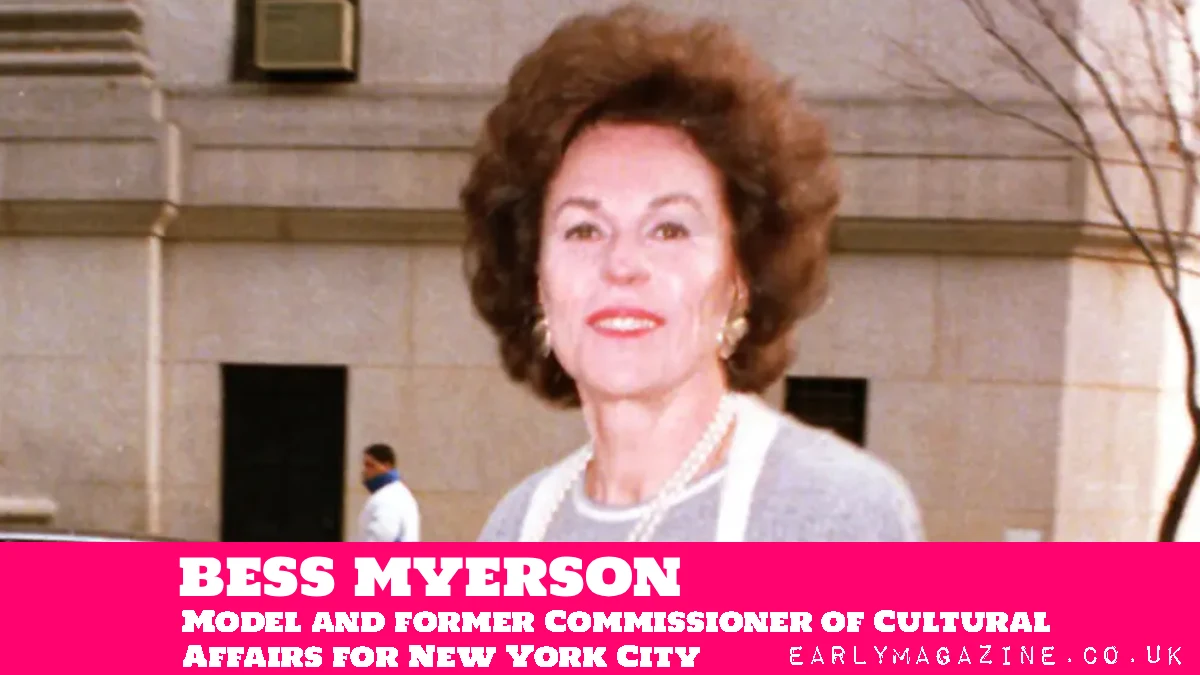
Bess Myerson net worth at the time of her death in 2014 was estimated at $3 million. She built her wealth through television appearances, modeling, public speaking, and government roles. Earlier estimates from the late 1980s placed her net worth as high as $16 million before legal troubles and career setbacks reduced her finances.
Who Was Bess Myerson, and Why Does Her Wealth Matter?
Bess Myerson net worth is a topic that surprises many people when they first search for it. Here was a woman who won Miss America in 1945, spent decades on national television, served in New York City government under two mayors, and ran for the U.S. Senate — yet she died with an estimated $3 million to her name. That number tells only part of the story.
Her financial journey is fascinating because it reflects every major turn in her life. She climbed from a working-class Bronx apartment to national fame, built real wealth during the golden age of television, saw that wealth threatened by scandal, and quietly faded from public view in her final years. Understanding how she built, kept, and lost portions of her fortune gives you a much clearer picture of who Bess Myerson really was.
This article covers how Myerson built her wealth from the ground up, what her main income sources were, how the “Bess Mess” scandal affected her finances, and where she stood financially when she passed away in December 2014 at age 90.
Starting from Nothing: Her Early Financial Life
Bess Myerson was born on July 16, 1924, in the South Bronx to Russian Jewish immigrant parents. Her father, Louis, worked as a housepainter and carpenter. The family lived in the Sholom Aleichem Houses, a cooperative housing complex. Money was tight, and her upbringing was shaped more by books and education than by comfort.
She studied piano from age 9 and attended the High School of Music and Art in New York City. She later earned a degree in music from Hunter College. None of this cost her family much — New York City public education was free — but it gave her the skills she would later monetize in ways neither she nor her parents could have predicted.
When she entered the Miss New York City pageant in 1945, she was wearing a borrowed swimsuit. That detail says everything about where she started financially.
The Miss America Win That Changed Everything
Winning the Miss America crown in 1945 did not come with a large cash prize by today’s standards. But it opened doors. The title gave Myerson a national platform at exactly the right moment: post-World War II America was hungry for wholesome, aspirational figures.
She became the first and, to this day, the only Jewish Miss America. Pageant officials reportedly urged her to change her name before the competition to something less Jewish-sounding. She refused. That decision shaped her public identity for decades and made her a symbol of cultural pride that translated into paid speaking engagements, endorsements, and media appearances throughout her career.
However, the commercial opportunities that typically follow a Miss America win were initially slower to arrive for Myerson. Antisemitism in 1940s America meant some sponsors pulled back. She compensated by accepting a paid lecture tour with the Anti-Defamation League, speaking on tolerance under the theme “You Can’t Be Beautiful and Hate.” These appearances kept income coming in while her television career developed.
Television: The Core of Her Net Worth
Game Shows and Regular Appearances
Television was where Myerson built the bulk of her wealth. Starting in the early 1950s, she became a familiar face on American TV screens. She hosted “The Bess Myerson Show” and appeared frequently on programs like “The Big Payoff,” where she was known as “the Lady in Mink.”
Her longest and most profitable regular gig was the celebrity quiz panel show “I’ve Got a Secret,” where she appeared from 1959 to 1967. Eight years of steady television work meant steady income at a time when TV hosts and panelists were paid well and treated like stars.
She also appeared on “The Name’s the Same,” “The Match Game,” and co-hosted “Candid Camera.” These were not just one-off appearances — she was a television fixture, and that kind of consistent presence paid consistently.
Acting and Film Work
On the acting side, Myerson appeared in the 1959 film “It Happened to Jane” and made guest appearances across multiple television dramas and comedies, including “The Philco-Goodyear Television Playhouse” and even a late-career appearance on “Frasier.” Acting added to her income, though television remained her primary earning platform.
Public Service and Its Financial Impact
In 1969, New York City Mayor John Lindsay recruited Myerson to serve as Commissioner of Consumer Affairs. She held the role with genuine dedication. During her first year, the city passed the Consumer Protection Act of 1969, described at the time as the toughest consumer protection law in the country.
Public service does not typically build personal wealth. Commissioner salaries in New York City were comfortable but not extravagant. What her government work did was maintain her public profile and lead to future opportunities: speaking engagements, book deals, and advisory roles that carried financial value.
She later served as Commissioner of Cultural Affairs under Mayor Ed Koch in the 1980s, further keeping her name in front of the public. She also made an unsuccessful run for the U.S. Senate from New York in 1980 — a campaign that cost money rather than made it.
The Bess Mess: How Scandal Dented Her Fortune
What Happened
In the mid-1980s, Myerson became involved with Carl Capasso, a married sewer contractor. Capasso was going through a divorce, and the presiding judge was Hortense Gabel. It emerged that Myerson had hired Gabel’s daughter, Sukhreet, for a city job around the same time Judge Gabel reduced Capasso’s child support payments.
In April 1987, Myerson invoked the Fifth Amendment during investigations and was forced to resign her government position. In 1988, she, Capasso, and Judge Gabel were indicted on federal charges including conspiracy, mail fraud, and obstruction of justice. The tabloids dubbed it the “Bess Mess,” and it became one of the most heavily covered scandals of the decade.
The Financial Cost
The trial lasted three months. All three defendants were ultimately acquitted, but the damage to Myerson’s professional standing was severe. Invitations to appear on television dried up. Her public image, once built on integrity and consumer advocacy, was tarnished. Opportunities that had paid her well for decades simply stopped.
NPR reported that at the time of the shoplifting incident in 1988 — when she was arrested in Pennsylvania for taking roughly $44 worth of items from a drugstore — her net worth was estimated at $16 million. That figure, likely reflecting accumulated real estate and savings, stands in sharp contrast to the $3 million estimate from her final years. The gap suggests that legal costs, reduced income, and the lifestyle expenses of later decades significantly reduced what she had built.
Bess Myerson Net Worth: A Breakdown by Era
| Period | Estimated Net Worth | Key Earnings Sources |
|---|---|---|
| 1945–1955 | Under $500,000 | Modeling, speaking tours, early TV |
| 1955–1969 | $1–3 million | Game shows, regular TV appearances |
| 1970–1987 | $5–16 million | TV, government roles, real estate |
| 1988–2014 | $3 million (at death) | Reduced appearances, prior savings |
Personal Life and Its Financial Dimensions
Myerson was married twice. Her first marriage was to Allan Wayne; her second was to Arnold M. Grant, which lasted from 1962 to 1967. Divorces carry financial consequences. She also survived ovarian cancer in the 1970s and suffered a mild stroke in 1981, both of which likely came with significant medical costs.
In later years, she moved from New York City to Florida and eventually to Santa Monica, California, where she lived until her death. She was reportedly suffering from dementia in her final years. End-of-life care, particularly for extended illnesses like dementia, is expensive. These realities of aging likely drew down her remaining wealth.
Her daughter, Barra Grant, from her first marriage to Allan Wayne, survived her.
Her Legacy Beyond Dollars
Whatever the final dollar figure, Myerson’s financial story is inseparable from her cultural impact. She used her Miss America platform to fight antisemitism at a time when that took real courage. She championed consumer rights in ways that benefited millions of ordinary New Yorkers. She donated funds to help build “Bessie’s Bistro” at the Jewish Museum of Florida in memory of her parents.
That combination of public service, media presence, and advocacy built something harder to measure than net worth: a reputation that outlasted the scandal and the decades of silence before her death.
Frequently Asked Questions
What was Bess Myerson net worth when she died?
Her net worth at death in December 2014 was estimated at approximately $3 million, according to Celebrity Net Worth and other sources.
How did Bess Myerson make her money?
She earned primarily through television appearances, game show panels, modeling, public speaking, and her roles in New York City government from the late 1960s through the 1980s.
Was Bess Myerson wealthy at the height of her career?
Yes. In the late 1980s, her net worth was estimated as high as $16 million before legal costs and reduced career opportunities affected her finances.
Did the “Bess Mess” scandal ruin her financially?
It significantly reduced her income by ending her government career and drying up television opportunities, though she was acquitted of all charges.
Is Bess Myerson still the only Jewish Miss America?
Yes. As of her death in 2014 and confirmed by The New York Times, she remained the only Jewish woman to hold the Miss America title.
A Life Measured in More Than Money
Bess Myerson net worth at the end of her life — $3 million — reflects a woman who lived through extraordinary highs and genuinely difficult lows. She started with nothing in the Bronx, built real wealth over decades of television work and public service, and watched portions of that wealth erode through scandal, legal battles, and the quiet costs of aging.
The number alone does not capture what made her significant. She refused to change her name when it would have been easier to disappear into the crowd. She used her platform to speak against hatred decades before that became fashionable. She passed consumer protection laws that still serve as models today.
The real question her story raises is not how much she was worth, but how much a life spent breaking barriers is worth to the people who come after. By that measure, Bess Myerson left behind considerably more than $3 million.
For more insights into how trailblazing women navigated fame, power, and fortune across the decades, visit EarlyMagazine UK — where remarkable careers and real financial stories come together.
