

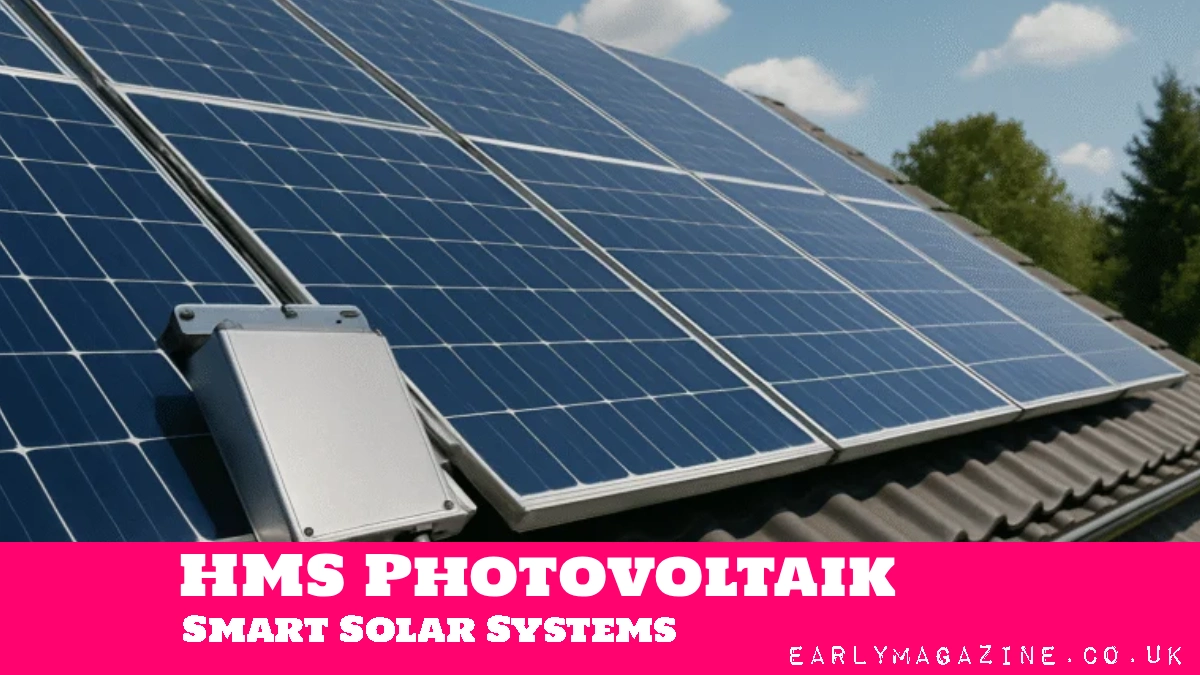
HMS Photovoltaik is an intelligent solar technology using microinverters mounted behind each panel to convert DC power to AC electricity at the source. This allows independent panel operation, reducing shading impact and improving overall system efficiency by 5-30% compared to traditional string inverters while providing real-time monitoring capabilities.
What Is HMS Photovoltaik?
HMS Photovoltaik represents a modular, intelligent solar system that integrates advanced communication technologies with traditional panel setups. The term primarily refers to two key innovations: the Hoymiles HMS microinverter series, which connects to individual panels with output power ranging from 300 to 2000 VA, and hybrid management systems that combine solar generation with smart monitoring.
These microinverters achieve CEC peak efficiency up to 96.7%, making them significantly more efficient than traditional string inverters. Each panel transmits data to a central gateway connected to a cloud-based platform, allowing real-time performance analytics and remote system control.
How HMS Photovoltaik Works
The process begins with solar panels absorbing sunlight using photovoltaic cells made from semiconductor materials, typically silicon. When sunlight strikes the panels, it excites electrons within these semiconductors, generating a flow of electricity that produces direct current.
Unlike string inverters used in traditional setups, HMS systems rely on microinverters mounted behind each solar module, allowing independent operation and reducing the impact of shading, dirt, or malfunction. An inverter then transforms this DC electricity into alternating current through an inverter, making it usable for your home or business.
Key System Components
HMS systems include high-efficiency photovoltaic modules, microinverters that convert DC to AC power, hybrid management systems that balance multiple power sources, energy storage batteries using lithium-ion or other technologies, and AI and IoT-based platforms providing real-time data visualization.
HMS Microinverter Models Explained
The Hoymiles HMS series is equipped with reactive power control and meets requirements of EN 50549-1:2019, VDE-AR-N 4105:2018, and VFR2019. Here’s what you need to know about each configuration:
| Model Type | Power Output | Panels Connected | Best For |
|---|---|---|---|
| HMS-300 to 500-1T | 300-500 VA | 1 panel | Small installations, limited roof space |
| HMS-600 to 1000-2T | 600-1000 VA | 2 panels | Residential rooftops, balcony systems |
| HMS-1600 to 2000-4T | 1600-2000 VA | 4 panels | Larger residential, small commercial |
| HMS-2250-6T | 2250 VA | 6 panels | Commercial applications |
Each microinverter features independent Maximum Power Point Tracking (MPPT), meaning even if some panels are shaded or dirty, others continue operating at peak efficiency.
HMS vs String Inverters: Key Differences
Understanding the differences helps you choose the right system for your needs.
Performance Under Shading
With string inverters, the lowest performing panel dictates production of the entire system, so if one panel has a branch shading it by 30%, you receive only 70% of your total system’s possible production. HMS microinverters optimize each solar panel individually, ensuring that even if some panels are shaded or dirty, others continue operating at peak efficiency, generating up to 30% more energy than traditional inverters.
Warranty and Lifespan
Microinverters are typically warrantied for 25 years — the same as solar panels — while string inverters are typically warrantied for 12 years. Hoymiles microinverters adopt topological upgrades with reliable structures and warranties of up to 25 years.
Safety Features
Microinverters significantly enhance safety by operating at lower DC voltages, with each panel running at just 60V in a Hoymiles system, unlike string inverters with much higher voltages across the array. HMS microinverters comply with NEC-2017 and NEC-2020 Article 690.12 rapid shutdown requirements.
Comparison Table
| Feature | HMS Microinverters | String Inverters |
|---|---|---|
| Panel Independence | Each operates independently | All panels affected by one weak panel |
| Warranty | 25 years | 10-15 years |
| Efficiency | 96.7% peak | Lower overall efficiency |
| Monitoring | Panel-level data | System-level only |
| Initial Cost | 10-20% higher | Lower upfront |
| Shading Impact | Minimal | Significant performance loss |
Cost and ROI Analysis
HMS Photovoltaik systems cost vary by size, features, and region, but expect a premium of 10-20% over traditional systems — often offset by higher ROI. The average cost-per-watt across the U.S. is around $2.53/W before incentives, with typical residential systems costing $28,000.
Price Breakdown for HMS Systems
A standard residential installation includes equipment costs (46%), labor (17%), soft costs like permitting and design (13%), customer acquisition (10%), overhead and profit (14%). The microinverter premium adds approximately $1,500-$3,000 to a typical residential installation.
Financial Incentives
Under the federal solar investment tax credit expiring at the end of 2025, you can take 30% of your total solar panel cost off your taxes. Solar energy can reduce household electricity bills by up to 50-70%, depending on location and usage.
Long-Term Savings
People with solar panels can save around $62,219 on utility bills over 25 years, with systems typically paying for themselves within 5 to 15 years. The longer warranty period of HMS microinverters means you avoid costly inverter replacements that string inverter users face.
Installation Process
HMS microinverters are designed for quick and simple installation, with their compact, lightweight design making them easy to mount and connect through plug-and-play functionality.
Step-by-Step Installation
First, select appropriate AC Trunk Cable according to spacing between microinverters, ensuring connector spacing matches. Next, determine how many microinverters you plan to install on each AC branch and prepare AC Trunk Connectors accordingly.
Then lay out cable on the rail so microinverters can connect to trunk connectors, attach AC Trunk Cable to mounting rail and fix with tie wraps, and push AC Sub Connector from microinverter to AC Trunk Connector until it clicks. Finally, connect the AC end cable to the distribution box and wire it to the local grid network.
Professional vs DIY Considerations
Most jurisdictions require licensed electricians for grid-connected systems. Installation tutorials are available for various HMS models, with the 2-in-1 HMS-1000-2T installation suitable for other models like HMS-600/700/800/900W-2T.
Smart Monitoring Capabilities
A distinctive aspect of HMS Photovoltaik is its built-in wireless communication, with each panel transmitting data to a central gateway connected to a cloud-based platform. This technology transforms your solar array from a passive power generator into an intelligent energy management system.
Real-Time Performance Tracking
Module-level monitoring enables users to check operation data and performance of each module remotely in real-time and detect potential problems in time, making maintenance super easy. You can identify underperforming panels immediately rather than waiting for annual inspections.
Predictive Maintenance
Using AI and historical data, the system can alert users about potential issues before they become critical, reducing downtime and service costs. This proactive approach prevents small problems from becoming expensive repairs.
Energy Optimization
HMS systems can respond to real-time weather data, adjusting energy strategies based on cloud cover, temperature, and solar irradiance forecasts. The system learns your consumption patterns and optimizes energy distribution accordingly.
Applications and Use Cases
HMS technology serves diverse sectors with specific energy needs.
Residential Installations
Homeowners benefit from greater control over energy usage, better system uptime, and easy expansion, with app-based monitoring making it user-friendly for non-technical users. The HMS series is particularly well-suited for small-scale solar installations like those on balconies due to its compact size and enhanced efficiency.
Commercial and Industrial
For businesses, HMS Photovoltaik allows facility managers to track energy losses, optimize load distribution, and forecast energy costs using AI-powered dashboards. One manufacturing facility reported a 40% decrease in energy expenses within the first year after installing HMS panels.
Agricultural Operations
In farming, where energy demands fluctuate and grid access is often limited, HMS Photovoltaik provides decentralized power solutions that can adapt to seasonal requirements. Farmers use solar energy for irrigation systems and greenhouses, enhancing productivity while conserving resources.
Applications Table
| Sector | Typical System Size | Key Benefits | Payback Period |
|---|---|---|---|
| Residential | 5-10 kW | Bill reduction, energy independence | 7-12 years |
| Small Commercial | 10-50 kW | Tax benefits, sustainability credentials | 5-8 years |
| Agriculture | 20-100 kW | Irrigation power, operational savings | 6-10 years |
| Industrial | 100+ kW | Demand charge reduction, grid stability | 4-7 years |
Advantages of HMS Systems
HMS Photovoltaik offers greater independence by reducing reliance on the grid through solar-storage integration, improved reliability with backup power during outages ensuring energy continuity, reduced bills through optimized solar performance and stored energy, environmental benefits by maximizing renewable energy usage and cutting carbon emissions, and smart monitoring that reduces energy losses.
Panel-Level Optimization
Microinverters feature module-level MPPT which means PV modules operate independently, so they are not influenced in case some are underperforming due to shading, guaranteeing 5–30% more energy output than traditional inverters.
Scalability and Flexibility
HMS systems are modular and allow for seamless panel additions. If you need to add solar panels because you got an electric vehicle or heat pump, it’s easier and cheaper to add panels with microinverters than an additional string inverter with optimizers.
Durability
With an IP67 protection rating, HMS microinverters can withstand extreme weather conditions, and have passed North America’s most stringent 6kV surge lightning test. The aluminum enclosure makes the product light and more erosion resistant while dissipating heat quickly through natural convection.
Common Challenges and Solutions
Every technology has limitations. Understanding them helps you make informed decisions.
Higher Upfront Costs
Micro-inverters are usually more expensive per watt than string inverters. However, this premium is offset by longer warranties, higher energy production, and elimination of future replacement costs. The 10-20% premium is often offset by higher ROI.
Installation Complexity
Not all solar installers are familiar with HMS-specific equipment, which can limit availability in certain regions. Choose certified Hoymiles installers who have specific training on microinverter systems.
Maintenance Considerations
Although rare, microinverter maintenance can be more complicated than string inverter replacement, as malfunctioning parts must be replaced beneath solar panels. However, microinverters provide built-in redundancy by eliminating the single point of failure in central inverter systems.
Future Developments
The HMS Photovoltaik landscape continues advancing rapidly.
Technology Improvements
Hoymiles unveiled the new MiS Series microinverter at Intersolar North America 2025, its lightest and most efficient microinverter yet, rated at 97.5% efficiency. Fourth-generation technology promises even better performance and lower costs.
Market Growth
In 2025, renewables account for over 90% of global power expansion with solar leading with an expected 698 GW increase. Most HMS systems are designed to last 25–30 years with minimal maintenance.
Integration Possibilities
Future developments include deeper IoT integration linking solar panels, inverters, EVs, and home appliances into one smart ecosystem, and AI-powered diagnostics predicting faults before they occur.
FAQ: HMS Photovoltaik Systems
What’s the main difference between HMS and traditional solar systems?
HMS systems use microinverters mounted behind each panel allowing independent operation, while traditional systems use string inverters where one underperforming panel affects the entire string. This results in 5-30% higher energy production with HMS systems.
Is HMS Photovoltaik worth the extra cost?
While HMS systems cost 10-20% more upfront, they offer higher ROI through increased energy production, 25-year warranties, and no mid-life inverter replacement costs. Most users recoup the premium within the first 5-7 years.
Can I add more panels to my HMS system later?
HMS systems are modular and allow for seamless panel additions. You can expand your system as your energy needs grow without replacing existing equipment.
Do HMS microinverters work in cloudy climates?
Yes. Microinverters optimize each solar panel individually through module-level MPPT, meaning panels continue operating at peak efficiency even in varying light conditions. The system maximizes available sunlight regardless of weather.
HMS Photovoltaik systems deliver superior performance through microinverter technology and intelligent monitoring. While initial costs run 10-20% higher than string inverters, you gain 5-30% more energy production, 25-year warranties, panel-level monitoring, and simplified future expansion. For homeowners and businesses seeking maximum solar ROI with cutting-edge technology, HMS systems represent the smartest long-term investment in 2025.
For more expert guidance on solar technology, energy efficiency strategies, and sustainable home improvements that reduce costs while protecting the environment, visit EarlyMagazine—your trusted resource for practical renewable energy solutions and smart living innovations that empower you to take control of your energy future.
