

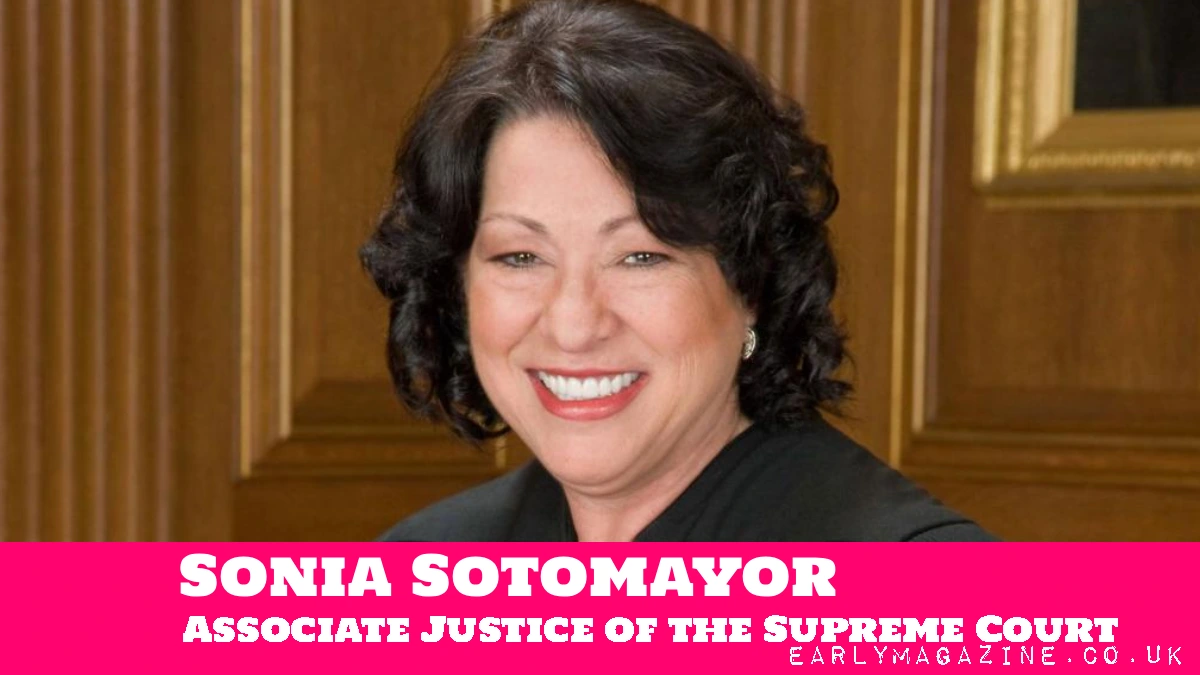
Sonia Sotomayor serves as an associate justice of the Supreme Court of the United States since 2009. She was nominated by President Barack Obama and is the first Hispanic justice and third woman to serve on the Supreme Court.
Sonia Sotomayor made history in 2009 when she became the first Hispanic justice and third woman to serve on the United States Supreme Court. Her journey from a Bronx housing project to America’s highest court represents one of the most inspiring stories of determination and achievement in modern American history.
Early Life and Childhood Challenges
Sonia Maria Sotomayor was born on June 25, 1954, in the Bronx, New York City, to Puerto Rican-born parents. Her early years were marked by significant hardships that would shape her character and worldview.
Her father died when she was nine, and she was subsequently raised by her mother. This loss occurred just one year after Sotomayor was diagnosed with Type 1 diabetes at age seven, requiring daily insulin injections. Her mother, Celina, worked hard to raise her and her younger brother as a single parent, placing what Sotomayor would later call an ‘almost fanatical emphasis’ on higher education.
Despite living in public housing, Celina Sotomayor put great stress on the value of education; she bought the Encyclopædia Britannica for her children, something unusual in the housing projects. This investment in learning would prove transformational for young Sonia.
Sotomayor has said that she was first inspired by the strong-willed children’s book detective character Nancy Drew, but, after her diabetes diagnosis led her doctors to suggest a different career path, she was inspired by the TV series Perry Mason to pursue a legal career and become a judge.
Educational Excellence and Early Determination
For grammar school, Sotomayor attended Blessed Sacrament School in Soundview, where she was valedictorian and had a near-perfect attendance record. Her academic excellence continued through high school, where she excelled on the debate team.
When a debate team friend who was a year older won a scholarship to Princeton University, he suggested that Sonia apply as well, and to her surprise she was accepted and awarded a full scholarship.
She earned a B.A. in 1976 from Princeton University, graduating summa cum laude and receiving the university’s highest academic honor. At Princeton, she faced the challenge of being one of the few Latina students on campus during the mid-1970s.
Following Princeton, in 1979, she earned a J.D. from Yale Law School where she served as an editor of the Yale Law Journal. This position at one of the most prestigious legal publications in America demonstrated her exceptional legal writing abilities early in her career.
Building a Legal Career
She served as Assistant District Attorney in the New York County District Attorney’s Office from 1979-1984. During this time, she prosecuted cases ranging from shoplifting to murder, gaining valuable courtroom experience and developing her reputation as a fearless advocate for justice.
She then litigated international commercial matters in New York City at Pavia & Harcourt, where she served as an associate and then partner from 1984-1992. Within four years, Sotomayor had become a partner of the firm.
During her private practice years, she also served on several important boards, including the Puerto Rican Legal Defense and Education Fund, demonstrating her commitment to civil rights and community service.
Federal Judicial Career
At 36, Sotomayor believed she was too young to be considered seriously for a judicial appointment. After an interview with New York’s U.S. Senator Daniel Patrick Moynihan, he recommended her to President George H. W. Bush, who appointed her to serve as judge on the U.S. District Court.
In 1991, President George H.W. Bush nominated her to the U.S. District Court, Southern District of New York, and she served in that role from 1992–1998. As a federal district judge, she presided over hundreds of cases and authored numerous opinions that demonstrated her careful legal reasoning.
She then served as a judge on the United States Court of Appeals for the Second Circuit from 1998–2009. President Bill Clinton nominated her to this appellate position, where she continued to build her reputation as a thoughtful and thorough jurist.
In addition to her work in the Court of Appeals, Sotomayor also began teaching law as an adjunct professor at New York University in 1998 and at Columbia Law School in 1999.
Supreme Court Appointment and Historic Achievement
President Barack Obama nominated her as an Associate Justice of the Supreme Court on May 26, 2009, and she assumed this role August 8, 2009. Her confirmation made her not only the first Latina to serve on the Supreme Court but also the third woman in the Court’s history.
The confirmation process highlighted her extensive judicial experience and legal qualifications. With 17 years of federal judicial service before joining the Supreme Court, she brought more experience as a federal judge than any justice appointed in the previous 70 years.
Judicial Philosophy and Notable Cases
Throughout her Supreme Court tenure, Sotomayor has become known for her detailed questions during oral arguments and her passionate written opinions. The New York Times noted that Sotomayor voted with fellow liberal Justices Ruth Bader Ginsburg and Stephen Breyer about 90 percent of the time.
In 2011, Sotomayor wrote the majority opinion in the Supreme Court’s 5–4 decision on J. D. B. v. North Carolina, which found that a child’s age is relevant for Miranda warning purposes when determining whether a person is in police custody. Her opinion demonstrated her practical approach to constitutional interpretation.
Sotomayor was in the majority on several notable rulings in 2012, including a 5–4 ruling that upheld most of the provisions of the Patient Protection and Affordable Care Act.
Recent Impact and Current Activities
In 2025, Sotomayor continues to be an active and influential voice on the Court. Supreme Court Justice Sonia Sotomayor said Tuesday that lasting change in the country depends on citizens, not the courts, as she discussed her new children’s book during an interview with “CBS Mornings.”
“I don’t think whether I’m concerned matters. I think what matters is whether people are concerned,” Sotomayor said. “I am a Supreme Court Justice. I get to decide individual cases. I get to speak my mind about them. In the end, I don’t change what exists. People change what they don’t like or they support what they do like. The power of change is in people.”
Her recent dissents have drawn significant attention for their passionate defense of constitutional rights. Justice Sonia Sotomayor dissented from Monday’s ruling, describing the court’s action as “yet another grave misuse of our emergency docket.”
Literary Contributions and Public Engagement
Beyond her judicial work, Sotomayor has become a bestselling author. In 2013, her autobiography, My Beloved World, received excellent reviews and became a bestseller in both English and Spanish-language editions.
The justice appeared on “CBS Mornings” to promote her new children’s book, “Just Shine: How to Be Your Best You,” which tells the story of her mother, Celina. The book is available in both English and Spanish, with an audiobook narrated by singer Gloria Estefan.
A Bronx native (born to Puerto Rican parents) Sotomayor says she made it a “condition” that her new picture book would be released on the same day in both English and Spanish. This commitment to bilingual accessibility reflects her dedication to reaching diverse communities.
Recognition and Legacy
United States Supreme Court Justice Sonia Sotomayor is the 2025 recipient of the Colin L. Powell Distinguished Leadership Award, bestowed by the Colin Powell School for Civic and Global Leadership at The City College of New York.
In June 2010, the Bronxdale Houses development, where Sotomayor grew up, was renamed after her. The Justice Sonia Sotomayor Houses and Justice Sonia Sotomayor Community Center comprise 28 buildings with some 3,500 residents.
She remains an inspiration to all young Americans who feel marginalized or excluded in American society. Her story demonstrates that with determination, education, and hard work, barriers can be broken and the highest levels of achievement are possible.
Comparison Table: Sotomayor’s Career Milestones
| Year | Position | Significance |
|---|---|---|
| 1976 | Princeton Graduate | Summa cum laude, university’s highest honor |
| 1979 | Yale Law Graduate | Yale Law Journal editor |
| 1992-1998 | Federal District Judge | Appointed by President George H.W. Bush |
| 1998-2009 | Federal Appeals Judge | Appointed by President Bill Clinton |
| 2009-Present | Supreme Court Justice | First Latina, appointed by President Obama |
Her journey from the Bronx housing projects to the Supreme Court continues to inspire new generations of lawyers, judges, and public servants. Through her judicial opinions, public speaking, and written works, Sonia Sotomayor has established herself as not just a groundbreaking jurist, but also a powerful voice for justice, equality, and the American dream.
FAQs
When was Sonia Sotomayor appointed to the Supreme Court?
Sonia Sotomayor was nominated by President Barack Obama on May 26, 2009, and assumed her role on August 8, 2009.
What makes Sonia Sotomayor historically significant?
She is the first Hispanic justice and the third woman to serve on the United States Supreme Court.
Where did Sonia Sotomayor go to college?
She graduated summa cum laude from Princeton University in 1976 and earned her law degree from Yale Law School in 1979.
What challenges did Sotomayor face growing up?
Her father died when she was nine, she was diagnosed with Type 1 diabetes at age seven, and she grew up in public housing in the Bronx.
What books has Sonia Sotomayor written?
She wrote the bestselling autobiography “My Beloved World” in 2013 and recently released “Just Shine: How to Be Your Best You” in 2025.
For more inspiring stories like Sonia Sotomayor’s journey from Bronx housing projects to Supreme Court Justice, visit us at EarlyMagazine, where we uncover the remarkable paths of trailblazers who transform personal challenges into historic achievements that shape our nation’s future.
