

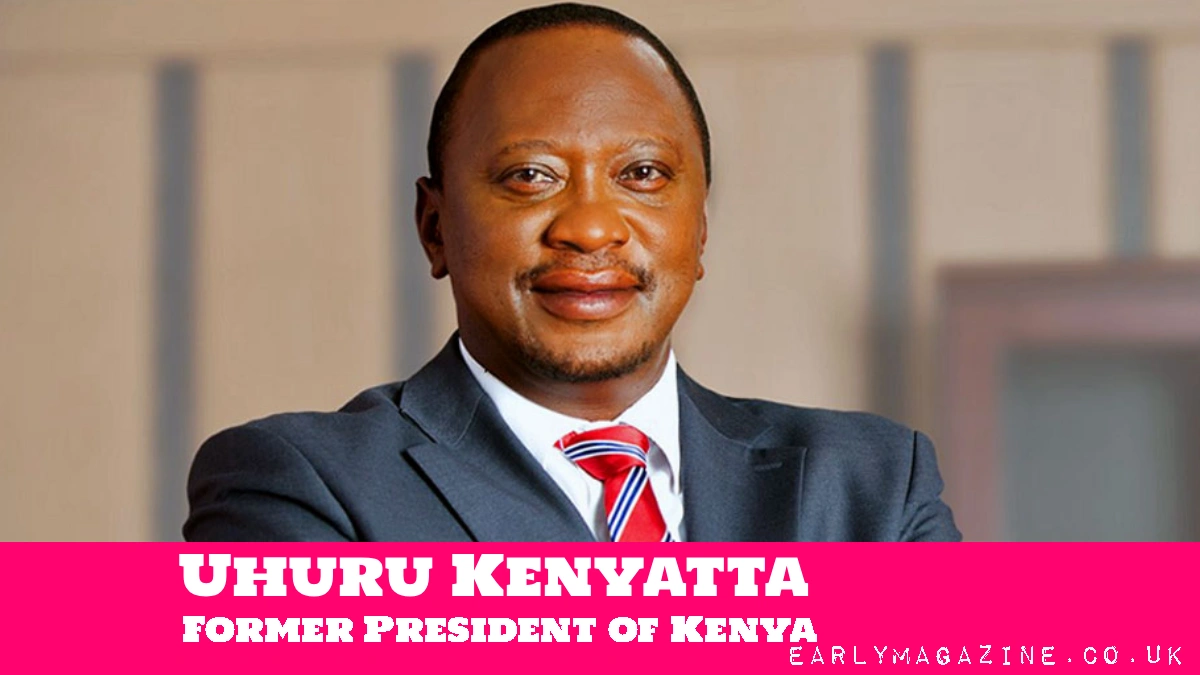
| Uhuru Kenyatta net worth is estimated between $500 million and $700 million as of 2025, according to multiple financial sources. His wealth comes from the Kenyatta family’s vast portfolio: Brookside Dairy, a 13.2% stake in NCBA Bank, Heritage Hotels, Mediamax, and over 500,000 acres of land across Kenya. |
When Kenyans debate wealth and political power, one name always comes up: Uhuru Kenyatta. The Uhuru Kenyatta net worth has fascinated citizens, journalists, and analysts for decades. He is not just a former head of state. He is the heir to one of the most powerful family fortunes in East Africa, an empire built on land, dairy, banking, hospitality, and media. Few political families on the continent combine political legacy with this level of business reach.
Pinning down an exact number is difficult. Estimates vary widely, from $500 million to nearly $1 billion, depending on the source and what assets are counted. What is clear, though, is that the Kenyatta family collectively sits at the top of Kenya’s wealth rankings, with holdings spanning multiple industries and counties. This article breaks down what we know, what the numbers suggest, and how Uhuru’s personal wealth fits within the broader Kenyatta family fortune.
You will find a clear breakdown of Uhuru’s known assets and business interests, a comparison with other wealthy African leaders and Kenyan elites, and answers to the most common questions people ask about his finances. You will also see why this topic matters beyond curiosity, and what it tells us about the intersection of politics and wealth in Kenya.
The Numbers: What Is Uhuru Kenyatta Worth?
Most credible estimates place Uhuru Kenyatta net worth at between $500 million and $700 million as of 2025. Some outlets have pushed the figure higher. Glusea, a wealth-tracking publication, cited $4 billion, though this appears to inflate the figure significantly. Kenyan Moves estimated $950 million. The most cited mid-range figure, supported by data from Business Daily Africa and Statista, places the Kenyatta family’s combined wealth at around $530 million to $528 million, recorded at 60 billion Kenyan shillings.
It is important to distinguish between Uhuru’s personal holdings and the broader Kenyatta family fortune. Much of the wealth is held collectively through the estate of his late father, Jomo Kenyatta, Kenya’s first president. The investment vehicle Enke Investments Ltd. is the family’s primary holding company, controlling stakes across multiple enterprises.
The 2021 Pandora Papers leak added another dimension to this conversation. The documents revealed that the Kenyatta family secretly held offshore companies for decades, including one entity with $30 million in stocks and bonds. Mama Ngina Kenyatta denied wrongdoing. In a 2018 BBC interview, Uhuru Kenyatta maintained that the family’s wealth was acquired legally and was known to the public.
Where the Money Comes From
The Kenyatta fortune did not come from a single source. It grew through decades of land acquisition, business expansion, and strategic mergers. Here is where the money sits today.
Land: The Foundation of the Fortune
The Kenyatta family owns more than 500,000 acres of land across Kenya. This is the single largest land portfolio in the country. Holdings include a 13,000-hectare ranch in Kiambu County, Gicheha Farm in the Nakuru-Naivasha corridor covering approximately 5,000 acres, Koilel Farm in Uasin Gishu, coastal sisal estates near the Tanzanian border, and the massive Northlands City project in Ruiru spanning 11,576 acres.
Northlands City alone is a massive planned mixed-use development expected to include residential, industrial, logistics, conservation, and agricultural zones, designed to accommodate up to 250,000 people. The land was primarily acquired by Jomo Kenyatta in the 1960s and 1970s through a settlement transfer fund scheme that allowed government officials to buy land from departing British settlers.
Brookside Dairy: A Dominant Market Player
Brookside Dairy Limited, founded in 1993, is the largest dairy processor in Kenya and the wider East African region. According to the Kenya Dairy Board, Brookside held a 45% market share as of 2019. Some reports from the company’s own directors put the figure closer to 67%. Brookside supplies approximately 60% of Kenya’s packaged milk under brands including Tuzo, Delamere, Ilara, and Molo Milk.
In 2014, French food giant Danone acquired a 40% stake in Brookside. The deal revealed the company’s scale: it had generated Ksh15.4 billion in sales the prior year, a figure that dwarfed many publicly listed Kenyan firms. The Kenyatta family retained a controlling stake above 50%. Uhuru’s brother Muhoho Kenyatta serves as Brookside’s executive chairman.
NCBA Bank: A Growing Stake
The Kenyatta family holds a 13.2% stake in NCBA Group, equivalent to 217.5 million ordinary shares. NCBA was formed in 2019 through the merger of NIC Bank and Commercial Bank of Africa, a deal the Kenyatta and Ndegwa families shepherded. As of July 2025, their NCBA stake was valued at approximately $103 million after a 14% rally on the Nairobi Securities Exchange boosted the bank’s total market value past $780 million.
The bank is the third largest in Kenya by assets. It operates 121 branches across Kenya, Uganda, Tanzania, and Rwanda. Standard Bank Group of South Africa has opened merger talks with NCBA through its Kenyan affiliate Stanbic Holdings, a deal that could significantly alter the family’s banking position.
Kenyatta Family Asset Overview
The table below summarizes the key assets tied to the Kenyatta family and Uhuru’s interests, based on data from Business Daily Africa, Billionaires.Africa, and Statista.
| Asset | Sector | Family Interest | Estimated Value |
| NCBA Group | Banking | 13.2% stake (217.5M shares) | ~$103 million (2025) |
| Brookside Dairy | Agribusiness | 50%+ controlling stake | Undisclosed (Ksh15.4B sales, 2013) |
| Land Holdings | Real Estate / Agriculture | 500,000+ acres nationwide | Hundreds of millions USD |
| Northlands City | Real Estate Development | Family-owned project | Ksh500 billion planned |
| Heritage Hotels East Africa | Hospitality | Family ownership | Undisclosed |
| Mediamax Network | Media | Controlling interest | Undisclosed |
| Peponi School | Education | Family ownership | Charges Ksh1M+ per term |
| London Apartments | International Real Estate | Family | ~$1.3 million (UK filings) |
Other Business Interests Worth Knowing
Beyond the headline assets, the Kenyatta family runs Mediamax Network Limited, a significant media company that owns K24 TV, Kameme FM, Milele FM, and The People Daily newspaper. Mediamax was acquired from founder Rose Kimotho after her company defaulted on a bank loan. The network gives the family both revenue and influence over public discourse.
Heritage Hotels East Africa operates a portfolio of high-end properties including Great Rift Valley Lodge in Naivasha, Mara Intrepid, Samburu Intrepid, and Voyager Beach Resort. Tourism remains one of Kenya’s top foreign exchange earners, and the Heritage portfolio sits squarely in the premium segment.
Timsales Holdings, based in Nakuru, is a timber and wood products company linked to the Kenyattas. It manufactures plywood, fiberboards, block boards, and flush doors, and supplies wooden poles to Kenya Power. The family has also invested in London real estate, with UK Land Registry filings showing apartment purchases worth approximately $1.3 million.
How Uhuru Compares to Other African Leaders
The Uhuru Kenyatta net worth puts him in select company on the continent. Among African heads of state and former leaders, Uhuru ranks among the wealthiest. For context, current Kenyan President William Ruto is estimated at $400 million. S.K. Macharia, founder of Royal Media Services, is estimated at $320 million. Within the Kenyatta family specifically, Mama Ngina Kenyatta, Uhuru’s mother, is considered Kenya’s only female dollar billionaire with a net worth reported at $1 billion.
The Moi family, heirs to former President Daniel arap Moi, tops Kenya’s richest family rankings in 2025 with an estimated $3.2 billion combined. The Kenyatta family sits second at an estimated $2.7 billion across all members. These are family-level figures, not attributable to Uhuru alone.
Compared to other African political dynasties, Uhuru’s position is notable. The wealth is substantial, but the family has also managed active businesses across multiple sectors rather than relying solely on passive inherited assets. That distinction matters when assessing the sustainability and legitimacy of the fortune.
The Transparency Problem
Kenya’s ethics laws require public officials to declare their assets. However, critics have long argued that declarations by senior officials, including the Kenyattas, have lacked granular detail. The Pandora Papers leak in 2021 renewed calls for greater financial transparency among political families. Business Daily Africa noted that there is no single reliable public estimate of the Kenyatta family’s net worth precisely because their vast business interests span transport, insurance, hotels, farming, land, and media.
Kenya’s wealth inequality remains a serious concern. According to Oxfam International, the Kenyatta family ranks among the top five billionaire families in Kenya, while the country’s poverty rate remains significant. As of 2021, per capita GDP in Kenya was around $1,838. The contrast between the wealth held by a handful of families and the living standards of most Kenyans is stark, and it drives ongoing public debate about land reform, corporate transparency, and tax policy.
Frequently Asked Questions
Q: What is Uhuru Kenyatta net worth in 2025?
Estimates range between $500 million and $700 million as of 2025, based on his share of the Kenyatta family’s land, dairy, banking, media, and hospitality assets. Some sources estimate higher figures, but these are not independently verified.
Q: What businesses does Uhuru Kenyatta own?
Uhuru holds interests in Brookside Dairy, NCBA Bank, Heritage Hotels, Mediamax Network, Timsales Holdings, and Northlands City, through the Kenyatta family’s holding vehicle Enke Investments Ltd.
Q: Is Uhuru Kenyatta a billionaire?
Not confirmed as a solo billionaire. The Kenyatta family collectively is estimated at $2.7 billion. Uhuru’s personal share is estimated below $1 billion, though his mother Mama Ngina is considered Kenya’s only female dollar billionaire.
Q: How did the Kenyatta family get rich?
Wealth originated through land acquired by Jomo Kenyatta in the 1960s and 1970s, followed by diversification into dairy processing, banking, hospitality, media, and real estate over subsequent decades.
Q: Was Uhuru Kenyatta involved in the Pandora Papers?
Yes. The 2021 Pandora Papers revealed the Kenyatta family held offshore companies for decades, including one with $30 million in stocks and bonds. The family denied tax evasion and said assets were acquired legally.
The Bottom Line on Uhuru Kenyatta’s Wealth
The Uhuru Kenyatta net worth, while hard to pin down precisely, reflects a fortune built over generations. From the land acquisitions of Kenya’s independence era to Brookside’s dairy dominance, the NCBA stake worth over $100 million, and a growing real estate empire, the Kenyatta family’s financial footprint is enormous. Uhuru’s own share falls most credibly between $500 million and $700 million, though the family as a whole commands multiples of that figure.
What makes this topic important is not just the size of the fortune. It is the questions it raises: about inherited advantage, the relationship between political power and private wealth, and the degree to which Kenya’s most prominent family businesses have operated with transparency. As Kenya pushes for stronger accountability in public life, the Kenyatta story will remain a reference point. Understanding where this wealth came from, and how it is managed, matters for every citizen trying to make sense of who holds power in East Africa.
For more insights into how Africa’s most powerful political dynasties build and manage their wealth, visit EarlyMagazine UK, where leadership, legacy, and financial power meet.
