

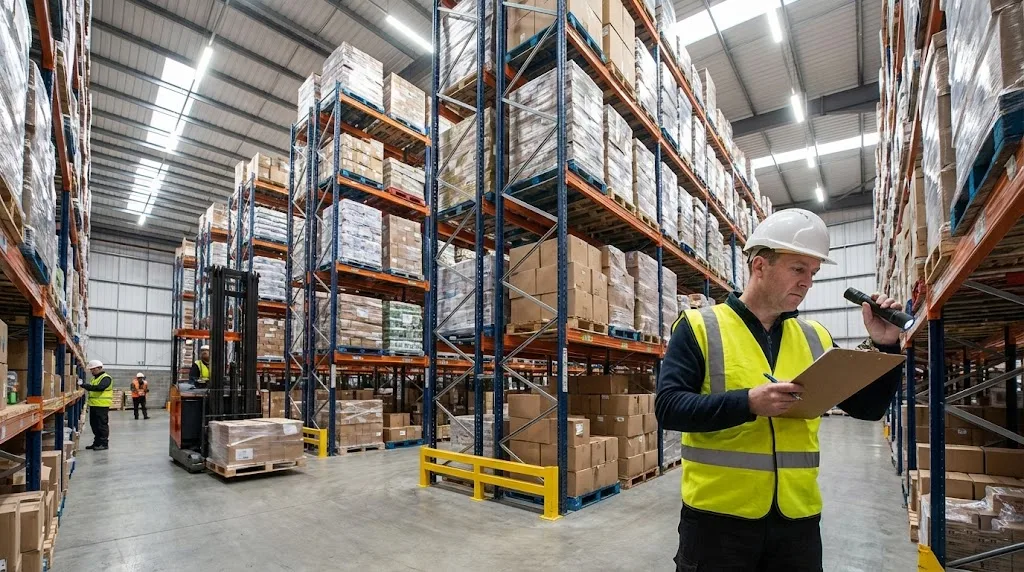
Pallet racking is one of the most important structural elements inside a warehouse. It carries heavy loads, operates under constant pressure, and is exposed to daily vehicle movement. Despite this, racking is often overlooked until visible damage appears.
A structured Warehouse Racking Inspection programme helps businesses identify risks early and remain compliant with UK regulations.
What a Professional Warehouse Racking Inspection Involves
A formal Warehouse Racking Inspection goes beyond a quick visual check. While internal staff should carry out regular weekly reviews, an expert inspection provides a detailed structural assessment.
During an inspection, specialists typically examine:
- Upright alignment and deformation
- Beam condition and locking mechanisms
- Bracing integrity
- Baseplates and floor fixings
- Signs of overloading
- Impact damage at ground level
- Load notice accuracy and visibility
Each issue is categorised according to severity. This helps warehouse managers prioritise corrective action.
Legal Responsibilities for UK Employers
Under the Health and Safety at Work Act 1974, employers are responsible for maintaining safe working environments. Racking systems fall within this duty of care.
The Provision and Use of Work Equipment Regulations also require that equipment is maintained in safe condition. Although pallet racking may be fixed in place, it is still considered work equipment under the law.
The Health and Safety Executive expects regular inspections by competent persons. Annual expert inspections are widely recognised as best practice.
Failure to carry out inspections can result in enforcement action if unsafe conditions are discovered.
The Risk of Ignoring Minor Damage
Small dents or slightly bent uprights may not appear urgent. However, structural steel weakens once it has been stressed beyond its design limit.
Over time, minor damage can escalate into serious structural instability. A fully loaded bay places significant downward and lateral force on frames. If one component fails, neighbouring bays may also be affected.
Regular inspections ensure that minor issues are identified before they become major hazards.
Reducing Accident Risk
Racking collapse is rare but can have severe consequences. Injuries, stock damage, and operational disruption can follow.
Inspections reduce risk by:
- Identifying compromised components
- Ensuring loads are within safe limits
- Highlighting missing safety clips
- Detecting corrosion or fatigue
Early intervention protects both staff and inventory.
Supporting Insurance and Due Diligence
Insurance providers expect businesses to manage structural risks responsibly. If an incident occurs and no inspection records exist, claims may be complicated.
Documented inspection reports demonstrate that the business has taken reasonable steps to maintain safe systems. This protects both operational continuity and reputation.
Clear records also assist during audits and safety reviews.
Integrating Inspections Into Daily Operations
An effective inspection strategy usually includes three levels:
- Ongoing visual checks by warehouse staff
- Monthly internal reviews by trained supervisors
- Annual inspections by external specialists
This layered approach ensures that issues are identified quickly and verified by qualified professionals.
Communication is essential. Staff must be encouraged to report impact damage immediately. Prompt reporting supports accurate assessment.
Identifying Root Causes
Inspections do more than identify damage. They often reveal patterns.
For example:
- Repeated impact in the same aisle
- Consistent overloading of certain bays
- Missing protective barriers
- Poor traffic management
Addressing root causes reduces future repair costs and improves overall safety.
Planning Corrective Action
Inspection reports typically classify damage using traffic light systems. High risk issues require immediate offloading and repair. Medium risk issues must be addressed within a defined timeframe. Low risk issues should be monitored.
This structured approach allows warehouse managers to allocate resources efficiently while maintaining safety standards.
Long Term Asset Protection
Racking systems represent a significant capital investment. Regular inspection extends their lifespan by ensuring timely maintenance.
Instead of reacting to emergencies, businesses can plan repairs strategically. This reduces downtime and supports smoother operations.
Conclusion
Warehouse racking inspection is not simply a compliance exercise. It is a critical part of maintaining safe and efficient storage environments across the UK.
By implementing structured inspection programmes and acting promptly on findings, businesses protect staff, stock, and infrastructure. In busy warehouse settings where risk is constant, regular inspection provides clarity, control, and confidence.
For more practical insights on business safety, compliance standards, and operational efficiency, visit EarlyMagazine UK—where smart management meets real-world industry solutions.
