


Most of us deal with money every day — but only in small amounts. We swipe cards, tap phones, and move numbers on a screen. But what if that money were real, physical cash? How much space would it actually take up?
Let’s take a fun, eye-opening journey through some mind-blowing numbers — from $1 million all the way up to $1 trillion in cold, hard cash.
Can You Really Fit $1 Million in a Briefcase?

Short answer? Yes — but only if you use $100 bills.
Here’s the math: $1 million in hundreds means you need exactly 10,000 bills. Each bill is about 6.14 inches long, 2.61 inches wide, and just 0.0043 inches thick. Stack all 10,000 together and you’d get a pile roughly 43 to 50 inches tall (the extra height comes from natural air gaps between bills).
Now, a standard briefcase measures about 18 × 12 × 4.5 inches on the inside. So you’d split the cash into several shorter stacks — about 1,000 bills per stack, each standing around 4–5 inches tall. Arrange them side by side, close the lid, and boom — $1 million fits perfectly.
It would weigh about 22 pounds, roughly the same as a one-year-old baby.
Tried it with $20 bills? You’d need 50,000 bills. That briefcase isn’t closing anytime soon.
$10 Million — Now You Need a Suitcase

Once you hit $10 million, a briefcase won’t cut it anymore.
Pack those bills into standard Federal Reserve bundles (100 bills per strap) and arrange them tightly. The resulting block would measure roughly:
- Length: ~30.7 inches (about 2.5 feet)
- Width: ~10.4 inches (just under 1 foot)
- Height: ~21.5 inches (just under 2 feet)
Picture a large, stuffed storage tote or an overpacked rolling suitcase. It would weigh around 220 pounds — heavy enough that you’d definitely need help lifting it. But size-wise? It could still fit in the trunk of a regular car or slide under a coffee table.
What If You Stacked It All in One Column?
Lay all 100,000 bills on top of each other in a single tower and it would shoot up to 35.8 feet — taller than a three-story building or a telephone pole. Quite the sight.
$100 Million — This Is Getting Serious

At $100 million, we’ve left suitcases behind. Now we’re talking pallets.
Stack $100 million in $100 bills neatly on a standard wooden pallet and the pile would stand about 4 to 4.5 feet tall (including the pallet itself). Next to an average person, it looks surprisingly… manageable. But don’t let that fool you — that’s an enormous amount of money sitting right there.
The $207 Million Drug Bust — A Real-Life Example
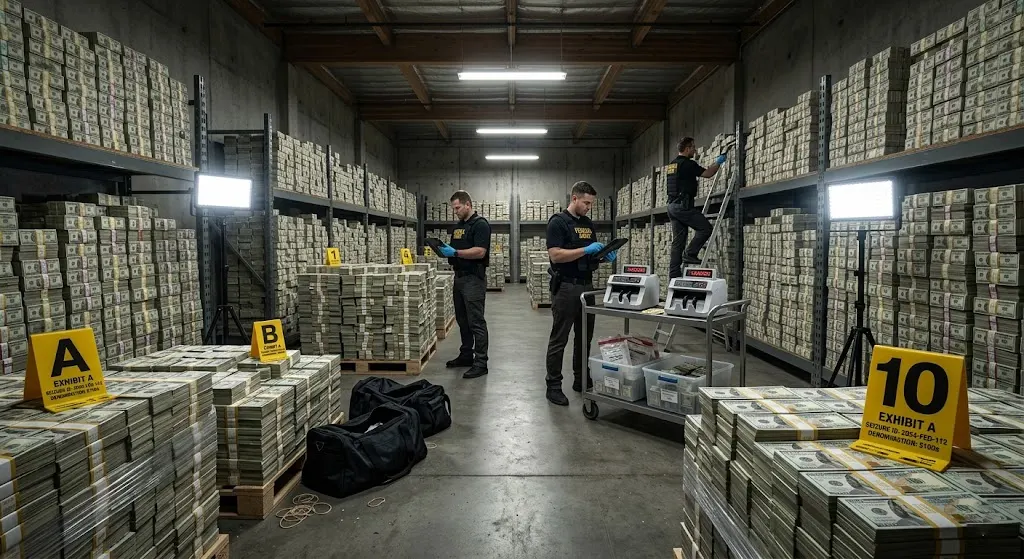
In 2007, DEA agents and Mexican law enforcement raided a quiet suburban home in Mexico City. They suspected it was connected to a methamphetamine cartel — and they were right.
Inside a plain back bedroom, agents found something staggering: $207 million in cash, mostly in $20 bills, stacked neatly from floor to ceiling. It remains one of the largest single cash seizures in history. That ordinary-looking bedroom held more money than most people will ever see in a thousand lifetimes.
$1 Billion — You’ll Need a Forklift

Now we’re entering serious territory.
One billion dollars in $100 bills, loaded onto pallets, would fill a room you could actually walk around in. Picture several towering stacks of cash — each pallet holding $100 million — lined up in neat rows. It’s not just heavy; it’s architecturally impressive.
To put it in perspective: if you spent $1,000 every single day, it would take you nearly 3,000 years to spend $1 billion.
$1 Trillion — A Football Field of Cash

Here’s where things get truly unimaginable.
One trillion dollars equals 10,000 pallets of $100 million each. Arrange all those pallets in double-stacked rows on the ground, and they would cover an entire NFL football field — end zones included — with no room to spare.
That’s not a room. That’s not a warehouse. That’s a stadium floor, wall to wall, buried in cash.
It’s almost impossible for the human brain to truly process that number. And yet, that’s what $1 trillion looks like in real life.
Final Thoughts
We throw around words like “million” and “billion” like they’re similar — but they’re not even close. A million dollars fits in a briefcase. A billion fills a room. A trillion buries a football field.
Next time you hear these numbers in the news — whether it’s a government budget, a tech company’s valuation, or a celebrity’s net worth — you’ll have a much better picture of what it actually means. Numbers are just numbers until you can see them.
For more mind-blowing money facts, wealth breakdowns, and financial comparisons that put big numbers into perspective, visit EarlyMagazine UK — where curiosity meets financial intelligence, and every number tells a story worth reading.
