

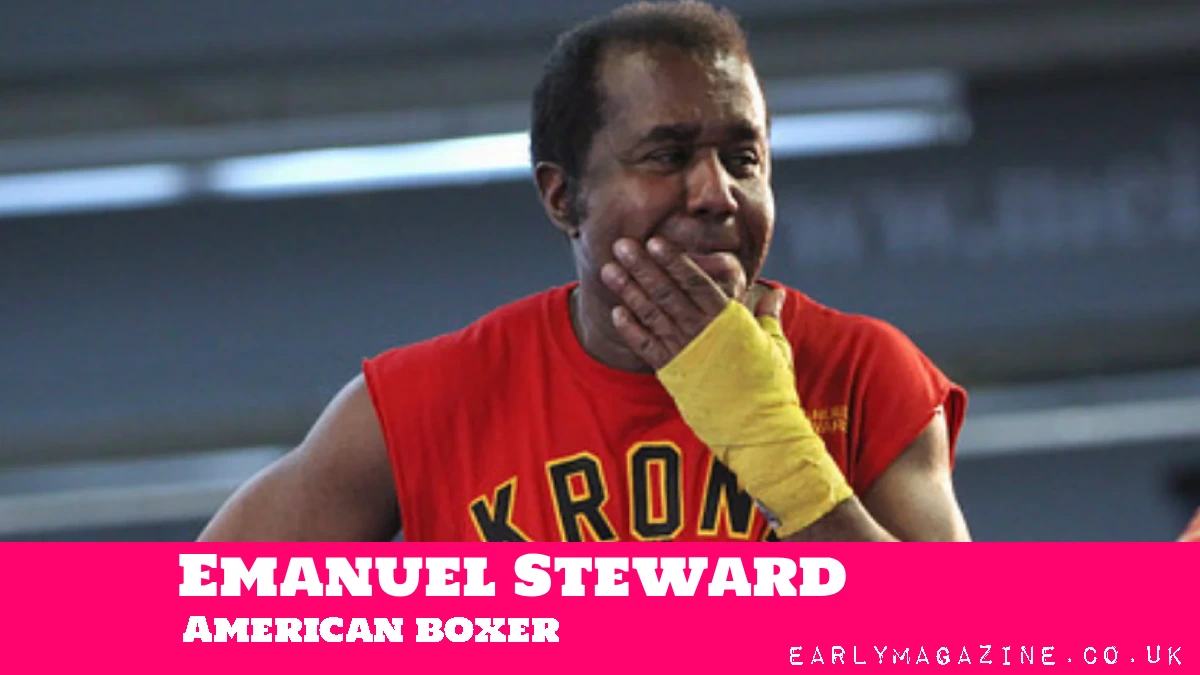








Emanuel Steward net worth at the time of his death in October 2012 was estimated between $10 million and $15 million. He built his wealth through training fees from 41 world champion fighters, ownership of the iconic Kronk Gym in Detroit, and over a decade as a boxing commentator for HBO.
Who Was Emanuel Steward?
Most people who follow boxing know the name Emanuel Steward. But far fewer understand just how extraordinary his financial journey was, or how a kid who grew up without much in West Virginia became one of the wealthiest and most respected figures in professional sports.
Emanuel Steward net worth, estimated between $10 million and $15 million at his death in 2012, tells only part of the story. Behind that figure sits four decades of relentless work, smart business decisions, and a rare ability to turn raw, untested fighters into world champions. He did not inherit wealth. He did not play the sport professionally at the highest level. He built everything through coaching, ownership, and broadcasting, one fighter at a time.
This article breaks down exactly where Steward’s money came from, how he grew it, what his career looked like in financial terms, and why his legacy still matters to boxing today.
Emanuel Steward Net Worth at a Glance
Before going deeper, here is a quick overview of the key figures and facts surrounding his wealth:
| Category | Detail |
|---|---|
| Estimated Net Worth | $10M–$15M (at time of death, 2012) |
| Primary Income Source | Training fees from world champions |
| Secondary Income | HBO Boxing commentary (2001–2012) |
| Business Asset | Kronk Gym, Detroit (owner) |
| World Champions Trained | 41 |
| Hall of Fame Inductions | 2 (International + World Boxing) |
| Career Span | 1971–2012 (41 years) |
| Starting Salary at Kronk | $35 per week (1971) |
How Steward Built His Wealth
Training Fees From World Champions
The biggest driver of Emanuel Steward’s income was his cut of fighter earnings. Top boxing trainers typically receive between 10% and 15% of a fighter’s purse. When your stable includes names like Thomas Hearns, Lennox Lewis, and Wladimir Klitschko, those percentages add up to serious money.
Hearns alone fought in some of the most commercially significant bouts of the 1980s. Lewis earned tens of millions during his heavyweight title reign in the 1990s and early 2000s. Klitschko, whom Steward trained from 2004 until his death in 2012, was one of the highest-paid heavyweights in the sport at the time. Each of those relationships put money directly into Steward’s pocket.
By the time his career ended, Steward had trained 41 world champions. His heavyweight fighters alone posted a combined title fight record of 34 wins, 2 losses, and 1 draw. That kind of consistent success meant demand for his services never dropped. Top fighters sought him out. He could name his price.
The Kronk Gym: A Business Asset
Steward started coaching at Kronk Gym in 1971, earning just $35 a week as a part-time coach. Within a few years, he had transformed it into one of the most famous boxing gyms on the planet. Eventually, he became its owner.
Kronk was not just a gym. It was a brand. Its gold and red colors were recognized across the boxing world as a symbol of quality. Steward opened a branch in Tucson, Arizona, and partnered with the Dodge Theater in Phoenix to run monthly boxing undercards. These ventures added revenue streams beyond simple training fees.
He was also known for his collection of Rolls-Royce cars and multiple properties, visible signs of the financial success he had built from scratch. The gym itself became a commercial and cultural asset tied directly to his personal brand.
HBO Boxing: A Decade of Commentary Income
Starting in 2001, Steward joined HBO Boxing as a commentator and analyst. He held that role until his death in 2012. HBO was the premier boxing broadcaster of that era, covering the sport’s biggest fights. A long-term contract with a major network adds a steady, reliable income stream on top of training fees.
Steward was widely praised for his commentary. His insider knowledge and clear communication made him one of the most trusted voices in the broadcast booth. That role also raised his profile, which in turn kept demand for his training services high.
The Road From West Virginia to Millionaire Trainer
A Modest Start With Big Amateur Credentials
Emanuel Steward was born on July 7, 1944, in Bottom Creek, West Virginia. His father was a coal miner. When his parents divorced, he moved with his mother to Detroit at age 12. He trained at the Brewster Recreation Center, the same gym where Joe Louis once prepared for fights.
As an amateur, Steward compiled a record of 94 wins and 3 losses. He won the 1963 National Golden Gloves bantamweight title. Despite that record, he could not secure a professional manager. He took a job as an electrician to support himself. That steady paycheck kept him grounded, but boxing remained his focus.
From Electrician to Hall of Famer
In 1971, he brought his younger half-brother James to Kronk Gym and started coaching part-time. He left his electrician job not long after to focus entirely on the gym. Within a few years, he had built Kronk into a national amateur powerhouse.
His first professional world champion came on March 2, 1980, when Hilmer Kenty stopped Ernesto España to win the WBA lightweight title. Five months later, Thomas Hearns became champion number two. From that point, the wins and titles kept coming.
Steward was inducted into the International Boxing Hall of Fame in 1996. He later earned a spot in the World Boxing Hall of Fame as well. He also received a Lifetime Achievement Award from the World Boxing Council in 2008.
Steward’s Most Financially Significant Fighters
Not every fighter on a trainer’s list contributes equally to earnings. These three relationships likely moved the needle most in financial terms for Steward:
Thomas Hearns was Steward’s signature product from the 1980s. Hearns fought Sugar Ray Leonard, knocked out Roberto Durán, and challenged Marvelous Marvin Hagler in one of boxing’s most memorable bouts. Those fights generated enormous pay-per-view and live gate revenues.
Lennox Lewis gave Steward a second financial peak in the 1990s. Lewis became the undisputed heavyweight champion and one of boxing’s most commercially valuable fighters. His bouts drew massive international audiences.
Wladimir Klitschko extended Steward’s earning years deep into the 2000s. Klitschko was a dominant heavyweight who held titles from 2004 onward and became one of the sport’s top earners. Steward worked with him from 2004 until 2012, a highly productive and lucrative eight-year partnership.
Adonis “Superman” Stevenson, who went on to become the WBC light heavyweight champion in 2013, was the last world champion Steward trained before his death. Stevenson later recalled that Steward told him directly: “You will be a superstar and a world champion.”
Comparing Steward’s Net Worth to Other Top Trainers
To understand where Steward’s wealth sits in context, it helps to compare him to his peers:
Freddie Roach, who trained Manny Pacquiao and dozens of other champions, has an estimated net worth of around $20 million. His earning period coincided with the massive pay-per-view explosion of the 2000s and 2010s.
Angelo Dundee, trainer of Muhammad Ali, never accumulated the same estimated wealth as Steward, partly because his peak years predated the sport’s biggest TV contracts.
Steward’s $10 million to $15 million figure is solidly in the upper tier of boxing trainer wealth. It reflects both his long career and the caliber of fighters he worked with.
His Philanthropy and Community Impact
Money was not Steward’s only measure of success. He used the Kronk Gym as a resource for Detroit’s youth throughout his career. He ran programs aimed at keeping young people off the streets, giving them structure, discipline, and a path forward through boxing.
His community work became formalized through the Emanuel Steward Champions of Tomorrow (ESCOT) program, which continues to operate as a free youth development program in Detroit. His family, including his daughter Sylvia Steward-Williams, has remained involved in keeping Kronk’s legacy alive. In late 2025, plans were announced to reopen Kronk Gym at the historic Brewster-Wheeler Recreation Center in Detroit.
His Legacy Lives On Through the Kronk Name
Steward’s nephew, SugarHill Steward, carried the Kronk tradition into the next generation by training Tyson Fury to multiple world heavyweight titles. After Fury’s February 2020 rematch victory over Deontay Wilder, SugarHill publicly credited his uncle, saying Emanuel knew years earlier that Fury had the talent to become a world champion.
That is the kind of financial and professional legacy that cannot be fully captured in a dollar figure.
Frequently Asked Questions
What was Emanuel Steward net worth when he died?
Most sources estimate it between $10 million and $15 million at the time of his death in October 2012. The range depends on how business assets like the Kronk Gym were valued.
How did Emanuel Steward make his money?
Primarily through training fees from 41 world champion fighters, ownership of Kronk Gym, and his long-term role as a boxing commentator for HBO starting in 2001.
Did Emanuel Steward own Kronk Gym?
Yes. He became the owner of Kronk Gym in Detroit after starting there as a part-time coach in 1971 for $35 a week. He later opened a branch in Tucson, Arizona.
How many world champions did Emanuel Steward train?
He trained 41 world champions throughout his career, including Thomas Hearns, Lennox Lewis, Wladimir Klitschko, Oscar De La Hoya, Evander Holyfield, and Julio César Chávez.
Is Emanuel Steward in the Boxing Hall of Fame?
Yes, twice. He was inducted into the International Boxing Hall of Fame in 1996 and the World Boxing Hall of Fame. He also received a Lifetime Achievement Award from the World Boxing Council in 2008.
The Full Picture of Steward’s Financial Legacy
Emanuel Steward net worth of $10 million to $15 million represents something specific: what happens when genuine expertise meets sustained effort over four decades. He did not start rich. He started earning $35 a week coaching teenagers in a Detroit basement gym. He built from there, one champion at a time.
His income came from multiple directions, training fees, gym ownership, commentary contracts, and business partnerships, which gave him financial stability even as boxing’s economics shifted across different decades. He won multiple Trainer of the Year and Manager of the Year awards from the Boxing Writers Association of America, recognitions that reinforced his value to top fighters.
What makes Steward’s financial story worth studying is not the final number. It is the path. Few trainers have matched his combination of longevity, consistency, and the ability to produce champions across weight classes and generations. He worked with fighters in the 1970s. He was still producing world champions in 2012. That kind of career arc is exceptionally rare in any profession.
The gold and red of Kronk still carry meaning in boxing gyms around the world. That brand, that reputation, and the fighters who still train in the Kronk tradition are the parts of Steward’s legacy that no net worth estimate fully captures.
For more insights into how legendary coaches and sporting icons built their wealth from the ground up, visit EarlyMagazine UK — where boundary-breaking careers and financial wisdom come together.
