
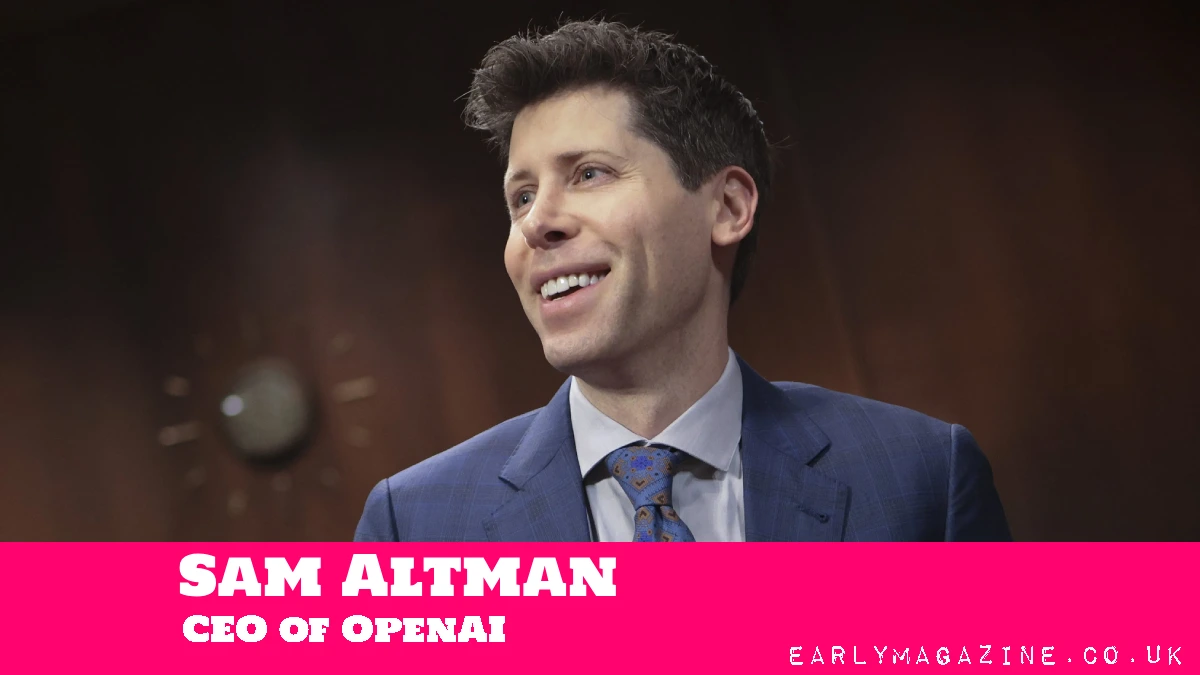
Sam Altman, the CEO of OpenAI, currently holds zero percent equity in the company he runs — valued at over $850 billion. His stake is listed as “TBD” on a leaked cap table. Legal experts believe he is waiting for the Elon Musk lawsuit to end before accepting a massive founders grant.
There’s a secret buried inside one of the most talked-about legal battles in Silicon Valley history — and it changes everything you think you know about the world’s most powerful AI company.
Sam Altman runs OpenAI. He’s the face of the AI revolution. He fields death threats, congressional hearings, and trillion-dollar decisions every week. And yet, as of right now, he does not own a single share of the $852 billion company he built.
How is that even possible?
The Company That Was Never Supposed to Make Anyone Rich
To understand how we got here, you have to go back to 2015.
OpenAI launched as a 501(c)(3) nonprofit. The mission was simple on paper — build Artificial General Intelligence safely, for all of humanity. Not for shareholders. Not for insiders. For everyone.
At that point, Altman was already rich. He’d made his name and fortune running Y Combinator, one of Silicon Valley’s most powerful startup accelerators. He didn’t need OpenAI to make him a billionaire. Or so the story goes.
But then something unexpected happened. The AI race exploded.
The Rocket Ship Nobody Expected
According to diary entries from co-founder Greg Brockman — revealed during the ongoing Musk v. Altman trial — the founding team quickly realized they were sitting on something historic. The nonprofit structure couldn’t raise the capital needed to compete. It couldn’t buy the computing power necessary to win.
So OpenAI did something unprecedented. It engineered a transformation from a pure nonprofit into a capped-profit company. It brought in billions from Microsoft, venture funds, and celebrity investors. And it grew into the most valuable private company in American history.
Along the way, co-founders quietly secured massive personal stakes.
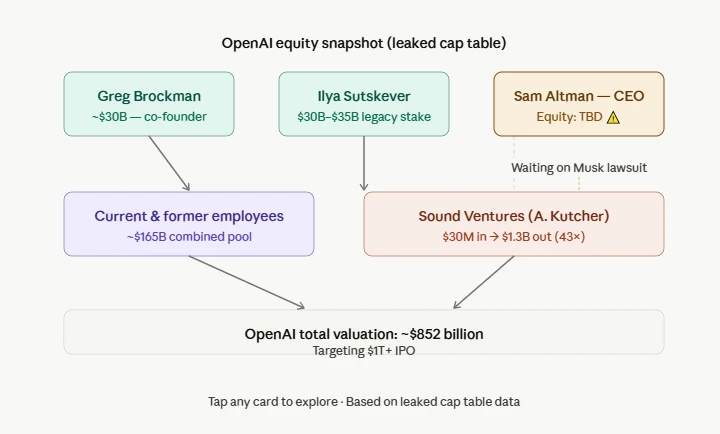
Brockman himself admitted on the witness stand that he owns roughly $30 billion in OpenAI equity — and paid nothing for it. Former Chief Scientist Ilya Sutskever sits on a legacy stake worth somewhere between $30 billion and $35 billion.
Ashton Kutcher’s VC firm, Sound Ventures, turned a $30 million early bet into a $1.3 billion stake — a jaw-dropping 43x return.
And current and former employees collectively control around $165 billion in equity.
So Where Is Sam Altman’s Piece?
This is where the story gets genuinely strange.
On the leaked OpenAI cap table that circulated in early 2025, row eight reads: “Sam Altman — CEO.” Next to his name, under equity percentage and current value, it says one word: TBD.
To Be Determined.
Not zero. Not denied. Just… waiting.
The leading theory in Silicon Valley is strategic patience. Altman and his board — which he controls firmly following the failed coup attempt in late 2023 — are simply waiting for the right moment. The moment is almost certainly tied to the outcome of Elon Musk’s lawsuit.
Musk’s entire legal case argues that OpenAI’s conversion from nonprofit to commercial entity was a betrayal of its founding mission. He’s seeking up to $134 billion in damages redirected back to the original nonprofit structure.
If Altman awarded himself $30 to $50 billion in equity right now, mid-trial, he would hand Musk exactly the smoking gun the lawsuit needs. He would be proving, in front of a judge, that insiders hijacked a charity for personal gain.
So he waits.
How Altman Gets Rich Without Owning Any OpenAI Shares
Here’s what makes this story even more layered: Altman doesn’t need OpenAI equity to build extraordinary wealth. He’s already worth well over $2 billion through a sprawling personal investment portfolio — one that benefits enormously from OpenAI’s success without him appearing on the cap table.
Reddit is one of the clearest examples. Altman invested heavily in the platform years ago and now holds roughly 12.2 million shares, valued at over $1.2 billion following Reddit’s IPO. OpenAI recently signed major data-licensing deals with Reddit to train its AI models. The more powerful OpenAI grows, the more Reddit data it buys — and the more Altman’s Reddit investment climbs.
Then there’s energy. OpenAI requires staggering amounts of electricity to run its models. Altman personally invested $350 million into Helion Energy, a nuclear fusion startup he also chairs. Helion recently raised at a $5.4 billion valuation. If OpenAI needs power at scale, Altman’s company is positioned to sell it to them.
There’s also Rain AI, a chip startup building neuromorphic processors designed to challenge Nvidia. Altman personally backed the company and led a $150 million funding round. While he was running OpenAI, the company signed a $51 million letter of intent to buy chips from Rain AI.
He’s built an ecosystem around the company he runs — without officially owning a piece of it.
What “TBD” Actually Means
Most people in Silicon Valley believe the “TBD” next to Altman’s name is not a gap — it’s a timer.
The prediction shared widely in tech circles is this: the moment the Musk lawsuit is resolved in OpenAI’s favor, the board will formally grant Altman a massive retroactive founders stake. It may be structured around a milestone — perhaps tied to successfully navigating an IPO that hits $1 trillion in market capitalization.
That one move could instantly make Altman one of the wealthiest people alive.
The Nightmare Scenario: What If Musk Wins?
The stakes of the Musk v. Altman trial are almost impossible to overstate.
If Judge Yvonne Gonzalez Rogers sides with Musk, the impact would be catastrophic. Musk is seeking to unwind OpenAI’s for-profit transition entirely and redirect up to $134 billion to the original nonprofit.
What does that mean in practice?
The $852 billion valuation collapses. A stripped nonprofit version of OpenAI with no commercial rights is not worth anywhere near that number.
The IPO — reportedly targeting a $1 trillion valuation — dies instantly. Nonprofits cannot go public.
Greg Brockman’s $30 billion stake, Ilya’s $35 billion, the $165 billion employee pool — potentially all of it becomes worthless or trapped in endless legal limbo. Microsoft and every major venture investor would face devastating losses.
And Sam Altman’s TBD? It would stay TBD forever.
Property Details: The OpenAI Cap Table at a Glance
| Name / Entity | Estimated Equity Value |
|---|---|
| Greg Brockman (co-founder) | ~$30 billion |
| Ilya Sutskever (former Chief Scientist) | $30B–$35 billion |
| Employees (current + former) | ~$165 billion |
| Sound Ventures (Ashton Kutcher) | ~$1.3 billion (43x return) |
| Sam Altman (CEO) | TBD |
| OpenAI total valuation | ~$852 billion |
Market Insight: Why the “TBD” Strategy Is Brilliant (or Risky)
From a pure wealth strategy standpoint, Altman’s approach is arguably genius. By staying off the cap table during the most legally exposed period in OpenAI’s history, he avoids becoming a target for Musk’s lawsuit while still benefiting from the company’s momentum through his external investments.
But it comes with risk. If the Musk trial drags on for years — or if public sentiment turns against OpenAI’s growing commercial ambitions — the political cost of awarding a $30–$50 billion retroactive grant could become enormous.
The window to “determine” his equity may be narrower than it appears.
FAQs
Why does Sam Altman have no equity in OpenAI?
OpenAI was founded as a nonprofit, and Altman reportedly chose not to take equity in the early days to position himself as a neutral, mission-driven leader. His stake is listed as “TBD” on the leaked cap table, widely believed to be delayed until the Musk lawsuit concludes.
What does “TBD” mean next to Sam Altman’s name on the cap table?
It means his equity stake has not yet been formally granted or determined. The prevailing theory is that the OpenAI board is waiting for legal clarity before awarding him a large retroactive grant — potentially tied to an IPO milestone.
How is Sam Altman already a billionaire without OpenAI equity?
Altman has built a personal investment portfolio worth over $2 billion. Key holdings include Reddit shares (valued at over $1.2 billion), nuclear fusion startup Helion Energy, and chip company Rain AI — all businesses that benefit directly from OpenAI’s growth.
What happens to OpenAI equity if Elon Musk wins his lawsuit?
If the court sides with Musk and unwinds OpenAI’s for-profit transition, the company’s valuation could collapse, the planned IPO would be dead, and billions in employee and investor equity could become worthless or legally frozen.
Who are the richest people inside OpenAI right now?
Based on the leaked cap table, co-founder Greg Brockman and former Chief Scientist Ilya Sutskever both hold stakes worth approximately $30 to $35 billion each. The combined employee equity pool stands at around $165 billion.
Is OpenAI planning to go public?
Yes. OpenAI has been reportedly preparing for an IPO targeting a $1 trillion valuation. A Musk court victory could permanently block that plan, since nonprofits cannot issue public stock.
Conclusion
Sam Altman runs one of the most valuable companies ever built — and officially owns none of it.
That one fact tells you more about the complexity of OpenAI’s story than almost anything else. It’s a company born as a charity, transformed into a commercial juggernaut, and now at the center of the most consequential lawsuit in tech history.
When the legal dust finally settles, expect that single word — “TBD” — to be replaced by a number that makes headlines around the world.
Want to stay ahead of this story as it develops? Bookmark this page and follow the Musk v. Altman trial closely. The next major update could change everything.
For more insights into how Silicon Valley’s boldest minds build wealth and reshape industries, visit EarlyMagazine UK — where tech power, money moves, and the stories behind the headlines all come together.
