

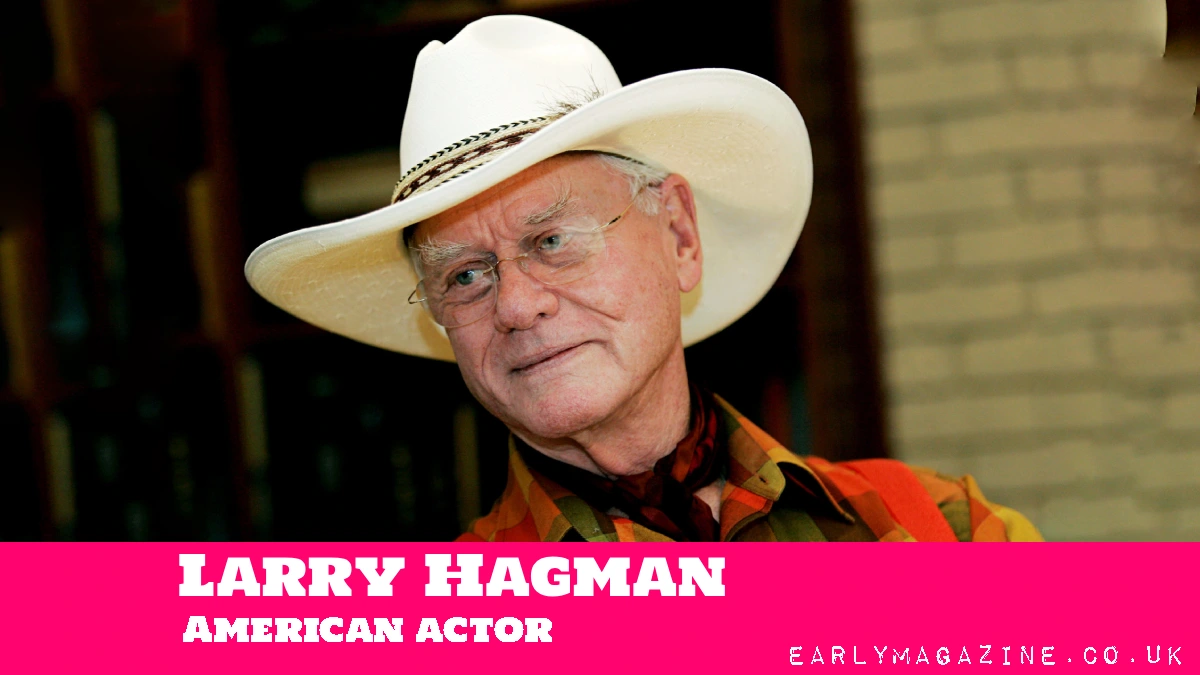
Larry Hagman had a net worth of $30 million at the time of his death in November 2012. He built his fortune primarily through his roles as Major Anthony Nelson in I Dream of Jeannie and oil baron J.R. Ewing in Dallas, where his salary eventually reached $250,000 per episode. He also earned merchandising royalties tied to his iconic character.
When people search for Larry Hagman net worth, they usually expect a simple number. But the real story is far more interesting. Hagman transformed himself from a struggling stage actor into one of the highest-paid television performers in American history, and the way he did it changed the entire business of TV contracts forever.
Most actors take what the network offers. Larry Hagman broke his contract, sent agents in cowboy hats to salary negotiations, and walked away with a deal that cast members of Friends and Seinfeld would later follow. His $30 million fortune was not handed to him. He built it episode by episode, negotiation by negotiation, across five decades in Hollywood.
This article breaks down where Hagman’s money came from, how much he earned per episode at his peak, what his real estate and assets looked like, and how his financial story ended. You will also find a clear comparison of his salary across different career stages.
From Broadway Kid to TV Breakout
Larry Martin Hagman was born on September 21, 1931, in Fort Worth, Texas. His mother was Broadway star Mary Martin. His father was a lawyer. His parents divorced when he was five, and he spent much of his childhood with his grandmother in Weatherford, Texas.
Growing up around theater gave him a head start. He worked small roles in Broadway productions early in his career, including Career and Comes a Day. He served in the U.S. Air Force, spent time in Britain, and returned to the United States ready to break into television.
His first television appearance came in 1957 on the crime drama Decoy. He worked steadily through the late 1950s and early 1960s in guest roles and small parts, but his career needed a defining moment. That moment arrived in 1965.
I Dream of Jeannie: The First Fortune
I Dream of Jeannie premiered on NBC in 1965. Hagman played Major Anthony Nelson, a NASA astronaut who discovers a 2,000-year-old genie. The show ran for five seasons and 139 episodes, turning Hagman into a recognizable face across American living rooms.
The show gave Hagman financial stability and enough fame to keep working through the 1970s. After Jeannie ended in 1970, he appeared in films and television movies, but nothing matched that level of success. For nearly a decade, he worked steadily without breaking through to the next tier.
That changed in 1978 when two pilot scripts landed on his doorstep.
Dallas and the Role That Built His Net Worth
According to Texas Monthly, Hagman and his wife Maj Axelsson each took a script to read one evening. He read The Waverly Wonders. She read Dallas. After just a few pages, she told him, “Larry, this is it.” She was right.
Dallas premiered in 1978 on CBS as a miniseries and was quickly picked up as a full series. Hagman played J.R. Ewing, a scheming, manipulative Texas oil baron who became one of television’s greatest villains. The character was so compelling that the show turned into a cultural phenomenon.
In the early seasons, Hagman earned $15,000 per episode. That was a solid salary for 1980, equivalent to roughly $50,000 per episode in today’s dollars. But Hagman knew his value was rising fast.
The Salary Negotiation That Changed TV History
In November 1980, the Dallas season 3 finale aired. The episode, titled “Who Done It,” drew 83 million viewers. It remains the second-most-watched non-Super Bowl broadcast in American television history, behind only the M*A*S*H finale.
The entire country was asking one question: Who shot J.R.?
Hagman sensed his power. He instructed his agents to break his contract and demand a new salary. The number they asked for was $100,000 per episode, unheard of at the time. At his insistence, the agents showed up to the meeting wearing Stetson hats and cowboy boots. The network thought the demand was absurd. Executives even threatened to kill off J.R. and replace Hagman entirely.
The network folded. Hagman got his $100,000 per episode.
By the end of Dallas‘s run, his salary had climbed to $250,000 per episode. He also negotiated a percentage of official J.R. Ewing merchandise royalties, a deal that continued generating income long after the show ended.
Hagman later reflected on the negotiations with characteristic candor: “I also think they should give me a little nod for blazing the trail for episodic television,” he wrote in his autobiography, referring to the later mega-salaries paid to cast members of Friends and Seinfeld.
He appeared in all 357 episodes of the original Dallas run, making him the only cast member with a perfect attendance record.
Larry Hagman’s Salary Across His Career
| Career Period | Role | Salary Per Episode |
|---|---|---|
| 1965–1970 | I Dream of Jeannie | Estimated $3,000–$5,000 |
| 1978–1980 | Dallas (early seasons) | $15,000 |
| 1981 (post-renegotiation) | Dallas | $100,000 |
| Late 1980s–1991 | Dallas (peak) | $250,000 |
| 2012 | Dallas revival (TNT) | Undisclosed |
Beyond Dallas: Films, Real Estate, and Other Income
Film Career
Hagman never became a major film star, but he worked consistently in movies throughout his career. His notable film appearances include Fail-Safe (1964), Harry and Tonto (1974), S.O.B. (1981), Nixon (1995), and Primary Colors (1998). These roles added to his income without defining his wealth.
Real Estate
Hagman and his wife owned properties in Santa Monica and Ojai, California. Ojai is a small city northwest of Los Angeles, known for its quiet hills and community of artists and performers. Both properties held significant value given California’s real estate market.
Personal Auction
In 2011, just one year before his death, Hagman held a personal auction in Beverly Hills through Julien’s Auctions. The collection brought in more than $500,000. A silver saddle sold for $80,000. A portrait of Dallas co-star Jim Davis sold for more than $38,000. A replica bottle from I Dream of Jeannie fetched over $10,000. The auction showed that his personal memorabilia carried real market value.
The 2012 Dallas Revival
Shortly before his death, Hagman returned to the role of J.R. Ewing in TNT’s revival of Dallas, which premiered in June 2012. He filmed several episodes before being diagnosed with acute myeloid leukemia. He died on November 23, 2012, in Dallas, Texas, at age 81. The production honored him by writing J.R.’s death into the show.
Health Struggles and Financial Resilience
Hagman’s financial story includes serious challenges. He struggled with alcoholism for decades. In the early 1990s, he was diagnosed with cirrhosis of the liver and liver cancer. In 1995, he underwent a life-saving liver transplant.
The medical bills were substantial. The transplant and years of treatment cost significant sums, yet Hagman maintained his financial footing. His passive income from Dallas syndication, merchandise royalties, and real estate kept generating money even during his years away from major productions.
His resilience mirrored the character he played. J.R. Ewing was famous for coming back from every setback stronger than before. Hagman, in real life, did the same.
Larry Hagman Net Worth at Death
At the time of his death in November 2012, Larry Hagman’s net worth was estimated at $30 million according to Celebrity Net Worth. Some sources put the figure lower at $15 million, reflecting differences in how real estate, royalties, and liabilities are valued.
The $30 million figure from more detailed reporting is widely considered the most accurate. It accounts for his decades of television earnings, merchandise royalties, real estate holdings, and syndication income from Dallas and I Dream of Jeannie.
For comparison, his fictional character J.R. Ewing was once estimated by Forbes to be worth approximately $2.8 billion. The man who played him left behind a real but far more modest fortune built through genuine work and smart negotiation.
Frequently Asked Questions
What was Larry Hagman net worth when he died?
Larry Hagman’s net worth was estimated at $30 million at the time of his death in November 2012, accumulated primarily through his roles in Dallas and I Dream of Jeannie.
How much did Larry Hagman make per episode of Dallas?
He started at $15,000 per episode and eventually reached $250,000 per episode after renegotiating his contract in 1981 following the massive success of the “Who shot J.R.?” storyline.
Did Larry Hagman receive royalties from Dallas?
Yes. As part of his renegotiated contract, Hagman secured a percentage of official J.R. Ewing merchandise royalties, which continued generating income beyond his acting salary.
How did Larry Hagman die?
He died on November 23, 2012, in Dallas, Texas, from complications of acute myeloid leukemia. He was 81 years old.
Was Larry Hagman wealthy compared to other TV actors of his era?
Yes. At his peak, his $250,000 per episode salary made him one of the highest-paid actors in television history. He paved the way for later stars like the Friends cast to negotiate similarly high fees.
Conclusion
Larry Hagman built a $30 million fortune through talent, timing, and remarkable boldness at the negotiating table. His transformation from a reliable character actor into television’s most famous villain gave him the leverage to rewrite the rules of what a TV star could earn. He did not simply benefit from a popular show. He turned that popularity into historic contracts, merchandise deals, and syndication income that outlasted him.
His story is worth studying even today. In an era when streaming services and multi-picture deals dominate entertainment finance, Hagman’s early fight for what he was worth remains one of the clearest examples of an actor understanding his own value and acting on it. The next time a cast negotiates collectively or a TV star signs a record deal, part of that path traces back to a man in a cowboy hat walking into a network boardroom and asking for $100,000 an episode.
For more insights into how television legends built their fortunes on and off screen, visit EarlyMagazine UK — where iconic careers and financial legacies get the in-depth treatment they deserve.
