

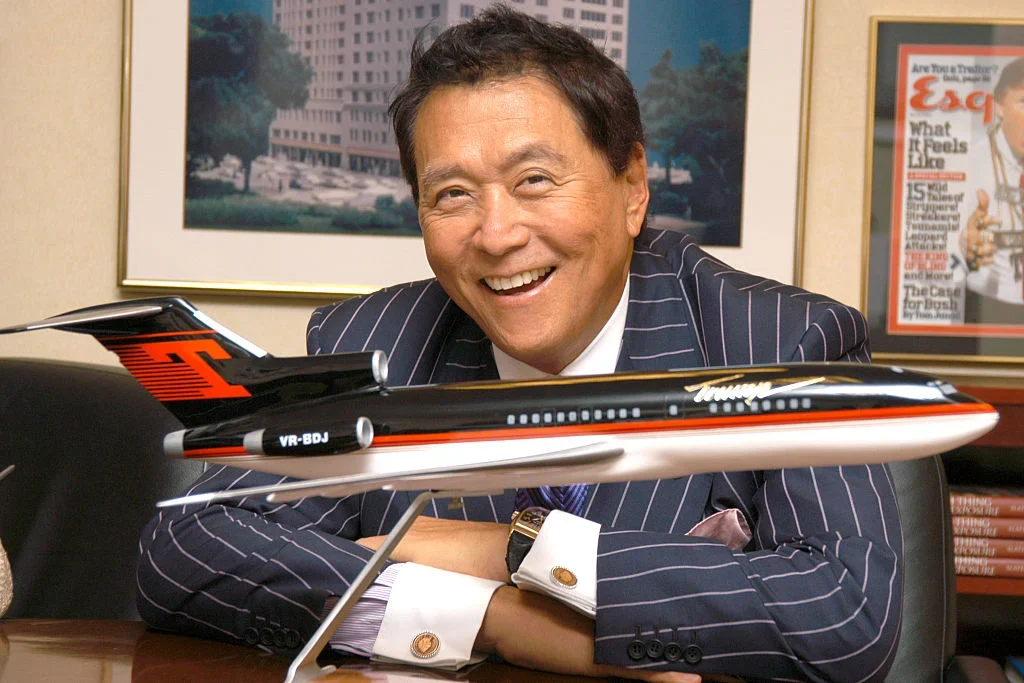
If you scrolled through financial news or social media this week, you probably ran into a jaw-dropping headline: Robert Kiyosaki, the man behind the personal-finance classic Rich Dad Poor Dad, is supposedly $1.2 billion in debt.
At first glance, it sounds almost poetic. The guy who taught millions of readers how to build wealth is now buried under more than a billion dollars in liabilities? That’s the kind of headline that practically writes its own punchline.
Except it isn’t true. Not even close.
Below, we’ll break down where this claim actually came from, why it’s so misleading, and what Robert Kiyosaki’s finances really look like — including his actual net worth, his investment philosophy, and why “debt” means something very different to him than it does to most people.
Where the $1.2 Billion Debt Claim Came From
The story traces back to a recent Vanity Fair profile examining Kiyosaki’s finances. The headline read something like:
“Poor Dad Author Goes Bust: How Robert Kiyosaki Went Into Debt, to the Tune of $1.2 Billion”
It’s an attention-grabbing headline, and it worked exactly as intended — it spread across financial news outlets and social media within hours. Read that headline on its own, and you’d reasonably assume Robert Kiyosaki personally owes $1.2 billion.
But buried deeper in the article is a much more accurate — and far less dramatic — explanation.
Kim Kiyosaki, Robert’s ex-wife and longtime business partner, stepped in to clarify the confusion. She explained that the $1.2 billion figure is “widely misunderstood” and that Robert does not personally owe anywhere near that amount.
Here’s what the number actually represents: it’s the total debt held collectively by a group of real estate investors, including Kiyosaki, who together own roughly 1,500 apartment units. Robert is one investor among many in that group — not the sole debtor.
According to Kim, his personal share of that debt is a small fraction of the headline number. Vanity Fair itself estimated his actual portion could fall somewhere between $30 million and $60 million — a huge difference from $1.2 billion, though still a significant sum by most standards. And importantly, that debt is backed by real, income-producing assets, not unsecured loans hanging over his head.
To put this in perspective: reporting that Robert Kiyosaki is “$1.2 billion in debt” because he’s one investor in a group carrying that liability is a bit like saying someone who owns a single share of a major tech company “controls” the entire multi-trillion-dollar business. Technically there’s a sliver of truth buried in there, but it badly misrepresents reality.
Why Kiyosaki Actually Likes Debt
To understand why this headline is so misleading, it helps to understand how Kiyosaki thinks about debt in the first place — because his philosophy is intentionally the opposite of mainstream financial advice.
Most financial experts tell people to pay off debt as fast as possible. Kiyosaki has spent decades arguing the opposite: that not all debt is bad, and that the difference between “good debt” and “bad debt” is what separates wealthy investors from everyone else.
In his view:
- Bad debt finances things that lose value or produce nothing — credit card balances, car loans, or consumer purchases.
- Good debt finances income-producing assets — like apartment buildings — that generate enough cash flow to cover the loan payments and then some.
In a 2025 interview, Kiyosaki summed up his entire philosophy in three blunt words: “Debt is money.” Rather than avoiding leverage, he believes investors should learn to use borrowed capital to acquire assets they couldn’t otherwise afford outright.
Vanity Fair’s reporting laid out how this strategy actually plays out in Kiyosaki’s real estate business. When one of his properties increases in value, instead of selling it and paying capital gains tax, he often refinances — borrowing more money against the property’s new, higher value. This lets him access cash without triggering a taxable sale.
He also structures his investments carefully, typically holding each property inside its own separate LLC. This creates a financial firewall: if one property or deal runs into trouble, it doesn’t automatically put his other assets at risk.
Is this approach risky? Absolutely — leverage cuts both ways. If property values fall, interest rates spike, or rental income dries up, heavily leveraged investors can get squeezed fast. But carrying tens of millions of dollars in mortgage debt tied to income-producing real estate isn’t the same as being “broke.” It simply means Kiyosaki operates the way many aggressive, experienced real estate investors do — with significant leverage baked into the strategy.
So What Is Robert Kiyosaki Actually Worth?
Despite the sensational headlines, nothing in the Vanity Fair report gives a real reason to slash Kiyosaki’s estimated net worth.
CelebrityNetWorth currently pegs his net worth at around $100 million, and that figure still holds up reasonably well based on what’s known about his income, assets, and business empire.
Here’s a quick look at where that wealth comes from:
- Book royalties: Rich Dad Poor Dad, first published in 1997, has sold more than 44 million copies worldwide and has been translated into at least 43 languages, making it one of the best-selling personal-finance books of all time.
- The Rich Dad brand: Kiyosaki expanded far beyond that one book, building out additional titles, seminars, online courses, speaking engagements, board games, licensing deals, a podcast, and other financial-education content.
- Ongoing business income: Kiyosaki told Vanity Fair that his combined businesses and investments currently bring in roughly $250,000 per month, or about $3 million per year.
- Real estate holdings: He owns a home in Arizona reportedly purchased for around $4.5 million, plus stakes in a large portfolio of apartment buildings and other real estate investments across the country.
The Real Unknown: How Much Equity Does He Actually Own?
Here’s the piece that most headlines conveniently skip over: nobody outside Kiyosaki’s inner circle actually knows how much equity he holds in these real estate partnerships.
If Kiyosaki and his fellow investors collectively carry $1.2 billion in debt against properties that are worth considerably more than that — which is common in real estate, where leveraged purchases typically run 60–80% loan-to-value — there could easily be hundreds of millions of dollars in combined equity spread across the entire investor group.
Without knowing the total value of the underlying portfolio or Kiyosaki’s exact ownership percentage in each deal, it’s impossible to calculate his personal equity stake with any precision. That’s exactly why serious financial reporting shouldn’t lead with a headline number that represents group debt while ignoring the far more relevant individual equity picture.
The Bottom Line
Let’s cut through the noise and get to what’s actually true:
- Robert Kiyosaki does not personally owe $1.2 billion.
- That figure represents debt held collectively by a group of real estate investors who together own about 1,500 apartment units.
- Kiyosaki’s personal share of that debt is estimated at somewhere between $30 million and $60 million — still substantial, but nowhere close to the headline number.
- That debt is secured by real, income-generating property, not consumer debt or unsecured loans.
- His estimated net worth still sits around $100 million, largely built on decades of book sales, business income, and real estate.
“Rich Dad Poor Dad Author Goes Bust” makes for a punchy, shareable headline. But it’s simply not an accurate description of what’s actually happening in Kiyosaki’s finances. The real story — a wealthy, book-royalty-backed investor who uses significant leverage across a large real estate portfolio, the same way countless professional investors do — is a lot less shocking.
It’s also, for what it’s worth, the version that’s actually true.
