

Most massive family fortunes don’t survive long.
Look at the Vanderbilts. When railroad tycoon Cornelius Vanderbilt died in 1877, he left behind one of the biggest private fortunes the world had ever seen. His son William grew it even bigger. But the generations after that split the money between more and more heirs, and they poured huge sums into mansions, parties, and art. Within about 70 years, the Vanderbilt fortune had all but vanished.
That is not what happened to the Grosvenor family, one of England’s oldest aristocratic dynasties.
In 1677, an English landowner named Sir Thomas Grosvenor married a 12-year-old heiress named Mary Davies. Her dowry included something that looked worthless at the time: about 500 acres of soggy, undeveloped marshland just west of London.
Nearly 350 years later, that marriage is the reason a 35-year-old man named Hugh Grosvenor is quietly one of the richest people on Earth.
Who Is Hugh Grosvenor, The 7th Duke Of Westminster?
Hugh Grosvenor is the 7th Duke of Westminster, a title he inherited in 2016 at just 25 years old, after his father died suddenly. He is famously private, rarely gives interviews, and spends most of his time at the family’s country estate in Cheshire.
He is also the great-great-great-great-great-great-great-grandson of Sir Thomas Grosvenor, and he sits at the top of a fortune we estimate at $13 billion.
That marshland Sir Thomas picked up through marriage in 1677? London grew around it — and kept growing. Today, that once-worthless patch of mud makes up huge chunks of Mayfair and Belgravia, two of the most expensive neighborhoods on the planet.
Because the Grosvenors held onto that land instead of selling it off, Hugh now controls a fortune roughly 16 times larger than that of King Charles III, who also happens to be his godfather.
How The Grosvenors Built A 350-Year Fortune
As London expanded westward through the 1700s and 1800s, the Grosvenors began developing their land. Mayfair went up first, in the 18th century. Belgravia followed in the 19th century, and both are still home to some of the most sought-after addresses in Britain.
Here is the key move that separates the Grosvenors from almost every other wealthy family in history: they never sold the land.
Instead of developing plots and flipping them for cash, the family built homes, shops, offices, hotels, and embassies on their land — and then leased it out. Tenants paid rent. The family kept ownership. And every year, the land grew more valuable while the income kept flowing in.
This is the exact opposite of what happened to the Vanderbilts. The Vanderbilts inherited cash and assets that could easily be spent or divided up. The Grosvenors inherited land that produced income forever, and later generations were legally blocked from breaking it apart.
The Estate Grew Far Beyond London
Over time, the family’s holdings spread well past central London. Today, the wider Grosvenor Estate includes five major rural estates across England, Wales, Scotland, and Spain, covering more than 150,000 acres. The family also holds investments in agriculture and food technology.
Their company, Grosvenor Group, is an international property investment and development firm with a footprint across Europe, Asia, and North America.
On top of the real estate, the family owns a private art collection built up over centuries, reportedly including works by Rembrandt, Van Dyck, Gainsborough, and Stubbs. Because the collection is private and hard to value, it is not included in the $13 billion estimate.
Fourteen Men, One Unbroken Fortune
Passing the dukedom down was rarely simple. Several heirs died without sons, which forced the title to jump sideways to a brother, nephew, or cousin instead of passing directly from father to son. But no matter who inherited it, the land and the underlying fortune stayed intact.
Here’s the line of succession, from the 1677 marriage that started it all to the man leading the family today:
- Sir Thomas Grosvenor, 3rd Baronet (1656–1700) — Married Mary Davies in 1677, bringing the London land into the family.
- Sir Richard Grosvenor, 4th Baronet (1689–1732) — Thomas’s eldest son. Died without surviving children.
- Sir Thomas Grosvenor, 5th Baronet (1693–1733) — Richard’s younger brother. Died unmarried.
- Sir Robert Grosvenor, 6th Baronet (1695–1755) — Younger brother of Richard and Thomas. Hugh descends directly from Robert.
- Richard Grosvenor, 1st Earl Grosvenor (1731–1802) — Robert’s son.
- Robert Grosvenor, 1st Marquess of Westminster (1767–1845) — Richard’s son.
- Richard Grosvenor, 2nd Marquess of Westminster (1795–1869) — Robert’s son.
- Hugh Lupus Grosvenor, 1st Duke of Westminster (1825–1899) — Made Duke of Westminster by Queen Victoria in 1874.
- Hugh Richard Arthur Grosvenor, 2nd Duke (1879–1953) — Grandson of the 1st Duke.
- William Grosvenor, 3rd Duke (1894–1963) — First cousin of the 2nd Duke. Died unmarried and childless.
- Gerald Hugh Grosvenor, 4th Duke (1907–1967) — A cousin of the 3rd Duke. Also died childless.
- Robert George Grosvenor, 5th Duke (1910–1979) — Younger brother of the 4th Duke.
- Gerald Cavendish Grosvenor, 6th Duke (1951–2016) — Robert’s son, and Hugh’s father.
- Hugh Richard Louis Grosvenor, 7th Duke (born 1991) — Gerald’s only son. Inherited the title in 2016 at age 25.
Why The Family Couldn’t Just Blow The Fortune
By the 1900s, the family realized they couldn’t just trust every future duke to manage things responsibly. So they placed much of the core wealth into trusts built to protect the estate across generations.
That single decision explains a lot about how this fortune has survived for nearly 350 years. Hugh and other family members benefit from the trusts, but they don’t have free rein over every building, field, and investment tied to the estate. A duke can’t wake up one morning, decide he wants an extra billion dollars, sell off a slice of Belgravia, and pocket the cash.
Hugh’s father, Gerald Cavendish Grosvenor, once summed up his relationship with the fortune in one blunt sentence: “I can’t sell. It doesn’t belong to me.”
Gerald saw himself as a temporary caretaker of something far older than himself — a mindset backed up by professional trustees whose job was to shield the estate from bad investments, reckless spending, messy divorces, and every other force that has wiped out other great fortunes.
Gerald Turned An Old Estate Into A Global Business
Gerald inherited the dukedom in 1979 and spent decades transforming an old-fashioned aristocratic estate into a modern international property business.
When he took over, the family had already weathered property crashes, inflation, heavy taxes, and steep death duties. Working alongside professional managers, Gerald stabilized the estate and helped it grow into a global operation.
By the time he died suddenly in August 2016, his personal fortune was estimated at somewhere between £8 billion and more than £9 billion, with the wider estate managing significantly more in total assets.
Gerald was 64. His son Hugh was 25.
Almost overnight, one of Britain’s largest fortunes landed in the hands of a young man who had been living a strikingly ordinary life. Hugh had studied countryside management at Newcastle University and had worked for a company that turned used coffee grounds into fuel and other products.
Then, suddenly, he became the 7th Duke of Westminster.
Just How Rich Is Hugh Grosvenor, Really?
We estimate Hugh’s net worth at $13 billion. That figure covers the value of the family’s London real estate, its rural estates, Grosvenor Group, its agricultural and technology investments, and other assets tied to Hugh as head of the dynasty.
It doesn’t mean he has $13 billion sitting in a personal bank account. The same trusts that protected the fortune for centuries also stop him from treating the family’s assets like a personal piggy bank.
But that doesn’t make the fortune purely theoretical, either. The businesses underneath it generate real, substantial cash every year. Grosvenor Group’s own financial statements show the company paid roughly £50 million in dividends in both 2022 and 2023 — around $70 million a year in USD. That money flows into the trust structure, where it can be reinvested or paid out to Hugh and other family beneficiaries.
Exactly how much Hugh personally takes home each year isn’t public. But being the central figure in a trust pulling in tens of millions of pounds annually in dividends alone points to an extremely comfortable income, even before touching the underlying empire.
And dividends are just one slice of the pie. The family also collects rent across some of London’s most valuable real estate, plus income from international property investments and rural estates. In short, the Grosvenors cracked the problem that sinks most inherited fortunes — they protected the core wealth while letting it keep generating cash, year after year.
How Does He Compare To King Charles?
For comparison, we estimate King Charles III’s personal net worth at $800 million. That means Hugh’s $13 billion fortune is roughly 16 times bigger.
Charles does have access to Buckingham Palace, Windsor Castle, and the Crown Jewels — but none of those belong to him personally, and he can’t sell them for his own benefit. The Crown Estate is also kept entirely separate from his personal wealth.
So, remarkably, the low-key 35-year-old duke — King Charles’s own godson, and godfather to Prince George — is worth vastly more on paper than the King himself.
Hugh Grosvenor’s Life Today
Despite his staggering wealth, Hugh has stayed far out of the celebrity spotlight. He rarely sits for interviews and has steered clear of the flashy billionaire lifestyle altogether.
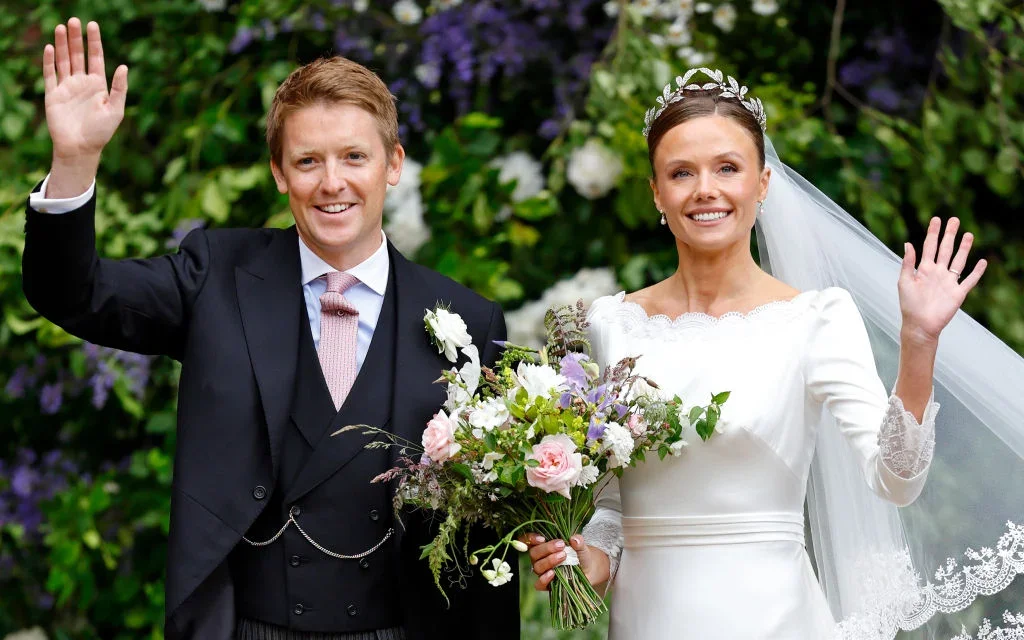
In June 2024, he married Olivia Henson at Chester Cathedral, with Prince William serving as an usher. Hugh is godfather to both Prince George and Prince Archie, one more sign of just how close the Grosvenors and the British royal family remain. In 2025, Hugh and Olivia welcomed their first child, a daughter named Cosima Florence Grosvenor.
For now, Hugh is simply the latest steward of a fortune whose defining decision was made centuries before he was born.
Sir Thomas Grosvenor married a 12-year-old heiress in 1677 and picked up hundreds of acres of land that nobody could have predicted would one day become some of the most valuable real estate on the planet. Generation after generation developed that land, collected the income, protected the core assets, and resisted the urge to cash out.
The Vanderbilts proved how fast a massive fortune can disappear. The Grosvenors proved what happens when a family refuses to let go.
And maybe the smartest decision this dynasty ever made was also the simplest one: they held on.
EarlyMagazine UK brings you the real numbers behind the world’s biggest fortunes, from royal wealth to celebrity net worth. Check back for more deep dives into the money stories nobody else is telling.
