

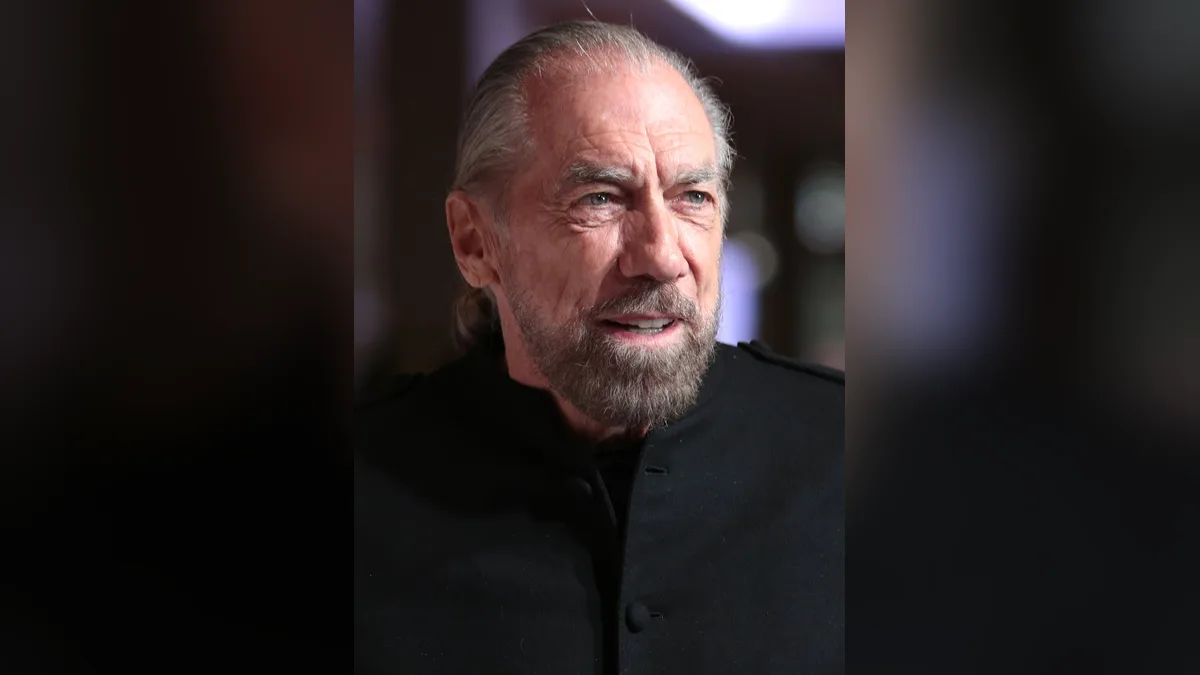
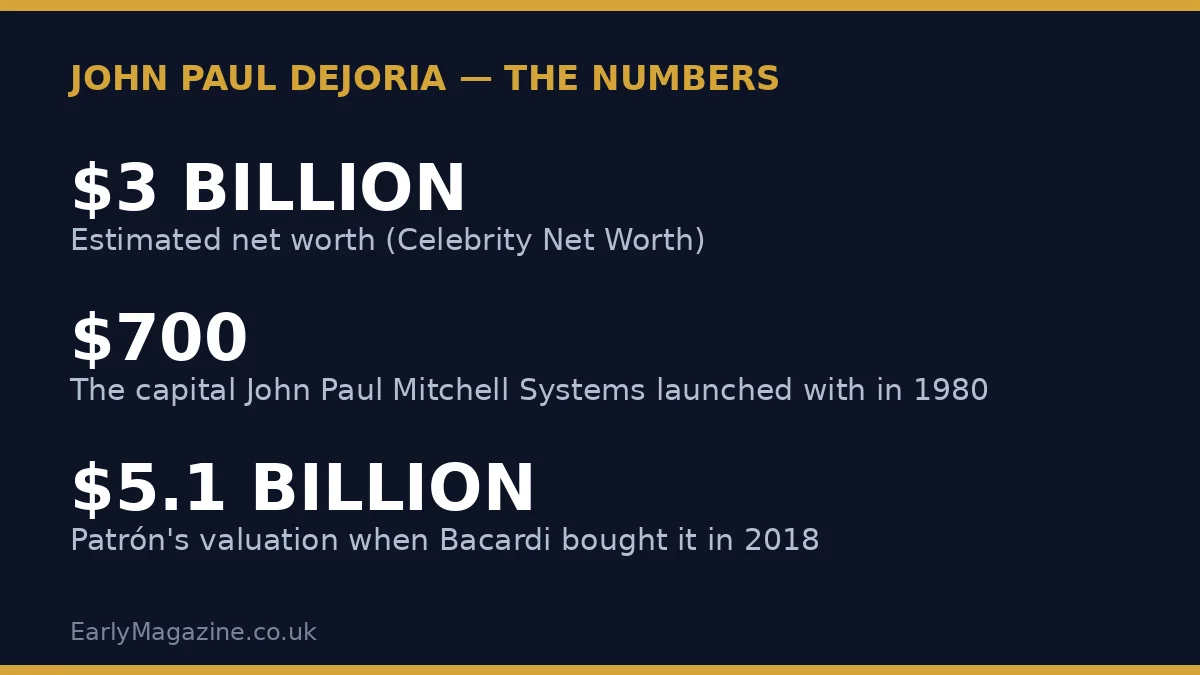
Before he was a billionaire, John Paul DeJoria slept in a borrowed 1951 Cadillac with his two-year-old son, collecting empty bottles — two cents for the small ones, five for the large — to pay for food. Then, incredibly, it happened to him a second time, more than a decade later, just as he was launching the hair-care company that would make him rich. Today DeJoria’s net worth is estimated at $3 billion, and he is one of the very few people in history to build not one but two entirely separate billion-dollar empires: John Paul Mitchell Systems in hair care, and Patrón in tequila.
Homeless at 22
DeJoria’s first collapse came in the 1960s, when he was 22. His wife left, taking almost everything, and he found himself on the street with their son, who was two and a half. He survived by gathering returnable bottles and doing whatever work he could find. He eventually landed on his feet and, in 1971, took a job at Redken, the professional hair-products company, earning about $600 a month.
Hair care was his trade from then on — but the industry kept firing him. He was dismissed by Redken in 1975, then let go by two more companies, Fermodyl and the Institute of Trichology, reportedly in part because his superiors disliked his habit of suggesting there were better ways to do things.
Homeless Again — at the Exact Wrong Moment
In 1980 DeJoria and the stylist Paul Mitchell planned a new company together. An investor was to put in $500,000 for 40%; the two founders would split the rest. The money never arrived. DeJoria, freshly broke again, spent the launch sleeping in a Rolls-Royce parked on Mulholland Drive — a friend’s car, not his — until the actress Joanna Pettet took him in.
John Paul Mitchell Systems launched anyway, on roughly $700 of combined capital. The brand’s famous black-and-white packaging was not a design statement; it was what they could afford. The numbers that followed were anything but modest: sales of $1.37 million in the company’s second year, more than $10 million by 1985, and $60.7 million by 1988. The beauty industry rarely produces fortunes on this scale — Kylie Jenner is the modern exception — and DeJoria was only halfway done. Paul Mitchell died of pancreatic cancer in 1989, leaving DeJoria to run the business they had started in a car park.
The Second Empire: A $37 Bottle of Tequila
In 1989 — the same year he lost his partner — DeJoria co-founded Patrón with Martin Crowley. DeJoria financed the first 12,000 bottles of a premium tequila made by distiller Francisco Alcaraz, priced at $37 a bottle at a time when tequila was supposed to be cheap. Instead, the price became the marketing: Patrón essentially created the ultra-premium tequila category.
Crowley died in 2003, and the ensuing ownership fight was settled in 2008 with Bacardi taking 30% and DeJoria 70%. A decade later, in January 2018, Bacardi agreed to buy the rest of Patrón at an enterprise valuation of $5.1 billion. DeJoria’s stake was worth roughly $3.5 billion. Patrón was by then selling more than three million cases a year.
The Empire He Refused to Sell
The Paul Mitchell business never went the same way. In 2007 DeJoria placed John Paul Mitchell Systems into a trust designed to run for 360 years, structured to keep the company private and family-led — his daughter Michaeline later became CEO. It remains one of the largest privately held beauty companies in the world, and it is deliberately unsellable. It is the same ownership-first instinct that later made Tyler Perry a billionaire in film and television: never sell the asset that prints the money.
In 2011 he joined the Giving Pledge, committing the majority of his wealth to philanthropy. His story has since become a staple of American business folklore — regularly retold alongside other self-made fortunes such as Taylor Swift’s — but the outline bears repeating, because almost nobody else has done it twice in two unrelated industries: homeless at 22, homeless again at 36, and then shampoo and tequila, worth billions each.
Sources and notes: Net worth estimate as published by Celebrity Net Worth ($3 billion). Sales figures, the 2018 Bacardi–Patrón valuation and DeJoria’s biography from CNW’s profile and contemporary reporting of the Bacardi acquisition. Figures are estimates based on public sources.
