

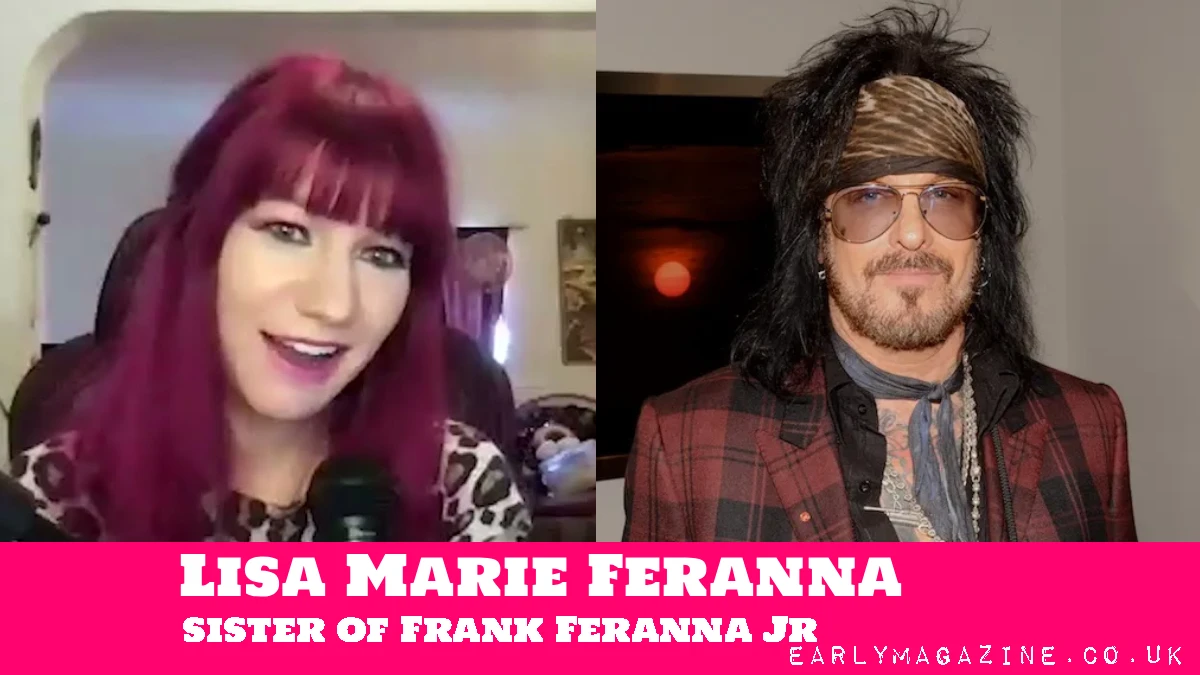
Lisa Marie Feranna was born November 12, 1960, in San Jose, California. She was the biological sister of Mötley Crüe bassist Nikki Sixx and lived with Down syndrome, blindness, and severe hearing loss. She passed away January 28, 2000, at age 39.
Who Was Lisa Marie Feranna?
Lisa Marie Feranna lived a life most people never heard about. Born on November 12, 1960, in San Jose, California, she was the biological sister of Frank Feranna Jr., who later became Nikki Sixx of Mötley Crüe. While her brother’s name became synonymous with rock stardom, Lisa spent most of her life in institutional care facilities, separated from her family and the public eye.
She was born with Down syndrome and faced additional challenges including blindness and being approximately 90% deaf. These conditions required extensive care throughout her life. Unlike her famous brother, Lisa never experienced the spotlight. Her existence remained largely private until Nikki Sixx began discussing his family history publicly decades later.
Lisa died on January 28, 2000, at age 39 in San Jose. Her passing occurred the same year her brother was forming his side project band Sixx:A.M. The two siblings never developed a meaningful relationship during her lifetime. This fact would later become a source of significant regret for the rock musician.
Early Life and Family Background
The Feranna Family in 1960s San Jose
The Feranna household in early 1960s San Jose was marked by instability. Lisa’s parents were Frank Carlton Serafino Feranna Sr., a man of Italian descent from Prato, Tuscany, and Deanna Richards (later Deanna Feranna). Her father was the first in his immigrant family to be born in America and to graduate high school. Her mother, described by Nikki Sixx as “wild,” had given birth to her brother Frank Jr. in 1958 at age 17.
When Lisa was born in 1960, Nikki Sixx was only two years old. The family struggled financially and emotionally. According to Nikki Sixx’s 2021 memoir “The First 21,” doctors advised the parents not to bring Lisa home from the hospital. Despite this recommendation, Frank Sr. and Deanna decided to bring their daughter home and care for her themselves.
Lisa lived with the family in San Jose for approximately 11 months. During this time, the household faced mounting pressure. The demands of caring for an infant with significant medical needs strained an already fragile family structure. This period would prove pivotal for everyone involved.
Lisa’s Birth and Initial Care
When Lisa was born in November 1960, medical professionals immediately identified Down syndrome. The diagnosis came with additional complications. She was blind and had severe hearing loss, conditions that frequently accompany Down syndrome but made her care needs substantially more complex.
In 1960, physicians routinely advised parents to institutionalize children born with Down syndrome. The medical establishment viewed these children as unable to learn, walk, talk, or contribute to family life. Parents who refused this advice took their children home without support services, educational resources, or community programs. The infrastructure we associate with special needs care today simply did not exist.
The Feranna parents initially resisted medical advice and brought Lisa home. However, after 11 months, Lisa was sent to an institutional facility. This decision coincided with Frank Sr. leaving the family, though family members have never confirmed whether Lisa’s institutionalization directly caused his departure. Nikki Sixx has stated his father opposed sending Lisa away, suggesting this disagreement may have contributed to the family’s collapse.
Living with Down Syndrome in the 1960s
Medical Understanding at the Time
The early 1960s represented one of the darkest periods for people with Down syndrome in the United States. In 1960, the same year Lisa was born, parent advocate Kay McGee founded the National Association for Down Syndrome after doctors told her to institutionalize her daughter Tricia. McGee was told her child would never walk or talk. This was standard medical guidance at the time.
Life expectancy for people with Down syndrome in institutional settings was drastically shortened. By the 1980s, the average lifespan was only 28 years. Children in institutions died young not because of Down syndrome itself, but due to neglect, lack of medical care, and abuse. Doctors routinely refused to perform lifesaving heart surgeries on children with Down syndrome until 1984. Some physicians classified feeding babies with Down syndrome as a “lifesaving procedure” and withheld food, effectively starving them to death.
The term “Down syndrome” itself was not widely adopted until the late 1960s and early 1970s. Before then, the condition was called “Mongolism,” a term rooted in racist pseudoscience. Medical professionals used dehumanizing language including “imbecile,” “moron,” and “retarded” to categorize people with intellectual disabilities.
Institutionalization Practices
Between 1946 and 1967, the number of people institutionalized in America nearly doubled, from 117,000 to over 193,000. Children admitted to state facilities were increasingly younger and had more pronounced disabilities. Many babies with Down syndrome were institutionalized immediately after birth. In some documented cases, doctors and fathers conspired to tell mothers their babies had died when they were actually placed in institutions.
Conditions inside these facilities were horrific. The 1969 Cardiff Ely hospital report in Britain found “cases of bad management, poor nurses and callousness.” In the United States, investigations at Willowbrook State School in New York revealed over 6,000 people housed in a building designed for 4,000, with no plumbing and severe understaffing. Residents were used in medical experiments, including being deliberately infected with Hepatitis A for vaccine research.
Lisa Marie Feranna entered this system as an infant. The specific facility where she lived remains undocumented in public records, but she spent most of her life in institutional care. The system that was supposed to provide for her safety and development instead likely deprived her of education, proper medical attention, and human dignity.
| Era | Avg. Life Expectancy | Common Practice | Legal Status |
|---|---|---|---|
| 1960s | 10-15 years | Institutionalization at birth | No education rights |
| 1980s | 28 years | Deinstitutionalization begins | IDEA passed (1975) |
| 2000s | 47-55 years | Community integration | ADA protections |
| 2020s | 60+ years | Inclusive education | Full civil rights |
A Life Apart from Her Famous Brother
While Nikki Sixx was building a music career in Los Angeles during the 1970s and 1980s, his sister Lisa remained in institutional care. The two had no relationship. Nikki Sixx has stated he has no memory of ever seeing Lisa during her lifetime, despite being two years old when she lived at home for those initial 11 months.
As Nikki Sixx formed Sister, then London, and finally Mötley Crüe in 1981, Lisa’s life continued in obscurity. She lived through the same decades that saw the disability rights movement gain momentum, the passage of the Individuals with Disabilities Education Act in 1975, and the Americans with Disabilities Act in 1990. Whether these legal protections improved her quality of life remains unknown.
Family members reportedly told Nikki Sixx he could not visit Lisa because it would “upset her.” This guidance kept the siblings separated throughout their lives. Lisa remained physically close to her birthplace in San Jose while her brother traveled the world as a rock star. The geographical proximity made the emotional distance more striking.
Public records about Lisa are minimal. She appears in genealogical databases like FamilySearch and Find A Grave, which confirm her birth date, death date, and family connections. Beyond these basic facts, details about her daily life, her personality, her relationships with caregivers, or her own thoughts and feelings remain absent from the historical record.
Nikki Sixx’s Discovery and Reflections
Learning About Lisa Later in Life
Nikki Sixx first attended Lisa’s funeral in 2000. This was reportedly the first time he saw his sister. She was 39 years old when she died. The bassist was 41. They had lived parallel lives for nearly four decades without connecting.
Years later, while researching his 2021 memoir “The First 21: How I Became Nikki Sixx,” Nikki Sixx began uncovering family history he had not known. He learned his father had opposed sending Lisa to an institution. He discovered his father left the family around the time Lisa was placed in care. He also realized much of what his mother had told him about his father was inaccurate.
In 2011, while working on his photo book “This Is Gonna Hurt,” Nikki Sixx had an unexpected realization. He looked around his photo studio at the props he had collected: wheelchairs, children’s leg braces, 1800s medical equipment, child mannequins. He suddenly understood his unconscious artistic choices were connected to Lisa. “Oh my God, this is all about her,” he told Express.com. His sister’s existence had shaped his creative work even though he never knew her.
Regrets and Understanding
In a 2021 Yahoo Entertainment interview, Nikki Sixx expressed regret about never seeing Lisa. “I have a lot of regrets around that,” he said. “But I realized I got a lot of wrong information.” He explained that family members had told him visiting would upset Lisa, guidance he followed without questioning.
As he researched his family history, Nikki Sixx developed empathy for his parents’ impossible situation. His mother was 19 years old when Lisa was born, already struggling to care for a two-year-old. She faced a medical establishment that provided no support and insisted her daughter should be institutionalized. His father opposed the decision but lacked the resources or social power to prevent it.
“I didn’t want to write a book and slay my parents, bring out the guillotines,” Nikki Sixx told Fox News in 2022. “But I wanted to look at the situation from a helicopter view.” He acknowledged his mother “did the best she could” given her age and circumstances. He also recognized his father may have left because of Lisa’s institutionalization, not because he was a “bad guy” as his mother had claimed.
For Nikki Sixx, understanding Lisa’s story became part of his sobriety journey. He achieved lasting sobriety in 2004, and the clarity that came with it allowed him to ask harder questions about his family. “You might think that when you get clean, life swells up into a big bowl of cherries, but the opposite happens,” he wrote. “You start to hurt and ask the hard questions.”
Lisa’s Death and Legacy
Lisa Marie Feranna died on January 28, 2000, in San Jose. She was 39 years old, which was above the average life expectancy for people with Down syndrome who had been institutionalized during her era. The specific cause of death has not been made public. She is buried in San Jose, with a memorial listed on Find A Grave (Memorial ID 247188446).
Her death received no media coverage at the time. She was not famous, and her connection to Nikki Sixx was not publicly known. Only close family members marked her passing. For most people, her death went entirely unnoticed.
Lisa’s legacy exists in small ways. She appears in genealogical records that preserve family histories. She is remembered in Nikki Sixx’s memoir and interviews as part of his family story. Her existence reminds readers that behind every famous person are family members whose lives took different paths, some marked by hardship and obscurity.
More broadly, Lisa represents the countless people with disabilities who lived during an era of institutionalization and neglect. Her story illustrates what society lost when it chose to hide people with Down syndrome rather than support them. The fact that she and her brother never knew each other speaks to the devastating impact of policies that separated families and denied people with disabilities the chance to be part of their communities.
Today, life expectancy for people with Down syndrome averages 60 years. Most attend school, live with families or in community settings, and participate in public life. These improvements came too late for Lisa, but her story helps explain why advocacy and legal protections matter. She lived in the gap between an old system that warehoused people and a new one that recognizes their humanity.
Frequently Asked Questions
Who was Lisa Marie Feranna?
Lisa Marie Feranna was Nikki Sixx’s biological sister, born November 12, 1960, with Down syndrome. She lived most of her life in institutional care.
When did Lisa Marie Feranna die?
Lisa died on January 28, 2000, at age 39 in San Jose, California. She is buried there.
Did Nikki Sixx know his sister Lisa?
No. Nikki Sixx first saw Lisa at her funeral in 2000. They never met during her lifetime.
What condition did Lisa Marie Feranna have?
Lisa was born with Down syndrome and was blind and approximately 90% deaf, requiring extensive lifelong care.
Why was Lisa Feranna institutionalized?
In the 1960s, doctors routinely advised parents to institutionalize children with Down syndrome. Lisa was sent to a facility after 11 months at home.
Thanks for reading. For more news, visit Early Magazine today!
