

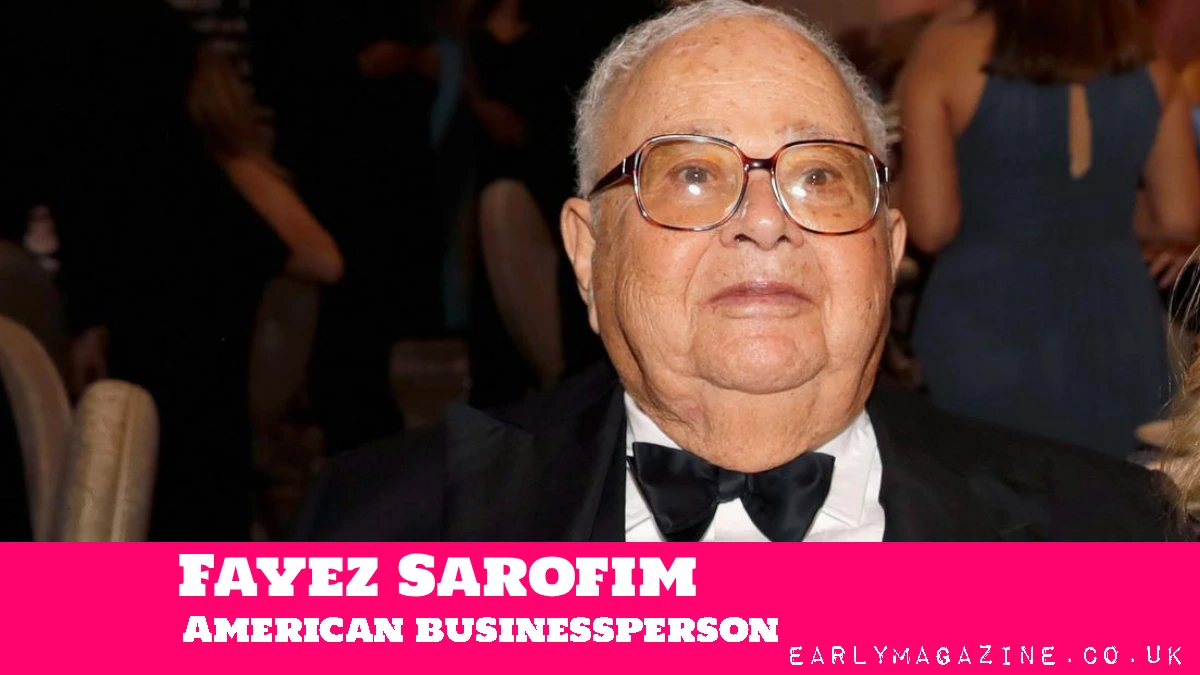









Fayez Sarofim net worth was estimated at $1.6 billion by Forbes at the time of his death in May 2022. However, a record-breaking $7 billion IRS estate tax payment in February 2023 — the largest in U.S. history — suggests his true fortune exceeded $20 billion, making him secretly one of the wealthiest people in Texas.
For decades, Fayez Sarofim lived in plain sight as a “mere” billionaire. Forbes put his Fayez Sarofim net worth at around $1.5 to $2 billion. He wore bow ties, gave few interviews, and quietly ran one of Houston’s most respected investment firms. Nobody guessed the full truth. Then in February 2023, a single IRS payment changed everything — and the financial world took notice.
That payment was $7 billion. One estate tax bill. Paid in a single day. It shattered the previous record by a factor of seven, and it pointed straight back to a Houston investor who had died just months before. The story of how much Sarofim was really worth is one of the most remarkable wealth revelations in modern American finance.
This article covers Sarofim’s confirmed net worth, how it was concealed for so long, his investment philosophy, the IRS bombshell that reframed his legacy, and what his life tells you about building and protecting real wealth.
Who Was Fayez Sarofim?
Fayez Shalaby Sarofim was born on November 19, 1928, in Cairo, Egypt, into a family of Egyptian nobility. His father was an agricultural magnate who held the title of Bey and owned large cotton estates across North Africa.
Sarofim came to the United States in 1946. He earned an undergraduate degree from the University of California, Berkeley, and then an MBA from Harvard Business School. After a brief stint at cotton company Anderson, Clayton & Company in Houston, he struck out on his own.
In August 1958, he founded Fayez Sarofim & Co. with a reported $100,000 in startup capital from his father. That decision — made in Houston, not New York, at a time when the investment business was dominated by East Coast firms — would define the next six decades of his life.
He died on May 28, 2022, at the age of 93, while still serving as chairman and co-chief investment officer of his firm.
Fayez Sarofim Net Worth: The Real Number
Here is where things get complicated — and fascinating.
For years, Forbes and other wealth trackers estimated Fayez Sarofim net worth at somewhere between $1.5 billion and $2.2 billion. That made him a notable Houston figure, but not a household name in billionaire circles.
Then came February 28, 2023. On that single ordinary day, the U.S. Treasury received a $7 billion estate-and-gift-tax payment. It was the largest such payment in the history of the IRS. The previous record, set in January 2017, was just over $1 billion.
Yale University Budget Institute researcher John Ricco, who was analyzing Treasury data for a separate study, spotted the anomaly. He described it as follows: “This was the biggest one by a factor of seven.”
Journalist Tim Fernholz of Sherwood News investigated for months. An anonymous tipster eventually called him on a burner phone and identified the source: Fayez Sarofim.
The math is straightforward. With an estate tax rate of 40% on taxable estates above $12.92 million, a $7 billion payment implies a taxable estate of roughly $17.5 billion. Tax professionals told Fox Business that the total estate was likely worth more than $20 billion. That would have made Sarofim the fourth-richest person in Texas and roughly the 80th-richest person in the world — a ranking he never held publicly.
Sarofim’s family has declined to confirm or deny the report.
Wealth Estimates Across the Years
| Year | Estimated Net Worth | Source |
|---|---|---|
| 2013 | $1.4 – $2 billion | Forbes, Arab America |
| 2022 | $1.6 billion | Forbes (at time of death) |
| 2022 | $20+ billion | Anonymous tipster, IRS data |
| 2024 | $20 billion | Celebrity Net Worth (revised) |
Why Did No One Know?
The gap between $2 billion and $20 billion is enormous. How did it stay hidden?
Private Investments Stay Private
Sarofim built his wealth through private investment vehicles, not publicly traded companies. When you own shares of Apple or Tesla, your stake appears in regulatory filings. When you manage private funds and hold assets through trusts and private entities, the paper trail is far thinner.
His firm, Fayez Sarofim & Co., managed approximately $26.7 billion in client assets as of December 31, 2024 — but most of that was other people’s money. The firm’s own structure, and Sarofim’s personal holdings within it, were largely opaque to outside trackers.
He May Have Inherited More Than Anyone Realized
Sherwood News reported that part of Sarofim’s hidden wealth may trace back to inheritance from his father’s Egyptian landholding empire. Overseas assets are notoriously difficult to track. Forbes and similar lists tend to count only verifiable, publicly-accessible wealth.
He Simply Did Not Want Attention
Sarofim earned the nickname “The Sphinx” — a nod to his Egyptian background and his legendary patience. He gave almost no interviews. He did not court press coverage. In a 2013 Barron’s profile, one of the rare times he spoke publicly, he said: “Retirement is not in my vocabulary.” That was about as much as the public ever got from him.
Byron Wien, then vice chairman of Blackstone Advisory Partners, once said of Sarofim: “Here’s an Egyptian who came here with nothing and made a fortune in Houston. He’s a warm and wonderful person.”
How Sarofim Built His Fortune
The Buy-and-Hold Philosophy
Sarofim’s investment approach was simple and disciplined. He bought high-quality, blue-chip companies and held them for years — sometimes decades. His firm’s flagship BNY Mellon Appreciation Fund had an annual portfolio turnover ratio of just 4%, one of the lowest in the industry.
His core holdings included names like Coca-Cola, Philip Morris, Procter & Gamble, and ExxonMobil. In later years, he added technology giants like Microsoft, Apple, and Amazon.
This is sometimes called a Buffett-style approach. Buy great companies. Wait. Do not panic. Sarofim executed it over 60 years without blinking through recessions, crashes, and market panics.
Institutional Trust Built Over Decades
One of his earliest clients was the Rice University endowment. Rice was still a client of Fayez Sarofim & Co. at the time of his death — a relationship stretching more than 60 years. That kind of institutional loyalty tells you something about how he managed money.
He made the same investments for himself as he made for his clients. That alignment of interests is rare and powerful.
Ownership Stakes and Alternative Assets
Beyond his investment firm, Sarofim held a minority ownership stake in the NFL’s Houston Texans. The franchise was purchased in 1999 (as part of an expansion group) for $700 million. By 2022, the team’s value had grown to more than $5 billion.
He also built a private art collection over 60 years. When part of it was exhibited at the Houston Museum of Fine Arts, the museum described it as a “rarity” for its “scope, scale, and quality.” The collection included works by Picasso, Mary Cassatt, Winslow Homer, Andy Warhol, Edward Hopper, and El Greco.
The $7 Billion IRS Mystery: What It Tells Us
The estate tax story is not just a curiosity. It carries real weight.
Most ultra-wealthy estates use trusts, charitable foundations, and sophisticated legal structures to minimize or entirely avoid estate taxes. The anonymous source told Sherwood News that Sarofim chose not to do that — out of gratitude for what the United States had given him as an immigrant.
Tax professionals note that a $7 billion voluntary payment, without aggressive avoidance strategies, is almost unheard of. Karla Dennis, an enrolled agent and CEO of accounting firm KDA, told Fox Business that a payment of that size implies an estate worth more than $17.5 billion.
This is not confirmed. Sarofim’s family has stayed silent. The IRS cannot legally disclose the source. But the data — the timing, the Texas origin, the scale, the 2022 death — all point in one direction.
Philanthropy: Where the Money Also Went
During his lifetime, Sarofim gave away substantial sums.
He donated $70 million to the Museum of Fine Arts Houston, and $25 million to build a health research center at the University of Texas. He funded the 2,600-seat Sarofim Hall at the Hobby Center for the Performing Arts in Houston, designed for touring Broadway productions.
After his death, his estate contributed more than $400 million to various charities, according to tax filings for his foundation. Beneficiaries included the Houston Ballet, Houston Grand Opera, Texas Children’s Hospital, and the Memorial Sloan-Kettering Cancer Center.
Frequently Asked Questions
What was Fayez Sarofim net worth at the time of his death?
Forbes estimated it at $1.6 billion. A $7 billion IRS estate tax payment in 2023, linked to his estate by anonymous sources and IRS data, suggests his true net worth exceeded $20 billion.
Why was Fayez Sarofim’s real wealth hidden from Forbes?
His wealth was held mostly through private investment vehicles, not publicly traded assets. These are extremely difficult for outside trackers to value or even identify.
What is Fayez Sarofim & Co. worth today?
The firm managed approximately $26.7 billion in client assets as of December 31, 2024. It remains privately held and is now led by his son, Christopher Sarofim.
Who paid the $7 billion IRS estate tax?
The payment has not been officially confirmed. Anonymous sources identified Fayez Sarofim as the payer, and IRS data points to a Texas-based estate. His family has declined to comment.
What was Fayez Sarofim’s investment strategy?
He focused on blue-chip, large-cap equities with a long-term buy-and-hold approach, rarely selling. His portfolio turnover ratio was as low as 4% per year, far below industry averages.
Legacy: A Different Kind of Billionaire
Fayez Sarofim was not the kind of billionaire who shows up at Davos or throws fundraisers for visibility. He built his fortune the way he invested: quietly, patiently, and with discipline few people can replicate.
What makes his story stand out is not just the size of the number — though $20 billion is extraordinary. It is the gap between what the world knew and what was real. For 60 years, one of the wealthiest people in America operated in near-total financial privacy. He ran Houston’s cultural institutions with his checkbook, held stakes in NFL franchises and fine art, and managed $30 billion in client assets, all while Forbes and similar trackers estimated him at roughly one-tenth of his actual worth.
The lesson for anyone interested in wealth, investing, or the mechanics of financial privacy is clear. Real wealth does not always announce itself. The patient, disciplined, private builders often accumulate more than anyone tracks — and sometimes the full picture only emerges when the IRS cashes a very unusual check.
For more insights into how the world’s most private billionaires built their fortunes away from the spotlight, visit EarlyMagazine UK — where untold wealth stories and financial wisdom come together.
