

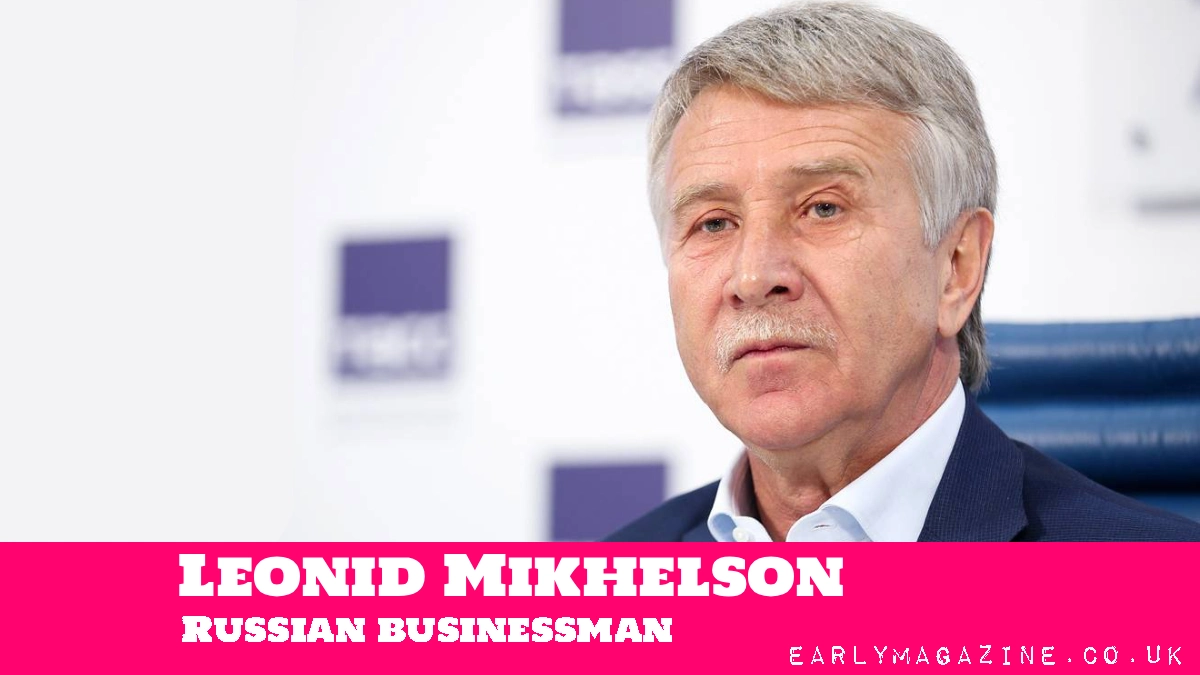

Leonid Mikhelson net worth is estimated at $29.5 billion as of 2025, according to both Bloomberg Billionaires Index and Forbes. He is the second-richest person in Russia and ranks 64th globally. His wealth comes primarily from a 25% stake in Novatek, Russia’s largest independent gas producer, and a 30.6% stake in petrochemical giant Sibur.
Who Is Leonid Mikhelson?
If you follow the money in Russia’s energy sector, one name keeps coming up: Leonid Mikhelson. His Leonid Mikhelson net worth of $29.5 billion places him among the top 70 wealthiest people on Earth, and at the very top of Russia’s billionaire class. He built that fortune not from inheritance or political handouts alone, but from three decades of grinding, deal-making work in natural gas and petrochemicals.
Mikhelson was born on August 11, 1955, in Kaspiysk, a small coastal city on the Caspian Sea. He graduated in 1977 from the Kuibyshev Civil Engineering Institute with a degree in industrial civil engineering. From there, he went straight to work as a foreman in Siberia, laying the pipes that would one day make him one of the world’s richest men. His early career was hands-on, literal trench work on major Soviet gas pipelines, including the Urengoi-Chelyabinsk line.
This article covers his current net worth, how he built it, what threatens it, and how he compares to other Russian billionaires.
Leonid Mikhelson Net Worth in 2025
As of 2025, both Bloomberg and Forbes peg Leonid Mikhelson net worth at $29.5 billion. That makes him the second-richest person in Russia and the 64th-richest person in the world. His wealth has fluctuated significantly over the years, shaped by oil prices, sanctions, and geopolitical upheaval.
Here is a snapshot of how his fortune has tracked over time:
| Year | Estimated Net Worth | Source |
|---|---|---|
| 2019 | ~$18 billion | Forbes |
| 2021 | $24.9 billion | Forbes |
| 2022 | ~$14 billion (post-war drop) | Forbes |
| 2023 | $21.6 billion | Forbes Annual Rating |
| 2024 | $27.4 billion | Bloomberg/Forbes |
| 2025 | $29.5 billion | Bloomberg Billionaires Index |
The dip in 2022 was sharp. Russia’s invasion of Ukraine triggered a wave of Western sanctions, and Novatek’s market valuation took a direct hit. But Mikhelson’s fortune recovered faster than most expected, partly because Novatek kept exporting gas and partly because Sibur continued operating outside the full scope of sanctions.
How Mikhelson Built His Wealth
From Pipelines to Novatek
After the Soviet Union collapsed in 1991, Mikhelson moved fast. His employer, a state pipeline construction company, was one of the first in the Samara region to undergo privatization. He obtained a stake and eventually reshaped it into what became Novatek, Russia’s largest non-state-owned natural gas producer.
Today, Novatek accounts for roughly 12% of Russia’s total gas output. Mikhelson owns approximately 25% of the publicly traded company. He holds most of that stake directly, with additional shares through two holding companies: Russia-based Optima and Levit. A further 2.3% held by his daughter Victoria is credited to him in Bloomberg’s calculations, recognizing his role as the company’s founder.
Novatek’s flagship project, Yamal LNG, is a $27 billion facility on the Arctic Yamal Peninsula. Despite being targeted by US sanctions in 2014, the project secured $12 billion in Chinese financing and has continued shipping gas to Asia and Europe via the Northern Sea Route.
Sibur: The Petrochemical Empire
Mikhelson does not just do gas. Starting in 2010, he purchased a controlling stake in Sibur, Eastern Europe’s largest petrochemical company, acquiring shares from Gazprombank. He now holds a 30.6% stake in the company, which operates 26 production sites across Russia and employs tens of thousands of people.
Sibur is a major source of his non-Novatek wealth. The company produces plastics, rubber, and chemical feedstocks. It has been less directly targeted by Western sanctions than Novatek’s Arctic LNG projects, giving Mikhelson a degree of financial insulation.
Strategic Partnership With Gennady Timchenko
Mikhelson’s closest business partner is Gennady Timchenko, another Russian billionaire with ties to the Kremlin. The two are majority shareholders in both Novatek and Sibur. Their partnership is described by analysts as a complementary relationship: Mikhelson handles the operational and industrial side, while Timchenko brings financial and political connections. In 2013, they sold 12% of Sibur to management partners, a move that helped diversify ownership without ceding control.
Sanctions, Geopolitics, and the Wealth Risk
Mikhelson’s fortune sits at the intersection of business and geopolitics, and that creates real risk.
He was named in the 2017 US Countering America’s Adversaries Through Sanctions Act (CAATSA) due to his close ties to Novatek and its relationship with Kremlin-connected partners. In 2022, the UK government sanctioned him directly in response to Russia’s invasion of Ukraine.
The bigger financial threat has come from sanctions on Novatek’s Arctic projects. The US sanctioned Arctic LNG 2 in November 2023. That project, designed to produce 19.8 million tonnes of LNG per year, was supposed to be Novatek’s next global export engine. Sanctions have complicated shipping, frozen out Western technology suppliers, and scared off most large buyers.
Novatek’s profits from Arctic LNG projects reportedly fell roughly 60% in the period through early 2026, according to industry reporting, as the company struggled to find buyers and lacked the specialized ice-class tankers needed for Arctic routes. The EU has also confirmed a ban on Russian LNG imports effective 2027, which will close off a significant market.
Despite this, Novatek has pressed ahead. The company worked with Chinese manufacturer Wison to install power modules at Arctic LNG 2, and made its first sales to Chinese terminals in late 2025. Mikhelson himself attended India Energy Week in early 2025, pitching Indian buyers on the project, signaling Novatek’s pivot toward Asian markets.
As Mikhelson told the Verona Eurasian Economic Forum: Russian LNG accounts for over 10% of global supply, and blocked European volumes “will simply go to other markets.”
Mikhelson’s Lifestyle and Personal Wealth
A fortune of $29.5 billion buys a particular kind of life.
Mikhelson lives primarily in Barvikha, the exclusive suburb outside Moscow that has been called the Beverly Hills of Russia. Reports have also linked him to a $15 million home in Miami Beach, though details remain unverified.
He owns a megayacht called Pacific, and was reportedly building a second, larger 142-meter vessel (nicknamed Project Alibaba) before sanctions complicated delivery. He flies on a Gulfstream G650 private jet, valued at roughly $70 million new, along with a G550. Both are registered in Russia.
For all his industrial power, Mikhelson’s most surprising public identity may be as an art collector and patron. He has stated that “99 percent” of his personal interest lies in Russian and contemporary art. His collection includes works by Gerhard Richter, Christopher Wool, Andy Warhol, Francis Bacon, and Claude Monet.
In 2009, he founded the V-A-C Foundation (Victoria: the Art of Being Contemporary), named after his daughter Victoria, who studied art history at NYU and London’s Courtauld Institute. The foundation promotes Russian contemporary art globally and has operated spaces in both Moscow and Venice. It is one of the most active private cultural institutions in Russia.
How Mikhelson Compares to Other Russian Billionaires
Russia’s billionaire landscape is dominated by energy wealth, and Mikhelson sits near the top of it. Here is a brief comparison:
Leonid Mikhelson ($29.5B) leads primarily through gas and petrochemicals, with Novatek and Sibur as his core assets. He ranks 2nd in Russia as of 2025.
Vladimir Potanin (Norilsk Nickel) holds roughly $27–30 billion depending on the index and competes closely for the top Russian spot.
Vagit Alekperov built his fortune through Lukoil, Russia’s largest private oil company, with a net worth in the $24–26 billion range.
Mikhelson’s position has been volatile, dropping sharply after 2022 sanctions and recovering strongly. His continued reliance on Novatek’s LNG expansion makes his wealth more sensitive to geopolitical developments than that of some peers.
FAQs About Leonid Mikhelson Net Worth
What is Leonid Mikhelson net worth in 2025?
His net worth is $29.5 billion as of 2025, according to both Bloomberg Billionaires Index and Forbes. That makes him the second-richest person in Russia.
How did Leonid Mikhelson make his money?
He built his wealth through Novatek, Russia’s largest independent gas producer, and Sibur, a major petrochemical company. Both stakes were built from the privatization era after the Soviet Union collapsed.
Is Leonid Mikhelson under sanctions?
Yes. He was named in the US CAATSA sanctions in 2017 and sanctioned directly by the UK in 2022 following Russia’s invasion of Ukraine.
Does Leonid Mikhelson own Novatek?
He owns approximately 25% of Novatek. The publicly traded company produces around 12% of Russia’s total natural gas.
What is the V-A-C Foundation?
It is a private arts foundation Mikhelson established in 2009, named after his daughter Victoria. It supports and exhibits Russian contemporary art internationally.
The Road Ahead for Mikhelson’s Fortune
Leonid Mikhelson’s story is still being written. His $29.5 billion net worth survived a punishing sanctions regime, a collapse in Novatek’s market valuation, and Russia’s growing isolation from Western financial systems. That resilience says something about both his business skill and his political positioning.
But the risks are real and growing. The EU’s 2027 LNG ban will close a major revenue channel. Arctic LNG 2 remains hamstrung by lack of ice-class tankers and buyer hesitancy. And any escalation in Western sanctions could target Sibur or Yamal LNG, which have so far remained partially shielded.
What is clear is that Mikhelson represents a specific and fascinating model of post-Soviet capitalism: an engineer who grabbed an opportunity at exactly the right moment, built it into a global energy empire, and has spent decades navigating the gap between Russian state power and international markets. Whether his fortune grows or shrinks from here depends less on his business acumen and more on decisions being made in Washington, Brussels, and Beijing. For anyone tracking the intersection of energy, geopolitics, and extreme wealth, his story is worth following closely.
For more insights into how the world’s most powerful energy titans build and protect their wealth, visit EarlyMagazine UK — where global business, billionaire finance, and boundary-breaking careers come together.
