

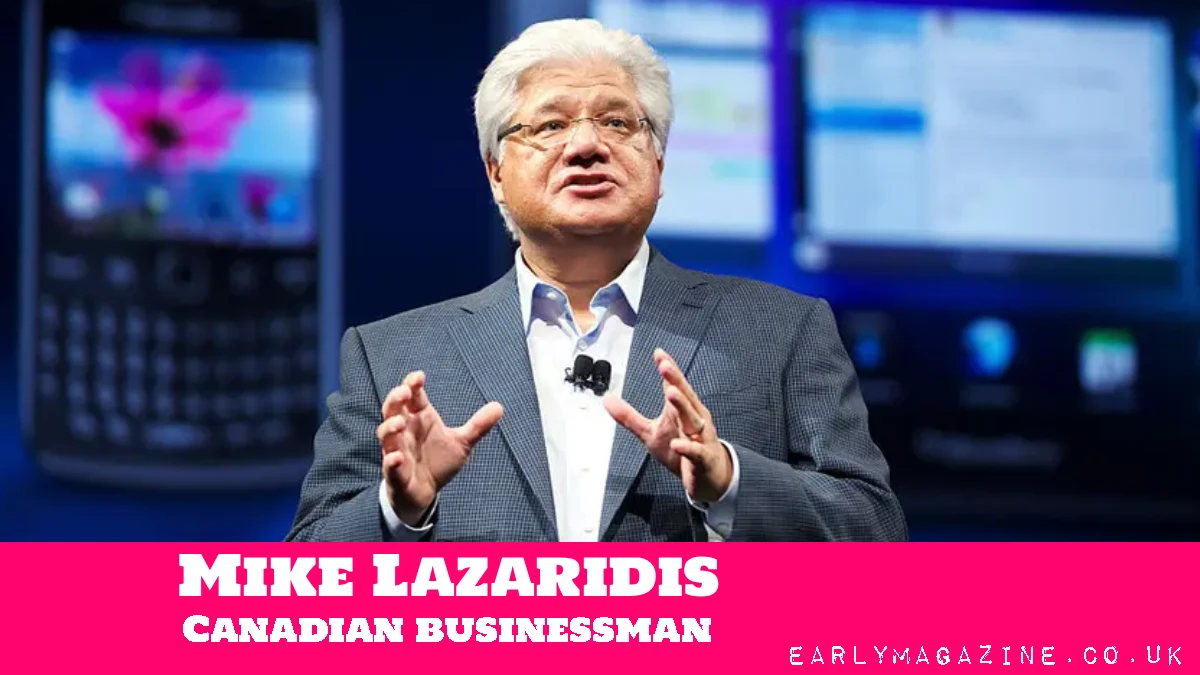
Mike Lazaridis net worth is estimated at $600 million as of 2025, down from a peak of $4 billion in 2008. The BlackBerry co-founder lost much of his fortune after Apple’s iPhone disrupted the smartphone market. He has also donated over $400 million to scientific research and philanthropy.
By a technology and finance journalist with 10+ years covering the global tech industry.
Few stories in tech history are as dramatic as Mike Lazaridis’s financial journey. The man who co-founded BlackBerry and once sat on a $4 billion fortune now has a Mike Lazaridis net worth of around $600 million. That’s still remarkable wealth, but it represents a staggering $3.4 billion decline from his peak. Understanding how that happened tells you a lot about innovation, disruption, and what one man chose to do with his remaining wealth.
Lazaridis was not just a businessman. He built the device that presidents, executives, and celebrities could not live without. At BlackBerry’s height in 2008, Research In Motion commanded an $85 billion market cap. Then came the iPhone. Then came Android. And everything changed.
This article covers how Lazaridis built his fortune, why it fell so sharply, what his current wealth looks like, how he is betting on quantum computing to build the next chapter, and the hundreds of millions he has given away to science.
How Mike Lazaridis Built His Fortune
Founding Research In Motion
Mike Lazaridis was born on March 14, 1961, in Istanbul, Turkey, to Greek parents. His family moved to Windsor, Ontario, Canada when he was five years old. By twelve, he had read every science book in the Windsor Public Library and won a prize for it. That early obsession with knowledge never left him.
In 1984, just two months before graduating from the University of Waterloo’s electrical engineering program, he left school. He had landed a contract with General Motors to develop a network control display system, and that was enough to launch Research In Motion (RIM) with his childhood friend Douglas Fregin, using $15,000 in startup capital.
RIM stayed relatively small through the late 1980s and early 1990s, building wireless data systems for businesses. The real turning point came in 1999 when the company released the BlackBerry 850, a two-way pager with email capability. Corporate America was immediately hooked.
The BlackBerry Decade
By the mid-2000s, BlackBerry had become the dominant smartphone for professionals. The device’s encrypted email, physical keyboard, and long battery life made it the go-to phone for Wall Street bankers, Washington politicians, and Fortune 500 executives. At its peak, BlackBerry held over 20% of the global smartphone market.
RIM’s stock surged. Lazaridis’s personal stake in the company ballooned. By 2008, his net worth peaked at an estimated $4 billion, making him one of Canada’s wealthiest individuals.
The iPhone and BlackBerry’s Collapse
Apple launched the iPhone in June 2007. At the time, Lazaridis famously dismissed it. The device had no physical keyboard, questionable battery life, and no enterprise security features. He believed corporations would never trust it with sensitive communications.
He was wrong.
Within three years, the iPhone had reshaped consumer expectations for what a smartphone should be. Google’s Android platform followed closely. Together, they commoditized the touchscreen phone and made BlackBerry’s once-prized features feel outdated.
RIM’s market cap cratered from $85 billion to less than $4 billion over roughly five years. Lazaridis stepped down as Co-CEO in January 2012. He left the board entirely in 2013. His personal wealth fell in lockstep with the company’s stock.
Net Worth Timeline
| Year | Estimated Net Worth | Context |
|---|---|---|
| 2008 | $4 billion | BlackBerry market peak |
| 2011 | ~$2.9 billion (CA$) | Still near peak |
| 2012 | Declining sharply | iPhone and Android dominance |
| 2015 | Estimated ~$1 billion | Post-RIM exit |
| 2025 | ~$600 million | Current estimate |
The decline is real, but it tells only part of the story. A significant portion of Lazaridis’s wealth was not destroyed by the market. He gave it away.
What Mike Lazaridis Is Worth Today
Most credible sources, including Celebrity Net Worth, place Mike Lazaridis’s current net worth at $600 million. Some estimates range higher, up to $1 billion to $2 billion, depending on how private investments and remaining assets are valued.
His wealth today comes from several sources. He retains some BlackBerry-related holdings and patent royalties. He co-founded Quantum Valley Investments in 2013 with Douglas Fregin, launching it with $100 million to fund quantum technology startups. He also owns notable personal assets, including the superyacht Artefact, a 80-metre vessel built by German shipyard Nobiskrug, widely reported to have cost over $200 million.
It’s worth noting that a major reason his fortune is lower than expected is deliberate generosity, not just market losses. By Celebrity Net Worth’s own account, Lazaridis has donated over $400 million of his personal wealth to scientific research and philanthropy.
Quantum Valley Investments and the Next Bet
Betting on Quantum Computing
After leaving BlackBerry, Lazaridis turned his focus entirely to what he believes is the next frontier of computing: quantum technology.
In March 2013, he and Fregin launched Quantum Valley Investments (QVI) from Waterloo, Ontario. The fund targets companies working on quantum physics and quantum computing breakthroughs, providing both capital and technical guidance to help early-stage research become commercially viable products.
QVI has backed companies including High Q Technologies, which develops quantum-enabled systems for drug discovery and materials science. The broader vision is to transform Waterloo into a global hub for quantum research and commercialization, a kind of Silicon Valley for the quantum era.
Quantum computing is no longer a distant concept. In 2025, major technology companies and governments around the world have invested billions into the sector. If QVI’s portfolio companies scale, Lazaridis’s wealth could increase meaningfully in the coming decade.
The Philanthropy That Defines His Legacy
$170 Million to the Perimeter Institute
In 1999, at the height of BlackBerry’s rise, Lazaridis made an extraordinary decision. He donated CA$100 million to found the Perimeter Institute for Theoretical Physics in Waterloo, Ontario. That donation represented roughly one-third of his personal fortune at the time. He followed it with an additional $50 million in 2004 and another $50 million toward a new research facility in 2008. His total donations to Perimeter now exceed $170 million, making it one of the largest private contributions to science in Canadian history.
The Perimeter Institute has since become one of the world’s leading centers for theoretical physics, drawing researchers working on quantum gravity, cosmology, particle physics, and related fields. In September 2025, during the institute’s 25th anniversary celebration, Lazaridis announced the creation of the Ray Laflamme Early Career Chair to support emerging researchers in quantum information.
Over $120 Million to the Institute for Quantum Computing
In 2002, Lazaridis and his wife Ophelia helped establish the Institute for Quantum Computing (IQC) at the University of Waterloo. Their personal donations to IQC exceed $120 million. He also helped found the Quantum-Nano Centre at the same university and donated $20 million to Wilfrid Laurier University in 2015 to create the Lazaridis Institute for the Management of Technology Enterprises.
The Lazaridis family has supported cultural institutions as well, including a major gift to the Stratford Festival for the Tom Patterson Theatre.
Across all institutions, estimates suggest Lazaridis has directed well over $400 million of his personal wealth toward research, education, and the arts.
Awards, Recognition, and Cultural Legacy
Lazaridis’s contributions have earned him rare cross-disciplinary recognition. He holds an Academy Award for developing a high-speed barcode reader used in film editing. He has received an Emmy Award for technical achievement. Canada honored him as an Officer of the Order of Canada and he has been named a Fellow of the Royal Society (FRS).
The 2023 biographical film BlackBerry, directed by Matt Johnson, brought renewed public attention to Lazaridis’s story. Canadian actor Jay Baruchel portrays him as a tech-obsessed idealist navigating corporate ruthlessness, capturing the tension between his engineering vision and the business demands that ultimately outpaced it. The film was widely praised and sparked new curiosity about his actual financial standing.
Frequently Asked Questions
What is Mike Lazaridis net worth in 2025?
His net worth is estimated at $600 million as of 2025. Some sources place the figure higher, between $800 million and $2 billion, depending on how private assets and investments are valued.
Why did Mike Lazaridis lose his billionaire status?
The collapse of BlackBerry’s stock following the rise of the iPhone and Android platforms destroyed most of his equity value. He also donated over $400 million to scientific research and philanthropy.
What does Mike Lazaridis do now?
He is the managing partner and co-founder of Quantum Valley Investments, which funds quantum computing startups. He also chairs the boards of the Perimeter Institute and the Institute for Quantum Computing.
Did Mike Lazaridis invent the smartphone?
He is widely credited as the father of the modern smartphone, having invented the BlackBerry. Celebrity Net Worth describes him in exactly those terms. Apple’s iPhone later transformed the category he created.
How much has Mike Lazaridis donated to charity?
He has donated more than $170 million to the Perimeter Institute, over $120 million to the Institute for Quantum Computing, and tens of millions more to other institutions. Total philanthropic giving exceeds $400 million.
Conclusion
Mike Lazaridis built one of the most consequential technology companies of the early 21st century, saw it collapse in real time, and made a deliberate choice about what to do next. His $600 million net worth reflects a man who has already given away more money than most people will ever see, and who is now placing a long-term bet on quantum computing rather than chasing another consumer hit.
His story is a reminder that wealth in tech is never permanent. Markets shift. Platforms change. The people who built the last era rarely lead the next one. But what Lazaridis chose to do with his fortune and his time after BlackBerry says more about his character than any stock chart. The question worth asking is not what his net worth peaked at, but what the institutions and companies he is funding today might be worth in twenty years.
For more insights into how modern tech titans build, lose, and reinvent their fortunes, visit EarlyMagazine UK, where boundary-breaking careers and financial wisdom come together.
