

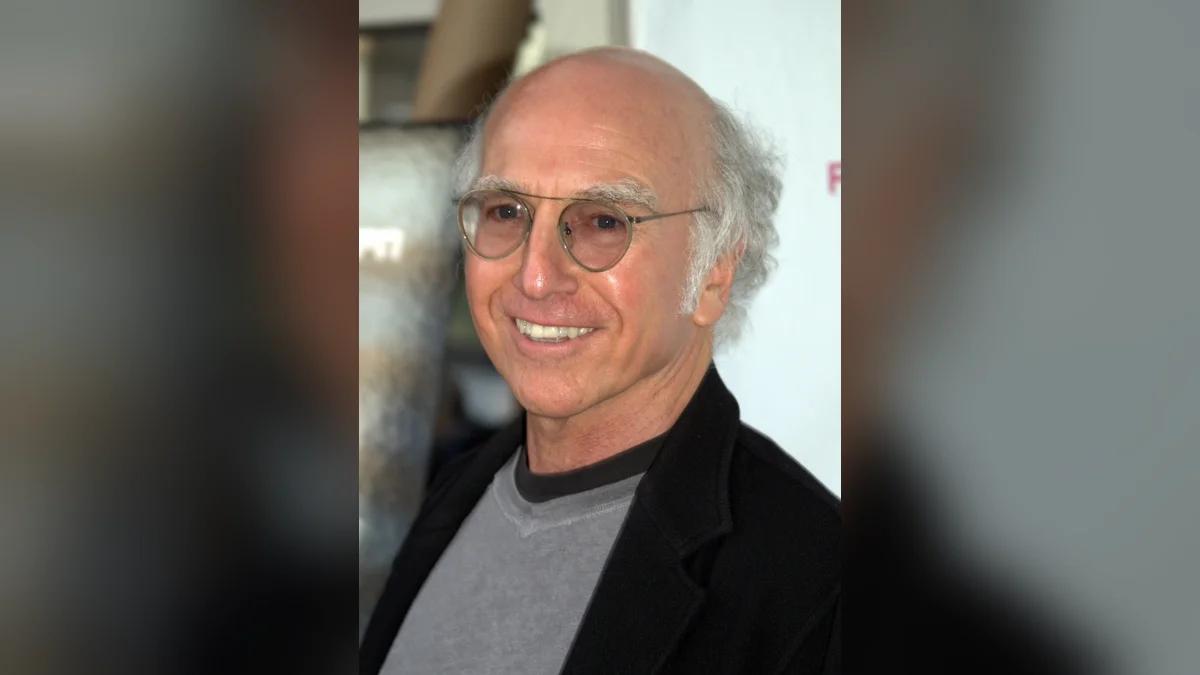
Larry David left “Seinfeld” in 1996, two years before it ended. The money never left him. Thanks to an ownership stake negotiated when the show was still an unproven idea, the co-creator who wrote George Costanza as a version of himself has earned an estimated $750 million from the sitcom — with some estimates running closer to $800 million — despite stepping away from the writers’ room three decades ago.
The Writer Behind the Show About Nothing
Larry served as co-creator, executive producer and head writer, writing or co-writing 62 of the show’s 180 episodes, including “The Contest,” which won him an Emmy for comedy writing. Jerry Seinfeld was the face of the series; Larry was its voice. As he once summarized what the show did for him: it gave him money — just not, he joked, the confidence to talk to a woman at a bar.
His writing and producing salaries were respectable. The fortune came from somewhere else entirely.
The Ownership That Changed Everything
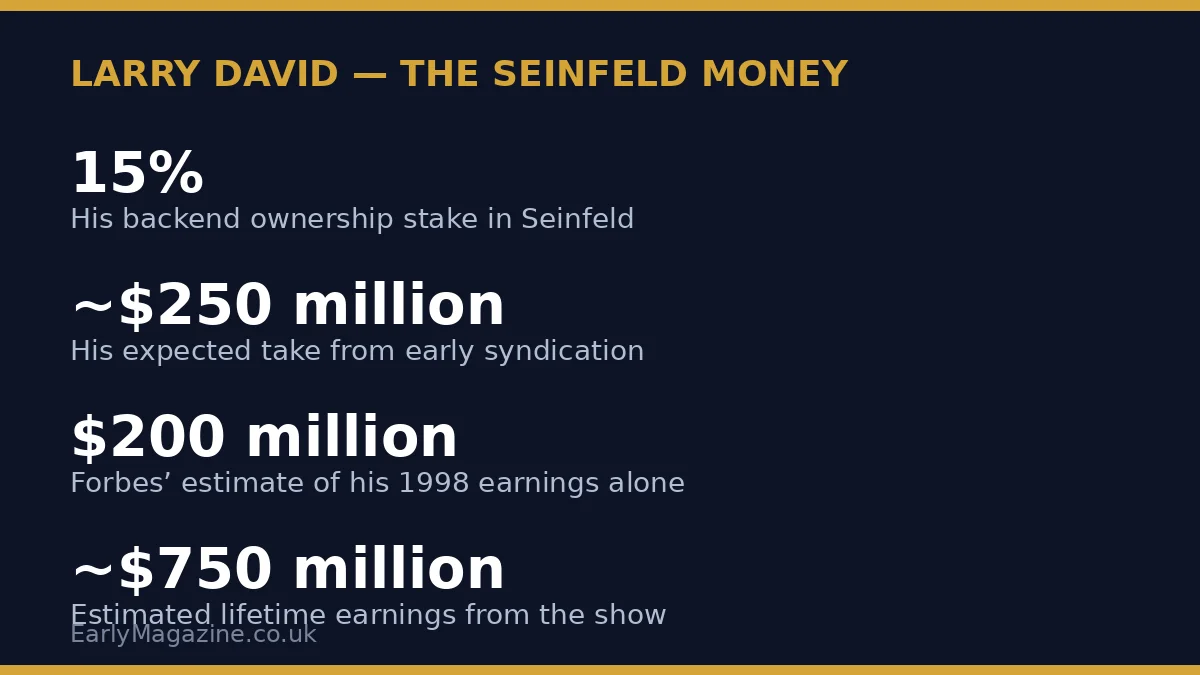
When “Seinfeld” was created, Larry and Jerry each took 7.5% of the show’s backend equity — participation in the profits whenever episodes were resold. As the series became a hit, they renegotiated upward, partly by buying out an early equity partner who preferred to cash in early. They finished with 15% each, 30% combined.
The maths of that decision is brutal in hindsight. On every $100 million of participation profits, a 7.5% stake pays $7.5 million; a 15% stake pays $15 million — and the show’s most lucrative years hadn’t happened yet. It is the precise opposite of the mistake that haunts Roseanne Barr, who signed away her share of “The Conners” and may have lost $100 million with it.
The $250 Million Payday — After He’d Already Quit
Syndication began in September 1995, while the show was still on NBC. Larry left after season seven — then watched the rerun market explode. By 1998, syndication agreements around the series were valued at roughly $1.7 billion, putting Larry and Jerry each in line for windfalls approaching $250 million.
In September 1998, Forbes ranked Jerry the world’s highest-paid entertainer at an estimated $225 million — and Larry second, at $200 million, ahead of Steven Spielberg and Oprah Winfrey. A man who no longer worked on the show had out-earned nearly everyone in entertainment, because ownership doesn’t clock out.
A $5 Billion Franchise That Keeps Reselling Itself
The library’s value kept compounding. Warner Bros. executives said reruns had generated about $2.7 billion by 2010 and more than $3 billion by 2013; including international licensing, DVDs, merchandise and streaming, cumulative business around the show has been estimated at roughly $5 billion. In strong renegotiation years, Larry’s royalty income has been estimated at $40–50 million.
Streaming added entirely new buyers. Hulu’s 2015 deal, reported at up to $180 million, implied about $27 million for Larry at 15% before fees. Netflix’s 2019 global deal — a reported $500 million-plus — was reported by TheWrap to be worth $100 million to $125 million apiece to the two creators, possibly more. In 2026 the show was renewed again: five more years on Netflix in the US and Canada, three more years of Paramount cable rights. A sitcom that ended in 1998 is still signing multi-year deals, and Larry still participates in all of them — the television equivalent of Michael Jackson’s catalog purchase, an asset that pays its owner forever.
The Divorce That Cut It in Half
So why is Larry’s personal fortune — estimated at around $400 million — so much smaller than Jerry’s $900 million, when both men earned similar sums from the same show? Larry himself has given the answer, with characteristic reluctance: his divorce.
He was married to environmental activist and producer Laurie David from 1993 to 2007 — precisely the years “Seinfeld” became a syndication juggernaut. Under California’s community property rules, Laurie received half of what they had accumulated, a division estimated at $200–300 million, reportedly including a share of future “Seinfeld” income. When an interviewer suggested in 2015 that he had made more than $500 million from the show, Larry objected and pointed to the divorce: his wife, he said, had taken half.
The irony would not be lost on a “Curb Your Enthusiasm” script. The deal of Larry David’s life — the ownership points, the syndication cycles, the streaming auctions — kept paying exactly as designed. It just pays two households now. Like John Paul DeJoria, he built his fortune on owning things outright; unlike DeJoria, he had to split the empire. Somewhere tonight, someone is watching “The Soup Nazi” for the twentieth time — and Larry David, who hasn’t run the show since 1996, is still getting paid for it.
Sources and notes: Ownership stakes, syndication values, Forbes’ 1998 rankings and streaming deal figures as reported by Forbes, Time Warner disclosures and TheWrap; divorce division estimate as widely reported; lifetime earnings estimate per Celebrity Net Worth. Participation calculations are illustrative — actual payouts depend on private contract terms and distribution fees.
