

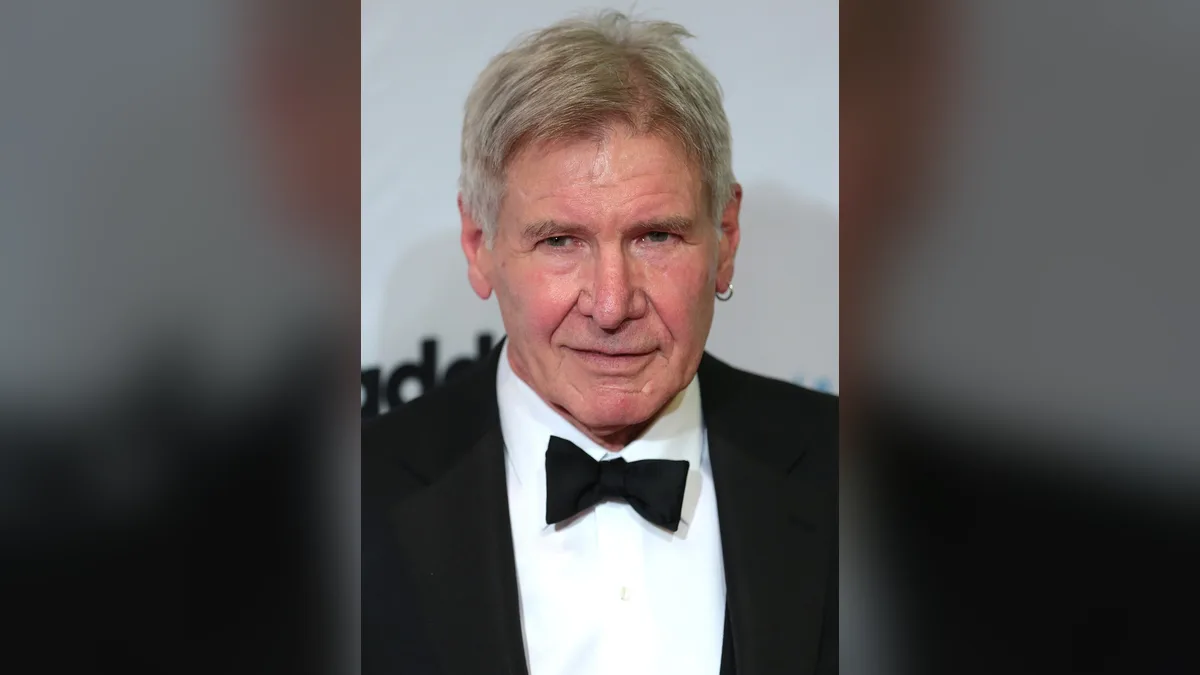
Star Wars cost about $11 million to make and went on to gross more than $775 million. Almost none of that first wave of money went to the people on the poster. The young leads of the 1977 original were paid by the week — in one case, $750 a week — while the film’s real fortunes were decided by a few percentage points negotiated, in one case almost by accident, before anyone knew what they had.
The Weekly Wages
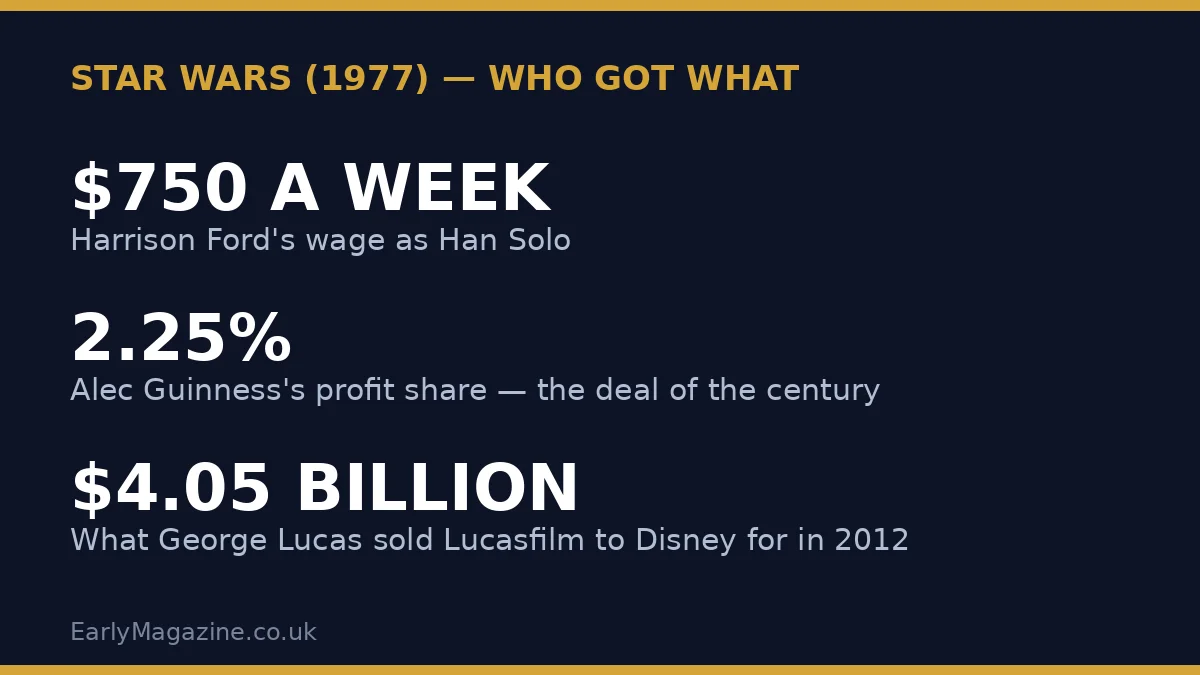
Harrison Ford (Han Solo) was paid $750 a week, roughly $10,000 in total for a role that made him the biggest movie star in the world. His life at the time was far from the fortune to come — his first wife, Mary Marquardt, had supported the family while he worked as a carpenter between acting jobs. His pay jumped to $100,000 for The Empire Strikes Back (1980) and $500,000 for Return of the Jedi (1983) — real money, but a rounding error against what the films earned.
Mark Hamill (Luke Skywalker) got $1,000 a week. Hamill later revealed that George Lucas voluntarily gave him a profit participation after the film exploded — a share he has said was worth around 30 times his salary. (The often-quoted “$650,000 salary” confuses that later profit payout with his wage.)
Carrie Fisher (Princess Leia) was paid $850 a week. Lucas also gave her a voluntary 0.25% of the profits, which TIME calculated was worth about $320,000 by 1980. But Fisher made the mistake she joked about for the rest of her life: she signed away her likeness for free, receiving no royalties from four decades of Leia merchandise.
The Knight Who Negotiated
The best deal on the call sheet belonged to the man who thought the film was beneath him. Alec Guinness (Obi-Wan Kenobi) was paid £15,000 a week — and, crucially, a profit participation that ended up at 2.25%. His agent had negotiated 2%; Lucas, in gratitude, offered an extra fraction on top. TIME reported that by 1980 Guinness had already collected $2.88 million from his points. Later estimates of his total take run far higher — figures as high as $85 million circulate — though no public accounting exists. What is certain is that the classically trained knight who described the dialogue as “ropey” earned more from Star Wars than the three young stars combined, by an enormous margin.
The Small Print
Everyone else was on flat fees. Peter Cushing (Grand Moff Tarkin) received £2,000 a day. James Earl Jones, whose voice is Darth Vader, was paid $7,000 flat for a recording session of about two and a half hours, and initially declined even a credit. David Prowse, the man inside the Vader suit, fared worst of all: he later said Lucasfilm’s statements showed Return of the Jedi had somehow made “no net profit” for participants in his position — the infamous “Hollywood accounting”. Peter Mayhew (Chewbacca) reportedly earned around $450 a week, and went back to his hospital job when filming ended.
Lucas Shared — Then Sold
TIME put the original film’s net profits at about $128 million by 1980, with Lucas’s 40% share worth roughly $51 million on paper. Unusually, Lucas redistributed points voluntarily — to Hamill, to Fisher, and deep into the crew: some received shares worth at least $64,000, and even office staff got around $6,400. Ownership, once again, was everything — the same lesson behind Britney Spears’s nine-figure catalog sale nearly five decades later. He and Steven Spielberg had also swapped 2.5% of each other’s 1977 films — Star Wars for Close Encounters of the Third Kind — a trade that paid Spielberg for decades.
The final number, of course, dwarfs all of these. In 2012 Lucas sold Lucasfilm to Disney for $4.05 billion. The cast got weekly wages, a few got points, and one elderly knight got the deal of the century. The modern heir to Lucas’s approach is Tyler Perry, who built a studio empire by owning it outright. The man who owned the galaxy got $4 billion.
Sources and notes: Salary and profit-participation figures as compiled by CNW from J.W. Rinzler’s The Making of Star Wars and TIME’s 1980 reporting. Guinness’s lifetime total and Mayhew’s weekly wage are estimates without public documentation. Lucasfilm sale price ($4.05 billion, 2012) is a matter of record.
