

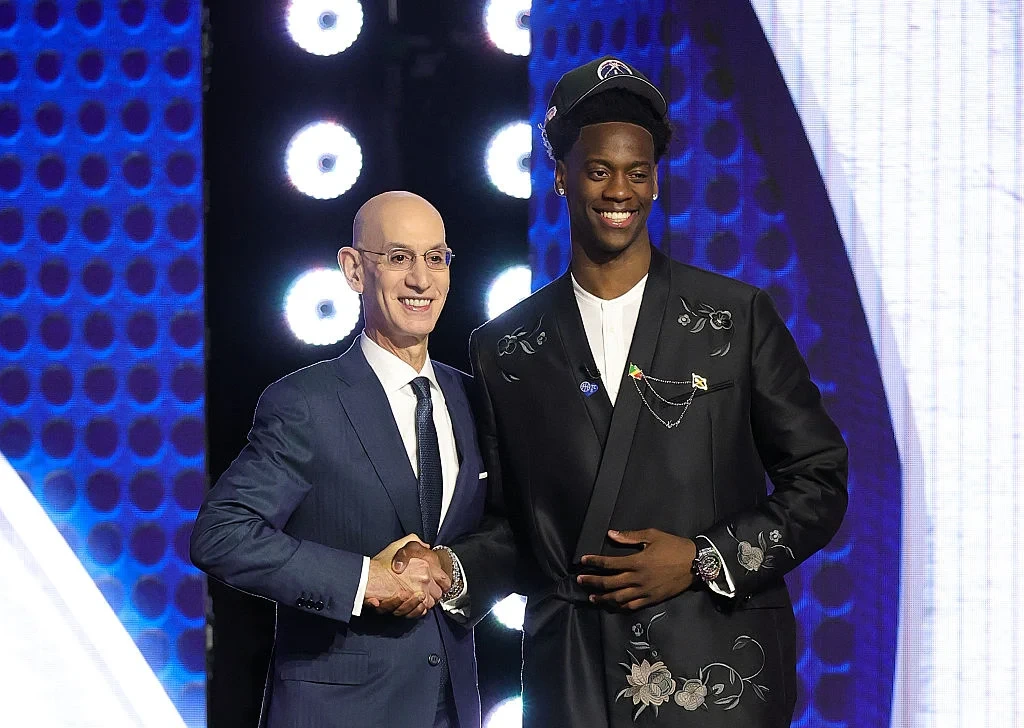
College basketball has changed forever, and AJ Dybantsa is proof of just how much.
Thanks to name, image, and likeness (NIL) deals, top college players don’t have to wait for the NBA to start cashing in. Some stars rack up six-figure paydays before they even attend their first college class. That shift hasn’t just changed life for amateur athletes — it’s also driven up the price tag on the rookies stepping into the league.
And nobody captures that better right now than Dybantsa.
From BYU Star to NBA Record-Breaker
The Washington Wizards made Dybantsa the No. 1 overall pick in the 2026 NBA Draft, pulling him straight out of BYU. It wasn’t a surprising choice — he absolutely dominated college basketball as a freshman, leading the entire nation in scoring with 25.5 points per game, while also grabbing 6.8 rebounds and dishing out 3.7 assists a night.
That kind of production made him the obvious top target, and Washington didn’t hesitate.
Dybantsa’s rookie contract is a four-year deal worth roughly $67 million, with his first-year salary landing around $14.8 million. That makes him the highest-paid incoming rookie in NBA history — edging past the previous record set all the way back in 1994, when Glenn Robinson signed a deal worth about $68 million as that year’s No. 1 pick.
Here’s the twist, though: Robinson’s contract was stretched across ten seasons. Dybantsa is earning nearly the same total money in just four years. That tells you everything about how much rookie pay has exploded.
Why Rookie Salaries Keep Climbing
So why is the top pick suddenly worth so much more than picks were getting just a few years ago?
It comes down to the NBA salary cap, which keeps rising. For the 2026–27 season, the cap is projected to hit around $165 million, a jump of about 7% from last year. Since rookie contracts are tied directly to that cap, every increase pushes first-round salaries higher too.
A big part of that growth traces back to the league’s massive 11-year, $77 billion media rights deal with NBC, ESPN/ABC, and Amazon, which kicked off with the 2025–26 season. That deal alone boosted the league’s TV money by roughly a third, and it’s set to keep climbing in the years ahead — though the NBA caps how fast the salary cap can grow each season, so there’s no risk of a sudden, wild spike.
For comparison, last year’s No. 1 pick, Cooper Flagg, signed a four-year deal worth about $62.7 million. Dybantsa’s contract topping that by several million shows just how quickly these numbers are climbing year over year.
The Other Big Names Are Cashing In Too
Dybantsa wasn’t the only rookie to land a massive payday on draft night.
This year’s draft class is being called one of the deepest in recent memory, with four prospects widely viewed as “can’t-miss” talents:
- Darryn Peterson — drafted No. 2 by the Utah Jazz
- Cameron Boozer — drafted No. 3 by the Memphis Grizzlies
- Caleb Wilson — drafted No. 4 by the Chicago Bulls
All three are locked into rookie deals worth somewhere between roughly $50 million and $62 million. That’s a historic first — it marks the first time ever that all four top picks in a single draft are guaranteed at least $50 million.
Compare that to the bottom of the first round, and the gap is massive. Koa Peat, taken with the final first-round pick, will earn a fraction of that — his deal is worth around $15 million total, with a first-year salary closer to $3 million.
How These Rookie Deals Actually Work
It’s worth understanding the structure behind these contracts, because it’s not as simple as “sign and get paid for four years no matter what.”
Every first-round rookie deal in the NBA follows the same basic blueprint:
- Two guaranteed seasons — the team is locked in to pay no matter what happens.
- Two team-option seasons — the franchise can choose to keep the player or part ways after years one and two.
Teams almost never cut a rookie loose early, especially a top pick. But it does happen occasionally if a player’s game just doesn’t translate to the NBA level.
For Dybantsa, that scenario seems unlikely. Given his scoring ability, size, and the buzz already surrounding him, both of his option years are expected to get picked up without much debate.
A Soft Landing in Washington
One thing working heavily in Dybantsa’s favor: he isn’t walking into a rebuilding situation alone.
The Wizards already have Anthony Davis anchoring the frontcourt and Trae Young running the offense — and Young isn’t going anywhere. He recently agreed to a massive $212 million extension to stay in Washington long-term.
That gives Dybantsa something most No. 1 picks don’t get: real support from Day 1. Instead of being asked to single-handedly carry a struggling franchise, he can ease into his rookie season alongside two proven veterans — and eventually chase the kind of long-term, life-changing extension Young just signed.
The Bottom Line
AJ Dybantsa’s rookie contract isn’t just a big number — it’s a sign of where the NBA is heading. Between a rapidly growing salary cap, a new media rights deal pumping billions into the league, and a draft class loaded with star power, rookie paydays are only going to get bigger from here.
For now, though, the record belongs to Dybantsa. And given the surrounding talent in Washington, he might be just getting started.
For more insights into how modern icons navigate fame and fortune, visit EarlyMagazine UK—where boundary-breaking careers and financial wisdom come together.
