

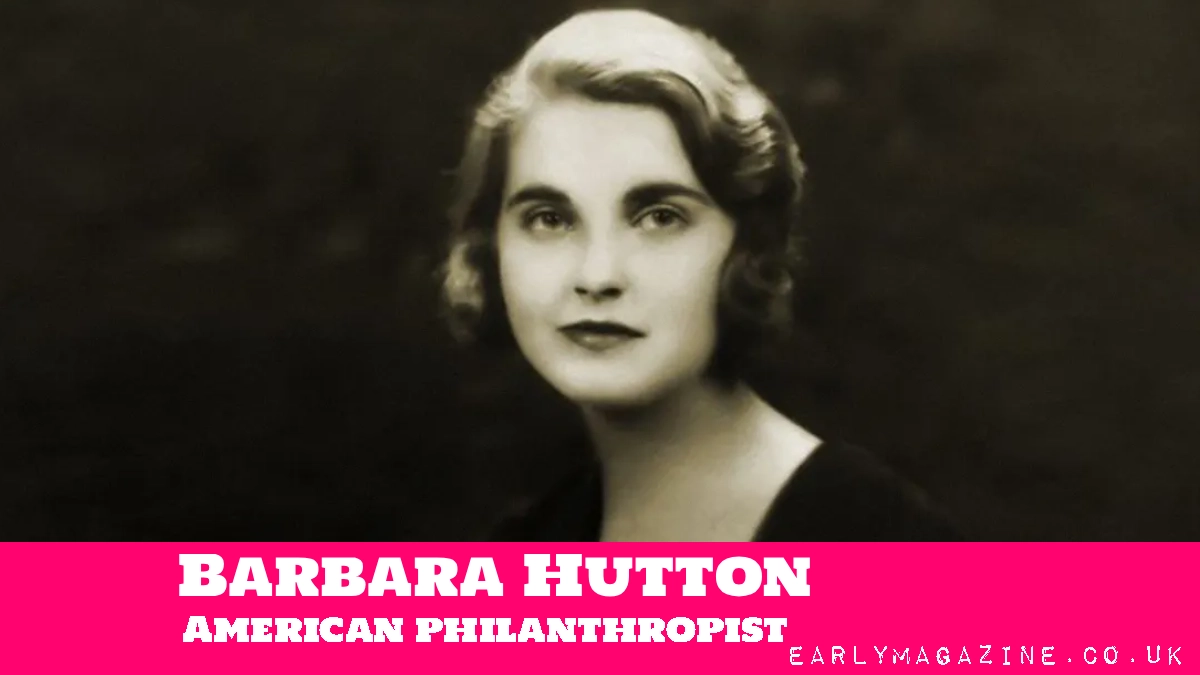











Barbara Hutton net worth peaked at roughly $900 million in today’s dollars when she inherited $50 million at age 21 in 1933. At the time of her death in 1979, she had just $3,500 left. She spent her Woolworth fortune on seven marriages, luxury real estate, fine jewelry, and lavish gifts over four decades.
The Rise and Fall of the “Poor Little Rich Girl”
Imagine inheriting nearly a billion dollars before your 22nd birthday, and dying with less money than a used car costs. That is the true story of Barbara Hutton net worth, one of the most staggering financial collapses in American history. She was born into the Woolworth retail dynasty in 1912, handed a fortune most people couldn’t dream of, and spent four decades dismantling every dollar.
Barbara Woolworth Hutton was not simply careless with money. She was a woman shaped by genuine tragedy, exploited by opportunistic husbands, and abandoned by a system that gave her unlimited cash before she had the emotional tools to handle it. Her story is the original cautionary tale about inherited wealth, and it is every bit as relevant today as it was in 1979 when she died in a Beverly Hills hotel with $3,500 to her name.
This article covers exactly how large her fortune was at its peak, where the money went, what each of her seven marriages cost her, and what her story teaches us about wealth without structure.
Where the Woolworth Fortune Came From
Barbara’s grandfather, Frank W. Woolworth, built the Woolworth five-and-dime store chain into one of the most profitable retail empires in American history. He was a self-made man who understood the value of every penny. When he died, his estate was divided among his heirs, and Barbara’s mother Edna was one of his daughters.
Edna died when Barbara was just four years old. Barbara later received her share through a trust managed by her father, Franklyn Laws Hutton, co-founder of the investment bank E.F. Hutton & Co.
By the time Barbara turned 10, her grandmother’s estate added another $26.1 million to her inheritance. That sum alone is equivalent to roughly $378 million today. Her father held it in trust and, to his credit, grew it substantially before Barbara could touch it.
The Inheritance She Received at 21
When Barbara turned 21 in 1933, the trust was released. Her fortune at that point had grown to approximately $50 million, which equals around $900 million in 2024 dollars. She was, without question, one of the wealthiest women in the world.
She also had no financial education, no business experience, and no one with her genuine best interests at heart.
Barbara Hutton Net Worth: A Timeline
| Year | Event | Estimated Net Worth (Today’s Value) |
|---|---|---|
| 1924 | Inherits from grandmother’s estate | ~$378 million |
| 1933 | Trust released at age 21 | ~$900 million (peak) |
| 1935 | Divorces first husband, Alexis Mdivani | Significantly reduced |
| 1942 | Marries Cary Grant (no prenuptial agreement) | Declining |
| 1953 | Multiple divorce settlements paid | Severely reduced |
| 1970s | Living off loans, selling jewelry | Near zero |
| 1979 | Dies in Beverly Hills hotel | $3,500 |
Seven Husbands, Seven Financial Disasters
Barbara married seven times. Each marriage came with enormous costs: elaborate weddings, lavish gifts, divorce settlements, and in several cases, husbands who spent her money as freely as she did.
The Princes Who Took the Most
Her first husband, Prince Alexis Mdivani, was a Georgian noble who married Barbara in 1933 just five months before she turned 21. He received a $1 million dowry from her father upfront. After that, he spent freely on polo ponies, clothes, jewelry, and personal extravagances until they divorced in 1935.
Her second husband was Count Kurt von Haugwitz-Reventlow, with whom she had her only child, Lance. This marriage ended in a brutal custody battle that drained both her finances and her emotional health.
She later married princes, a baron, an international playboy named Porfirio Rubirosa, and the Hollywood actor Cary Grant. The Grant marriage, her third, was the only one where financial exploitation was arguably absent. Grant had his own wealth and did not spend hers. Their pairing earned the tabloid nickname “Cash ‘n’ Cary,” but the mockery was unfair to him. They divorced in 1945.
The marriage to Rubirosa in 1953 lasted 53 days and reportedly cost Barbara $1 million in cash, jewelry, a private plane, and a polo string. He had done it before with other heiresses.
How She Spent the Rest
It was not just husbands who drained the fortune. Barbara’s lifestyle was genuinely extreme, even by the standards of the ultra-wealthy.
She owned palatial properties in London, Tangier, Palm Beach, Cuernavaca, and Pacific Palisades. Each was staffed with full household employees and maintained year-round. She collected fine art, including pieces once owned by Marie Antoinette and Empress Eugénie of France. Her jewelry collection was extraordinary. She purchased a 40-carat Pasha Diamond and had it recut to 36 carats simply to suit her preference.
She also gave money away impulsively. Writing large checks at cocktail parties, buying elaborate gifts for friends and strangers, funding causes on a whim. There was no budget, no advisor with real authority, and no structure.
By the 1970s, she was selling off jewelry and living on loans against her remaining assets. The woman who had once owned multiple palaces spent her final years in a suite at the Beverly Wilshire Hotel, largely isolated, in poor health.
Only 16 people attended her funeral.
What Financial Experts Say About Her Case
Wealth management professionals often use Barbara Hutton as a textbook example of what happens when large inheritances transfer without protective structures.
A spendthrift trust, which restricts a beneficiary’s direct access to principal while allowing a trustee to cover expenses, could have prevented the worst outcomes. Her grandfather Frank Woolworth reportedly drafted a new will that would have created such protections, but he died before signing it.
As one financial planning analysis notes, the core problem was not Barbara’s character. It was the absence of any mechanism to protect the money from both her own decisions and the decisions of those around her. Had the right trust structure been in place, her story might have been entirely different.
The Legacy She Left Behind
Barbara Hutton’s story entered popular culture through the 1987 NBC miniseries “Poor Little Rich Girl: The Barbara Hutton Story,” in which Farrah Fawcett portrayed her. The title, which she reportedly hated, had first been applied to her in 1930 when she threw a lavish debutante ball during the Great Depression, at a time when Woolworth workers were earning $18 a week.
The contradiction between her public image and private reality was stark. She was envied by millions and genuinely miserable for much of her life.
Her fortune, estimated at $900 million in modern terms, was gone by the time she was 66. She was one of history’s most dramatic examples of inherited wealth lost within a single generation.
FAQs About Barbara Hutton Net Worth
What was Barbara Hutton net worth at her peak?
At her peak in 1933, Barbara Hutton’s fortune was approximately $50 million, equal to roughly $900 million in today’s money. It came from her Woolworth inheritance and her grandmother’s estate.
How much money did Barbara Hutton have when she died?
Barbara Hutton had approximately $3,500 at the time of her death in May 1979. She had spent her entire fortune over 46 years.
Did Cary Grant take Barbara Hutton’s money?
No. Cary Grant had his own wealth and was one of the few husbands who did not financially exploit her. Their marriage lasted from 1942 to 1945.
How many times was Barbara Hutton married?
Barbara Hutton was married seven times. Her husbands included princes, a count, a baron, Cary Grant, and international playboy Porfirio Rubirosa.
Why is Barbara Hutton called the “Poor Little Rich Girl”?
The nickname was coined by the press in 1930 when she threw an extravagant debutante ball during the Great Depression. It later stuck as a reference to her troubled personal life despite immense wealth.
A Cautionary Tale Worth Remembering
Barbara Hutton’s life is not simply a story of reckless spending. It is a story of what happens when enormous wealth meets emotional vulnerability, predatory relationships, and no structural protection. She started with one of the largest personal fortunes in American history and ended with less than four thousand dollars.
The lesson is specific: money without financial literacy, legal protection, and trusted advisors can disappear faster than most people think possible. Barbara had none of those safeguards. Her grandfather built his fortune on hard discipline and steady reinvestment. Barbara had neither the tools nor the support to do the same.
If you are building wealth, inheriting it, or helping someone who will, her story makes the strongest possible case for education, structure, and trust before the money ever arrives.
For more stories on how history’s wealthiest figures built, spent, and lost their fortunes, visit EarlyMagazine UK — where remarkable lives and real financial lessons come together.
