

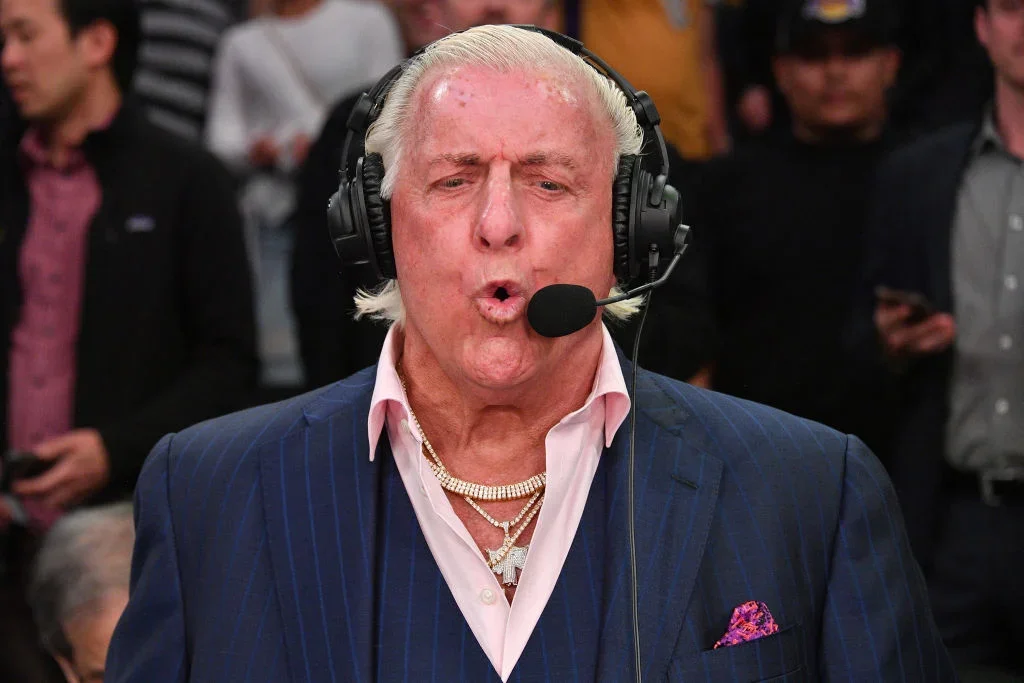
Ric Flair didn’t just wrestle for five decades. He built a brand.
The peroxide-blond hair. The sequined robes. The Rolex on his wrist. The unmistakable “Woooo!” The limousine-riding, private-jet-flying, “stylin’ and profilin'” Nature Boy persona became one of the most recognizable characters in American entertainment — inside the wrestling ring and far beyond it. Over the decades, that identity turned into a business of its own: merchandise, licensing deals, paid appearances, brand endorsements, social media influence, and an endless stream of pop-culture references.
So it’s worth sitting with this fact for a second: Flair signed away sweeping rights to that identity in 14 minutes — and without a lawyer reviewing the deal first.
Now he’s suing to get it back, and he wants at least $10 million in damages.
The Contract That Took 50 Years to Earn — and 14 Minutes to Sign
According to a lawsuit Flair filed earlier this month, digital talent agency FAM Networks emailed him a contract at 5:57 PM on December 5, 2025. By 6:11 PM, he had signed it.
Fourteen minutes.
For context, most people spend longer than that reading the terms of a new streaming subscription. Flair was reportedly agreeing to hand over control of his name, image, likeness, voice, social media accounts, and overall commercial identity — arguably the single most valuable asset he has left after a 50-year career.
His lawsuit describes the license FAM received as “irrevocable, perpetual, and sublicensable,” covering every language and every form of media, including formats that don’t exist yet. The geographic scope, according to the complaint, was listed as “throughout the universe.”
Flair says he signed without an attorney reviewing a single clause.
That single detail — a career-defining legal document, reviewed and signed in under a quarter of an hour, without legal counsel — sits at the center of this entire dispute.
Flair Claims FAM Knew He Had No Lawyer
Here’s where Flair’s legal team tries to shift the blame back onto FAM.
The lawsuit alleges the contract included language stating the agreement had been negotiated with the benefit of legal counsel. Flair says that simply wasn’t true, and that FAM knew it.
His complaint doesn’t hold back: “FAM knew he had no lawyer. FAM wrote the clause saying he did anyway.”
Rather than framing this as a case of a celebrity who didn’t read the fine print, Flair’s attorneys argue FAM actively misled him — presenting a complex legal document to someone they knew wasn’t equipped to evaluate it, falsely suggesting legal review had already happened, and giving him almost no time to think it over.
The lawsuit sums it up bluntly: FAM allegedly waited until Flair needed help managing his digital legacy, handed him paperwork he wasn’t prepared to understand, claimed he had legal representation when he didn’t, and walked away with a lifetime license to his identity.
It’s strong language. But it also raises the obvious question that’s driving most of the public conversation around this case: why did Flair sign so fast in the first place?
What FAM Allegedly Promised Flair
Flair wasn’t handing over his identity for nothing — at least, that wasn’t the plan.
According to the lawsuit, FAM pitched itself as a company that could dramatically grow Flair’s income from his online audience. A big piece of the pitch centered on his Facebook page, which had reportedly been hacked and lost its ability to earn ad revenue. FAM allegedly claimed it could restore the page and turn it into a six-figure-per-month revenue source.
The contract also reportedly promised Flair:
- 90% of revenue from speaking engagements and personal appearances booked through FAM
- 50% of revenue from collaborative content projects
- 10% of revenue from “passive content”
On paper, that’s a compelling deal. Flair may be decades past his in-ring prime, but the Nature Boy name still pulls serious commercial weight — appearance fees, merchandise sales, massive social media reach, and ongoing licensing opportunities. If FAM had delivered on its promises, this could have been a smart move for a 76-year-old icon looking to modernize his revenue streams.
The lawsuit says that’s not what happened.
Flair Says FAM Made $20,000 a Month — While He Got Almost Nothing
According to the complaint, FAM failed to deliver on nearly every promise.
“It sourced not one speaking engagement. Not one in-person appearance. Not one personal project at the ninety percent royalty tier,” the lawsuit alleges. Instead, Flair claims FAM mostly reposted content he’d already created — while quietly tightening its grip on his digital accounts.
Facebook is where things allegedly got worse. Flair’s complaint says FAM took control of the page in a way that locked his own team out of it entirely, which he claims disrupted an advertising deal his representatives were already negotiating.
Meanwhile, Flair alleges FAM was pulling in as much as $20,000 a month from that same page — while he saw very little of it. He told The Independent he believes the arrangement has already cost him more than $250,000 in lost revenue.
What Flair Is Asking the Court For
Flair isn’t just asking for unpaid royalties. His lawsuit asks a judge to:
- Rescind the contract entirely
- Return full control of his Facebook page
- Declare that FAM has no ongoing rights to his name, image, or likeness
- Order a full accounting of every dollar FAM made using his identity
Then come the damages: at least $5 million for breach of contract and another $5 million for fraudulent inducement, plus additional claims tied to New York state law, interference with business opportunities, disgorgement of FAM’s alleged profits, and attorneys’ fees.
Flair’s lawyers also flagged something they say he should have known before signing: FAM was reportedly already tangled up in a separate lawsuit involving ufologist Steven Greer at the time Flair signed his own agreement in December 2025. His attorneys claim that dispute involved similar allegations — and that FAM never mentioned it.
It’s important to note these are allegations only. FAM has not publicly responded to the lawsuit, and no court has ruled on whether fraud, breach of contract, or improper control actually occurred.
“I Built This Name” — Flair Isn’t Holding Back
Flair has been vocal about how personally he’s taking this.
“I spent more than forty years building the name Ric Flair, with my body, my blood, and everything I had,” he told The Independent, borrowing from one of his signature wrestling lines: “To be the man, you had to beat the man. FAM hasn’t beaten me.”
He says he trusted the wrong people, and that FAM overpromised while quietly taking control it never should have had.
“I built this name, I earned this name, and I’m going to fight to take it back,” Flair said.
It’s a powerful statement. But it also circles back to the same unresolved question: if that name took decades of “blood, sweat, and everything he had” to build, why hand over control of it in under 15 minutes without a lawyer in the room?
Money Troubles Aren’t New for Flair
This isn’t the first time Flair’s financial decisions have made headlines.
For years, the Nature Boy character bragged on television about Rolexes, custom suits, private jets, and five-star everything — and off-screen, Flair really did live that way. By his own admission, he spent lavishly throughout his career. Despite earning millions across one of wrestling’s longest careers, he’s faced repeated financial setbacks. Celebrity Net Worth currently puts his net worth at roughly $500,000 — a fraction of what his career earnings might suggest.
Taxes have been a recurring issue. The IRS reportedly filed a lien around $870,000 in unpaid taxes back in 2000, and the government later garnished portions of his WWE income. In 2019, filings showed he owed roughly $240,000 in federal taxes and another $40,000 to the state of Georgia.
A $1.8 Million Medical Bill
In 2017, Flair suffered a life-threatening health crisis that led to surgery, multiple organ complications, and a medically induced coma. He survived — but later said the ordeal left him with roughly $1.8 million in uninsured medical bills.
He’s said publicly that he was once around $500,000 in debt, and credited longtime rival Hulk Hogan with helping him through a rough financial stretch.
Multiple marriages, high-spending habits, tax bills, medical debt, and various business ventures help explain how one of wrestling’s biggest stars ended up with far less wealth than his decades-long career might imply.
The Bottom Line
Flair may not have held onto a massive fortune, but the Ric Flair name itself remains one of the most valuable things he has left. That’s exactly what makes this case so striking — a 50-year brand, handed over in a 14-minute email exchange, is now the subject of a multimillion-dollar legal fight.
Whatever happens in court, the case is already a cautionary tale for anyone — celebrity or not — about the risks of signing anything involving your name, image, and likeness without a lawyer reading it first.
For more insights into how legendary athletes and entertainers protect their legacy — and the legal pitfalls that come with fame — visit EarlyMagazine UK, where iconic careers and hard-earned wisdom come together.
