

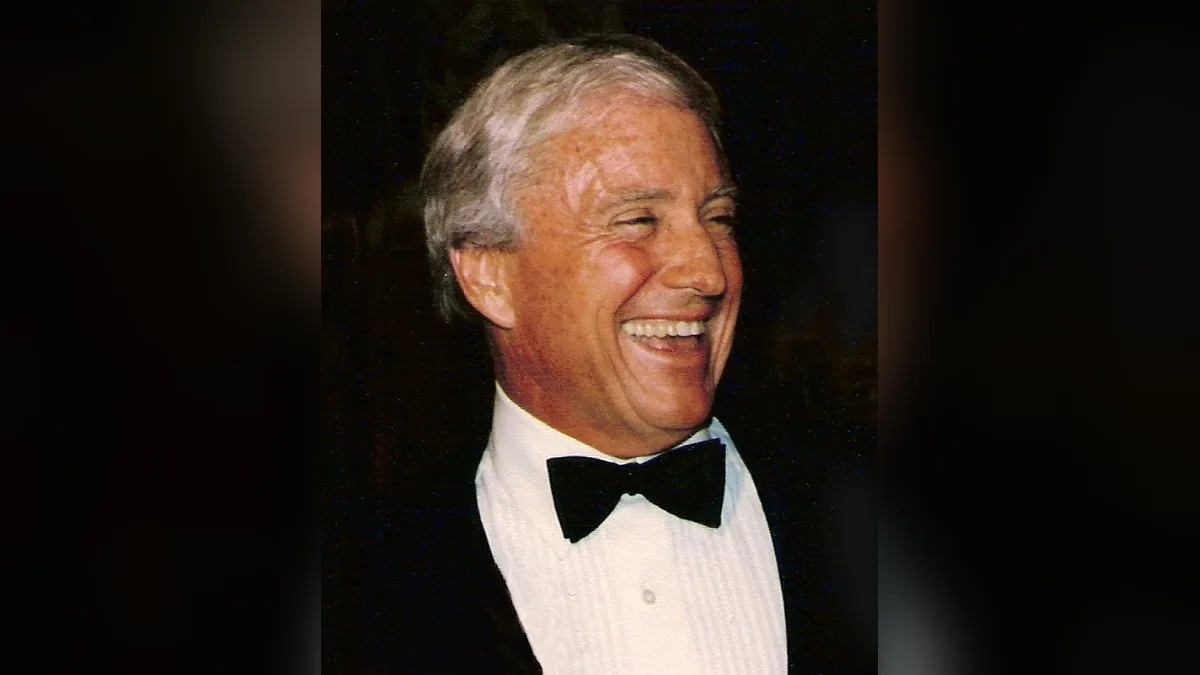
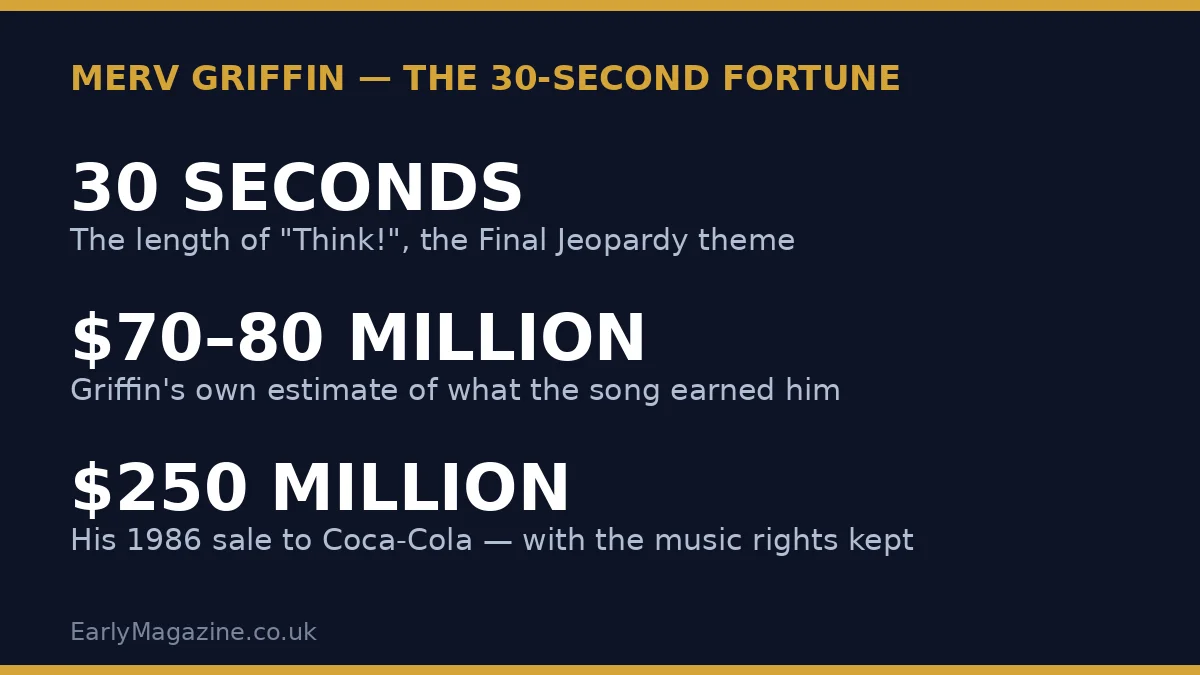
Every weekday, millions of people hum the same 30 seconds of music while three contestants scribble down an answer. That tune — the Final Jeopardy theme, officially called “Think!” — was written by Merv Griffin in 1963 as a lullaby for his five-year-old son. And because Griffin, almost alone among television moguls, kept hold of the rights to his own music, that half-minute of melody earned him somewhere in the region of $70–80 million. His estate is still collecting.
A Lullaby Called “A Time for Tony”
Griffin created Jeopardy! for NBC in 1964 — the quiz format with the answers given first was suggested by his wife, Julann — and needed music for the final round. He adapted a lullaby he had written for his son Tony, originally titled “A Time for Tony”. By Griffin’s own telling, the piece took about 30 seconds to write, roughly the length of the song itself. When the syndicated version launched with Alex Trebek in 1984, “Think!” also became the basis of the show’s main theme.
The show the song decorated became an institution: more than 9,000 episodes, dozens of Daytime Emmys and versions in some 30 countries.
The Smartest Line in the Contract
In 1986 Griffin sold Merv Griffin Enterprises — including Jeopardy! and Wheel of Fortune — to Coca-Cola for $250 million, around $770 million in today’s money. It was one of the great deals of television history. But the detail that kept paying was what he did not sell: Griffin retained ownership of “Think!” and his other game-show music.
It was television’s great ownership lesson — the same principle later applied at a far larger scale by Oprah Winfrey, who kept control of her own show. And it meant a royalty every time the theme aired — on the daily syndicated show, on network versions, on reruns, on international editions, in public performances. Game shows repeat endlessly, and Jeopardy! airs virtually every day of the year. In a 2005 interview with The New York Times, Griffin estimated the little song had earned him “probably $70–80 million” — in today’s dollars, roughly $125 million on the higher figure. Writers’ estimates of the total take for Griffin and, since his death, his estate run higher still, though no full accounting has ever been published.
The Song Outearned the Contestants
For scale: Ken Jennings, the greatest Jeopardy! champion of the modern era, won $2.5 million across his famous 74-game streak in 2004. Vanna White, Griffin’s Wheel of Fortune co-creation, has earned a reported salary of around $10 million a year for turning letters. Griffin’s 30-second lullaby outearned the streak, many times over, while he slept. Even the money chased on today’s biggest game and reality shows — the world of the Celebrity Traitors cast — is small change next to a royalty that never stops.
The Empire It Helped Build
The Coca-Cola sale, the royalties and a second act in real estate — he bought the Beverly Hilton, among other properties — left Griffin a billionaire. He died in 2007, aged 82, with a net worth estimated at about $1.3 billion. Today’s presenters — even top earners such as Maya Jama — are paid handsomely for their time; Griffin’s generation of owners were paid forever for a single asset. The theme he wrote for his little boy is still on television every day, and the cheques, now addressed to his estate, still follow it.
There may be no better ratio in entertainment history: 30 seconds of work, decades of payment — proof that in show business, the real money is rarely in performing the song. It is in owning it.
Sources and notes: Royalty estimates from Griffin’s own 2005 New York Times interview ($70–80 million), as compiled in CNW’s Merv Griffin profile; the $250 million Coca-Cola sale of Merv Griffin Enterprises (1986) is a matter of record. Later totals for the estate are estimates, not documented figures. Net worth at death (~$1.3 billion) per CNW.
