
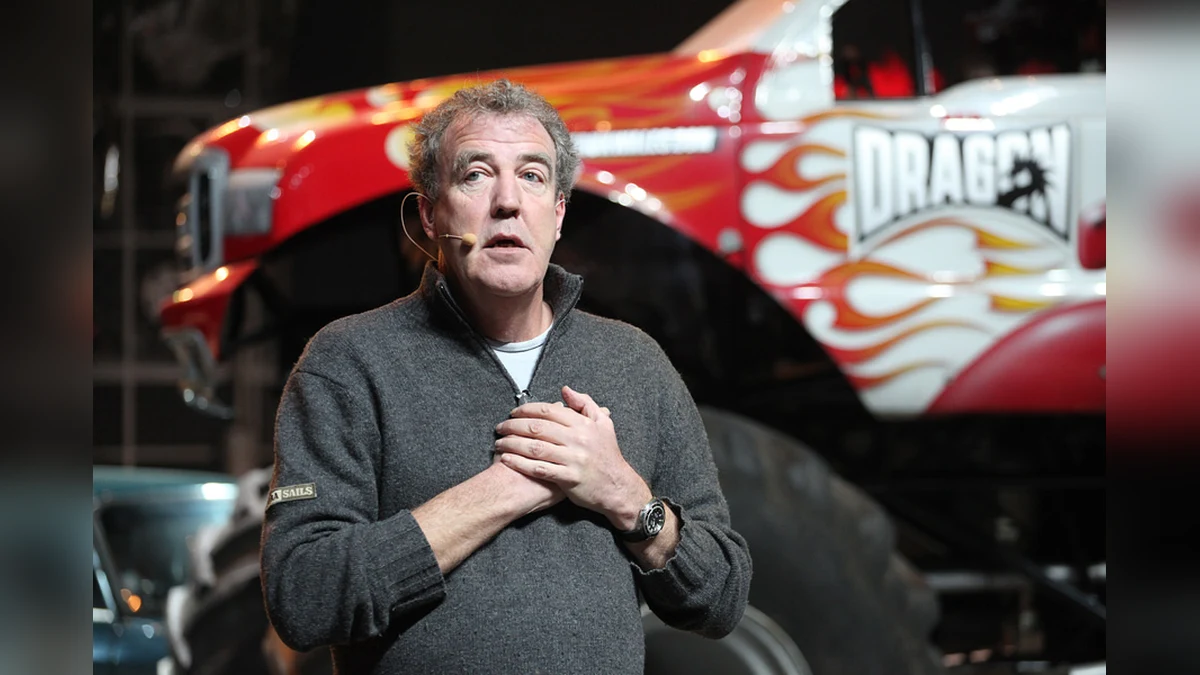
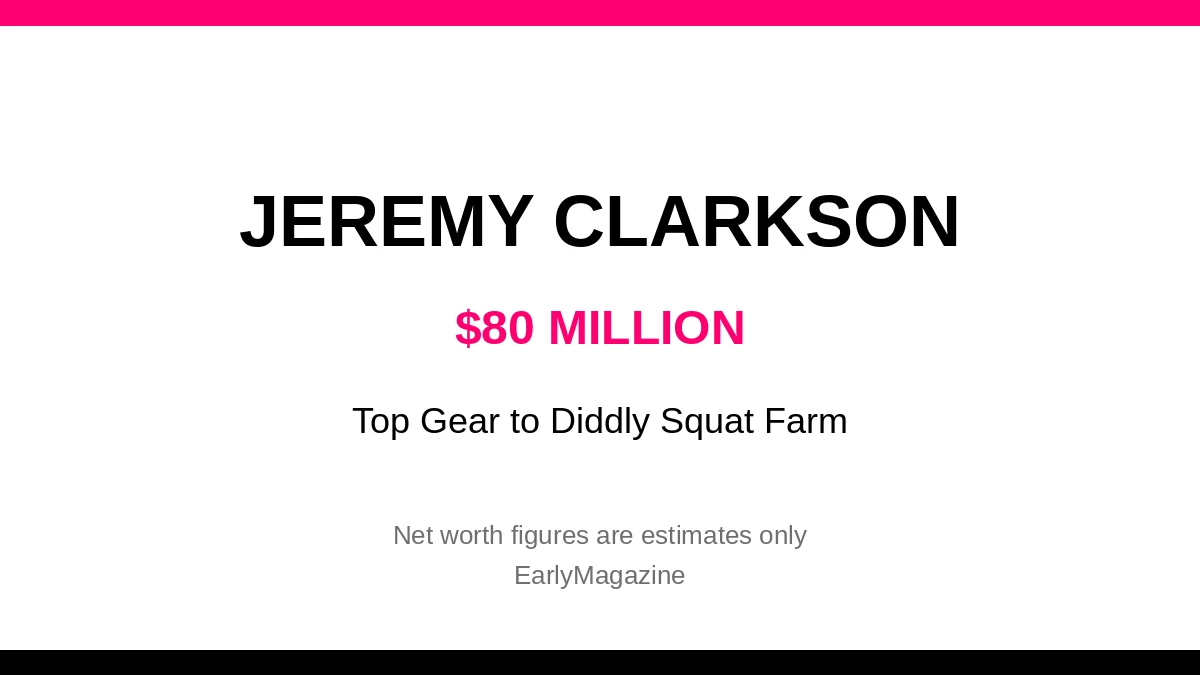
Jeremy Clarkson net worth is $80 million in 2026. The English television presenter, journalist, author, farmer and entrepreneur became internationally famous through “Top Gear,” which he presented alongside Richard Hammond and James May, and the BBC motoring program evolved under the trio into a global entertainment franchise built around exotic cars, enormous challenges, international road trips and the chemistry among its three hosts. What sets Clarkson’s fortune apart is that he made considerably more money from “Top Gear” than his television salary alone would suggest — he owned part of the business behind the show — and he has since repeated the trick with “The Grand Tour,” “Clarkson’s Farm” and a growing collection of rural businesses.
Quick Facts
| Full name | Jeremy Charles Robert Clarkson |
| Born | April 11, 1960, Doncaster, England |
| Occupation | Television presenter, journalist, author, farmer, entrepreneur |
| Known for | “Top Gear,” “The Grand Tour,” “Clarkson’s Farm,” “Who Wants to Be a Millionaire?” |
| Net worth | $80 million (Celebrity Net Worth estimate) |
Early Life
Jeremy Charles Robert Clarkson was born on April 11, 1960, in Doncaster, England. His father, Edward, worked as a traveling salesman, while his mother, Shirley, was a teacher. The family’s financial circumstances changed after his parents began producing stuffed Paddington Bear toys. They initially did so without a formal licensing agreement and eventually received a legal warning from Paddington creator Michael Bond. Edward Clarkson traveled to London to address the dispute and reportedly developed a friendly relationship with Bond, who allowed the family to continue manufacturing the toys under license. The business became successful enough to help pay Jeremy’s private-school tuition.
Clarkson attended Repton School, where his classmates included future “Top Gear” producer Andy Wilman and future Formula One designer Adrian Newey. Clarkson has described his school years as deeply unhappy and has spoken about being severely bullied. He ultimately left without completing his A-levels.
Journalism Career
After school, Clarkson worked for regional newspapers including the “Rotherham Advertiser,” “Rochdale Observer,” “Wolverhampton Express and Star” and “Shropshire Star.” His interest in cars gradually led him toward automotive journalism. In 1984, Clarkson and journalist Jonathan Gill founded the Motoring Press Agency, which supplied automotive road tests and articles to newspapers and magazines.
Clarkson distinguished himself from more technical automotive writers by treating cars as entertainment. His reviews combined automotive opinions with comedy, exaggeration, cultural commentary and deliberately provocative comparisons, establishing the style he would later bring to television.
Top Gear and Bedder 6
Clarkson first joined the original version of “Top Gear” in 1988 and quickly became one of its most recognizable presenters. He remained with the program until 2000. After the original show was canceled, Clarkson and Andy Wilman developed a dramatically different version of “Top Gear.” The relaunched program debuted in 2002 with a studio audience, a dedicated test track, celebrity laps, elaborate challenges and a much heavier emphasis on entertainment.
The chemistry among the trio transformed “Top Gear” into one of the BBC’s most successful international properties. The show was distributed around the world, adapted into local versions, turned into live touring productions and supported a lucrative ecosystem of magazines, DVDs, books, merchandise and licensing. The presenters also undertook increasingly elaborate challenges. In 2007, Clarkson and May became the first people to reach the 1996 position of the magnetic North Pole in a motor vehicle as part of the “Top Gear: Polar Special.”
Clarkson’s “Top Gear” finances are one of the clearest examples of the difference between earning a television salary and owning part of the underlying business. By the early 2010s, his direct BBC presenting fee had risen to just under £1 million per year. That alone made him one of Britain’s highest-paid television personalities, but his ownership of Bedder 6 was far more lucrative. BBC Worldwide owned 50% of Bedder 6, while Clarkson owned 30% and longtime “Top Gear” executive producer Andy Wilman owned the remaining 20%. The company participated in revenue from international versions of “Top Gear,” live shows, DVDs, merchandise, licensing and other commercial exploitation of the show’s global popularity.
In the year ending March 2012, Clarkson received approximately £3.16 million in fees and dividends from Bedder 6. Combined with his BBC salary, his “Top Gear”-related income for the year approached £4 million. In another year, Clarkson received a £4.86 million dividend from Bedder 6 and another £8.4 million when BBC Worldwide purchased his 30% ownership stake. Combined with his presenting salary, Clarkson earned more than £14 million from “Top Gear” during that year alone — roughly $18.5 million at current exchange rates. That ownership interest is a major reason Clarkson accumulated substantially more wealth than Hammond or May, despite the three eventually becoming similarly important to the program on screen.
Leaving Top Gear and The Grand Tour
During filming in North Yorkshire, Clarkson became involved in an argument with producer Oisin Tymon over the availability of hot food after a day of shooting. The confrontation became physical, and Clarkson struck Tymon. The BBC suspended Clarkson and subsequently decided not to renew his contract. Hammond and May declined to continue the show without him. Clarkson later apologized to Tymon, and the two sides reached a settlement over Tymon’s legal claims. The incident ended Clarkson’s 27-year association with “Top Gear,” but it also led directly to another extremely lucrative television business.
In 2015, Clarkson, Hammond, May and Andy Wilman formed W Chump & Sons and signed with Amazon to create “The Grand Tour.” The initial agreement was widely reported as involving a production budget of approximately £160 million for 36 episodes over three seasons — the cost of creating the series, not money paid directly to Clarkson. After the first season, W Chump & Sons reported approximately £35.3 million in turnover and £8.39 million in pre-tax profit. The following year, a related production company generated roughly £26 million in turnover and £7.6 million in pre-tax profit, while Clarkson, Hammond, May and Wilman also received a combined £5.2 million for presenting services during that year.
“The Grand Tour” eventually abandoned its regular studio format and concentrated on feature-length international road-trip specials. Its final Clarkson-Hammond-May adventure was filmed in Zimbabwe and released in September 2024 as “The Grand Tour: One for the Road.” After production ended, W Chump & Sons entered a solvent voluntary liquidation. By 2025, the company had approximately £24.1 million remaining on its books — an equal division among Clarkson, Hammond, May and Wilman would amount to approximately £6 million apiece, or close to $8 million, before individual taxes and final adjustments.
Clarkson added another major television franchise to his résumé in 2018 when ITV revived “Who Wants to Be a Millionaire?” with him as host. The original British version had been closely associated with Chris Tarrant, but Clarkson developed his own version of the role, including replacing the “Ask the Audience” lifeline with “Ask the Host.” He continued hosting “Who Wants to Be a Millionaire?” after “The Grand Tour” ended, giving him a second long-running television franchise alongside “Clarkson’s Farm.”
Diddly Squat Farm and Clarkson’s Farm
Clarkson purchased approximately 1,000 acres of farmland near Chipping Norton in Oxfordshire in 2008. The purchase price was not publicly disclosed. For years, the property was farmed by a local farmer while Clarkson concentrated on his television career. When the farmer retired in 2019, Clarkson decided to take over the operation himself.
He renamed the property Diddly Squat Farm, a joke about how little money he expected conventional farming to produce. The name quickly proved appropriate: during the first farming year documented for television, the agricultural operation generated just £144 in profit after expenses. The land itself, however, is a major asset regardless of annual farming profits. Recent farmland transactions around the Cotswolds have generally valued arable land at roughly £10,000 to £13,000 per acre and pasture at approximately £8,000 to £10,000 per acre — so the land alone could theoretically represent an asset worth many millions of pounds.
The series follows Clarkson as he attempts to operate Diddly Squat with help from contractor Kaleb Cooper, land agent Charlie Ireland, partner Lisa Hogan, Gerald Cooper and other members of the local farming community. Season five premiered in 2026 and continued to rank among Prime Video’s most-watched original programs in Britain and internationally. Its opening episode attracted roughly 4.4 million UK viewers during its first week, and earlier seasons regularly generated audiences of more than six million after consolidated viewing.
The success of the series dramatically changed the economics of Diddly Squat. Traditional agriculture may produce thin or nonexistent margins, but the television audience created enormous demand for products, merchandise, tourism, food and drinks carrying the Clarkson and Diddly Squat names. Clarkson opened the Diddly Squat Farm Shop in 2020 as a small outlet for produce grown on the property and products sourced from nearby farms. After “Clarkson’s Farm” became successful, the tiny shop became a major tourist attraction, with fans regularly traveling long distances to visit.
The drinks brand began with a lager produced using barley grown at Diddly Squat in partnership with the Cotswold Brewing Company. The range subsequently expanded into cider, pale ale, vodka and other beverages. Clarkson’s role grew beyond licensing his name: Companies House records identify him as a director of the Cotswold Brewing Company and show that he owns more than 25% but no more than 50% of its shares and voting rights. For the year ending March 2025, the company’s sales nearly tripled. Its total equity increased from approximately £432,500 to more than £3 million, while current assets rose from about £1.7 million to nearly £5 million. By 2026, Hawkstone products were being sold through thousands of British pubs, restaurants, supermarkets and other retailers.
Clarkson expanded further into hospitality in 2024 when he purchased a country pub near Burford, Oxfordshire, for £810,000, equivalent to roughly $1.1 million. The property, formerly known as The Windmill, was renamed The Farmer’s Dog. Owning a packed celebrity pub has not automatically meant owning a profitable one: Clarkson revealed that The Farmer’s Dog produced a pre-tax loss of £8,486 during its first four months despite being fully booked, with unusual expenses including approximately £47,000 per month for parking attendants needed to manage the crowds.
Writing, Cars and Personal Life
He has written long-running newspaper columns for “The Sunday Times” and “The Sun” and has published numerous collections of his writing, including the “The World According to Clarkson” series, “I Know You Got Soul” and “Driven to Distraction.” Writing has provided Clarkson with another substantial income stream for decades, alongside television, production-company ownership, books, live appearances and his newer rural businesses.
Clarkson has spent decades testing some of the world’s most expensive automobiles, but his personal ownership history is more eccentric than that of a traditional collector. Among the most valuable cars he has owned was a Ford GT, which cost a little over £100,000 when new in the mid-2000s; comparable first-generation Ford GTs have since become highly collectible, with British examples selling for roughly £250,000 to nearly £400,000. He also owned a Mercedes-Benz CLK63 AMG Black Series, a McLaren 675LT (only 500 coupes produced, with a British starting price of approximately £259,500), a Ferrari F355, a Lamborghini Gallardo Spyder, a Mercedes-Benz SLS AMG Roadster and an Alfa Romeo GTV6. By 2025, one of his regular personal cars was a used Jaguar F-Type that he bought for approximately £20,000 with 20,000 miles on the odometer. His farming career also introduced perhaps the most famous vehicle he currently owns: an enormous Lamborghini R8 tractor whose excessive size became a recurring joke during the first season of “Clarkson’s Farm.”
He married Frances Cain in 1993. They had three children together: Emily, Finlo and Katya. Clarkson and Cain separated in 2014 after more than two decades of marriage. Clarkson later began a relationship with Irish actress and model Lisa Hogan, who became an important figure on “Clarkson’s Farm” and plays an active role in the Diddly Squat businesses, particularly the farm shop and hospitality operations. Clarkson has increasingly centered his life around the Cotswolds following the end of “The Grand Tour,” while continuing his television, journalism, brewing, retail, farming and hospitality businesses.
His most important property is Diddly Squat Farm itself, the approximately 1,000-acre estate near Chadlington in the Cotswolds that he acquired in 2008. The original farmhouse was later demolished in characteristically dramatic fashion, with Clarkson blowing it up for “The Grand Tour.” He subsequently constructed a substantial Arts and Crafts-style country residence overlooking the farm, with extensive living space, an outdoor swimming pool, a tennis court and surrounding outbuildings. Taken together, the farmland, residence, pub, Hawkstone stake, Diddly Squat retail business, accumulated production-company earnings and decades of television and publishing income provide a strong foundation for Clarkson’s $80 million net worth.
Net worth figures are estimates only, based on public sources.
Related: Nicolas Cage, Jim Carrey, Macaulay Culkin
