

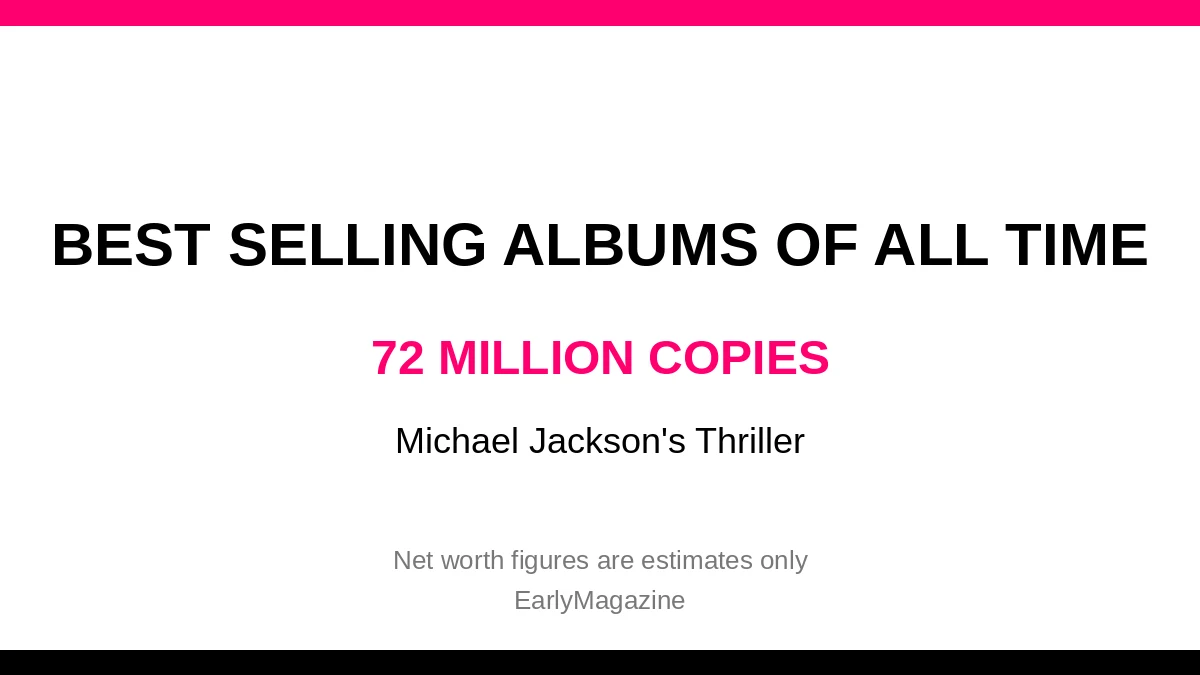
Michael Jackson’s “Thriller” is the best-selling album of all time, with an estimated 72 million copies sold worldwide, per CelebrityNetWorth — and no other record comes close.
The ranking below uses Media Traffic’s October 2026 estimates of worldwide album sales, compiled from international music-industry data and national certifications. These are estimated worldwide totals, not audited counts of individual purchases, and figures can differ considerably between sources — particularly for older releases, compilations and albums with multiple editions.
| Rank | Artist — Album (Year) | Worldwide Sales |
|---|---|---|
| 1 | Michael Jackson — “Thriller” (1982) | 72 million |
| 2 | Eagles — “Their Greatest Hits (1971-1975)” (1976) | 45 million |
| 3 | Pink Floyd — “The Dark Side of the Moon” (1973) | 43 million |
| 4 | AC/DC — “Back in Black” (1980) | 39 million |
| 5 | Whitney Houston / Various Artists — “The Bodyguard” (1992) | 38 million |
| 6 | Fleetwood Mac — “Rumours” (1977) | 37 million |
| 7 | Eagles — “Hotel California” (1976) | 37 million |
| 8 | Bee Gees / Various Artists — “Saturday Night Fever” (1977) | 35 million |
| 9 | Queen — “Greatest Hits” (1981) | 35 million |
| 10 | Adele — “21” (2011) | 34 million |
| 11 | Led Zeppelin — “Led Zeppelin IV” (1971) | 34 million |
| 12 | Michael Jackson — “Bad” (1987) | 34 million |
| 13 | The Beatles — “1” (2000) | 33 million |
| 14 | Shania Twain — “Come On Over” (1997) | 33 million |
| 15 | Bob Marley & the Wailers — “Legend” (1984) | 32 million |
| 16 | Alanis Morissette — “Jagged Little Pill” (1995) | 31 million |
| 17 | ABBA — “Gold: Greatest Hits” (1992) | 31 million |
| 18 | Pink Floyd — “The Wall” (1979) | 31 million |
| 19 | Various Artists — “Grease” Soundtrack (1978) | 30 million |
| 20 | Bruce Springsteen — “Born in the U.S.A.” (1984) | 30 million |
| 21 | Metallica — “Metallica” (The Black Album) (1991) | 30 million |
| 22 | James Horner / Various Artists — “Titanic” Soundtrack (1997) | 29 million |
| 23 | Celine Dion — “Let’s Talk About Love” (1997) | 29 million |
| 24 | Various Artists — “Dirty Dancing” Soundtrack (1987) | 29 million |
| 25 | Guns N’ Roses — “Appetite for Destruction” (1987) | 29 million |
| 26 | Michael Jackson — “Dangerous” (1991) | 29 million |
| 27 | The Beatles — “Sgt. Pepper’s Lonely Hearts Club Band” (1967) | 29 million |
| 28 | Celine Dion — “Falling into You” (1996) | 29 million |
| 29 | Dire Straits — “Brothers in Arms” (1985) | 29 million |
| 30 | Simon & Garfunkel — “Greatest Hits” (1972) | 28 million |
| 31 | Meat Loaf — “Bat Out of Hell” (1977) | 28 million |
| 32 | Mariah Carey — “Music Box” (1993) | 28 million |
| 33 | Madonna — “The Immaculate Collection” (1990) | 28 million |
| 34 | U2 — “The Joshua Tree” (1987) | 27 million |
| 35 | The Beatles — “Abbey Road” (1969) | 27 million |
| 36 | Adele — “25” (2015) | 26 million |
| 37 | Nirvana — “Nevermind” (1991) | 26 million |
| 38 | Green Day — “Dookie” (1994) | 26 million |
| 39 | Norah Jones — “Come Away with Me” (2002) | 26 million |
| 40 | Santana — “Supernatural” (1999) | 25 million |
| 41 | Taylor Swift — “1989” / “1989 (Taylor’s Version)” (2014/2023) | 25 million |
| 42 | The Beatles — “1967-1970” (The Blue Album) (1973) | 25 million |
| 43 | The Beatles — “1962-1966” (The Red Album) (1973) | 25 million |
| 44 | Backstreet Boys — “Millennium” (1999) | 25 million |
| 45 | Britney Spears — “…Baby One More Time” (1999) | 25 million |
| 46 | Eric Clapton — “Unplugged” (1992) | 25 million |
| 47 | Hootie & the Blowfish — “Cracked Rear View” (1994) | 25 million |
| 48 | Whitney Houston — “Whitney Houston” (1985) | 24 million |
| 49 | Elton John — “Greatest Hits” (1974) | 24 million |
| 50 | Eminem — “The Eminem Show” (2002) | 24 million |
Michael Jackson’s “Thriller”: The Biggest Album Ever
Released on November 30, 1982 and produced by Quincy Jones, “Thriller” contained seven singles that reached the American Top 10, including “Billie Jean,” “Beat It” and the title track. By the middle of 1984 it had already sold more than 35 million copies worldwide. Guinness World Records recognises sales exceeding 67 million copies, while some independent estimates place the figure above 70 million — Media Traffic puts it at 72 million.
How The Eagles Outsold Michael Jackson In America
Here is the surprise: “Thriller” is not the best-selling album in American history. That distinction belongs to the Eagles’ 1976 compilation “Their Greatest Hits (1971-1975),” which reached 40 million certified U.S. units in January 2026 — the first album to reach quadruple Diamond status. Jackson’s album holds second place in America with 34 million certified units. The Eagles also hold third place in the U.S. with “Hotel California,” certified at 28 million units in 2026.
The RIAA figure covers the American market and includes qualifying streaming and track-download equivalents — it is not a worldwide sales total, nor does it mean exactly 40 million physical copies were purchased.
Why These Albums Became So Enormous
Several of the biggest sellers benefited from exceptional timing. Pink Floyd’s “The Dark Side of the Moon” arrived as album-oriented rock became a dominant commercial format. Fleetwood Mac’s “Rumours” turned personal turmoil into a record that kept attracting listeners for generations. AC/DC’s “Back in Black,” released in 1980 following the death of original singer Bon Scott, introduced Brian Johnson and became one of hard rock’s greatest commercial achievements.
Soundtracks created phenomena of their own: “Saturday Night Fever” took disco mainstream, while “The Bodyguard” became inseparable from Whitney Houston’s recording of “I Will Always Love You.” Shania Twain’s “Come On Over” combined country songwriting with pop production on its way to 33 million sales, and Alanis Morissette’s “Jagged Little Pill” brought confessional alternative rock into the mainstream.
The clearest modern exception is Adele’s “21.” Released in 2011, it sold 34 million copies even as downloads and streaming were disrupting the traditional album business.
Why Some Famous Albums Have Conflicting Sales Figures
Meat Loaf’s “Bat Out of Hell” is the classic example. Guinness World Records credits the 1977 album with 44 million worldwide sales; Media Traffic’s more conservative chart places it at 28 million. Similar discrepancies exist for albums by AC/DC, Whitney Houston and Shania Twain. There is no single internationally audited database of lifetime album sales, and record labels have historically announced global totals that are difficult to reconcile with surviving certifications.
How Much Money Does An Artist Make From 30 Million Album Sales?
An album selling 30 million copies can generate hundreds of millions of dollars in consumer spending — but that revenue does not belong entirely to the artist. Retailers, distributors, labels, producers, songwriters, publishers and managers all take a share. The old rule of thumb that an artist earns $2 per album sold is too simplistic: a performer under a traditional deal might receive a royalty reduced by recoupable advances, while an independent musician who owns the masters could retain far more.
Songwriting is a separate revenue stream. When Whitney Houston recorded “I Will Always Love You,” Dolly Parton benefited enormously because she wrote the song and kept valuable publishing rights. And catalogues keep paying: in 2020, Stevie Nicks sold a reported 80% interest in her songwriting catalogue to Primary Wave in a deal valued around $80 million.
Why Modern Albums Rarely Reach 40 Million Sales
During the 1980s and 1990s, fans generally bought an entire album to own its songs. Today, listeners access enormous catalogues through streaming subscriptions. In 2025, Taylor Swift’s “The Life of a Showgirl” sold 6.05 million physical albums and digital downloads worldwide, according to the IFPI — the year’s best-selling album in that category, but a fraction of the CD-era giants.
Classic albums keep selling, though. IFPI’s worldwide vinyl rankings for 2025 included 296,000 copies of Fleetwood Mac’s “Rumours” and 277,000 copies of “Thriller.” More than four decades after their releases, both were still competing with contemporary hits on vinyl.
The lesson is that a truly successful album can remain a valuable asset for generations — through new purchases, streaming, publishing, licensing and renewed cultural attention. Phil Collins, whose Genesis and solo catalogues made him one of music’s richest stars, and Shakira, who built a $300 million fortune, both show how recordings made decades ago can keep building fortunes long after their release.
Sources: CelebrityNetWorth; Media Traffic October 2026 estimates; RIAA; IFPI (via CNW). Sales figures are estimates, not audited counts.
