

Being governor is an enormous job: multibillion-dollar budgets, thousands of employees, natural disasters, negotiations with legislatures and decisions affecting millions. You might assume the bigger the state, the bigger the paycheck — but that is not how it works.
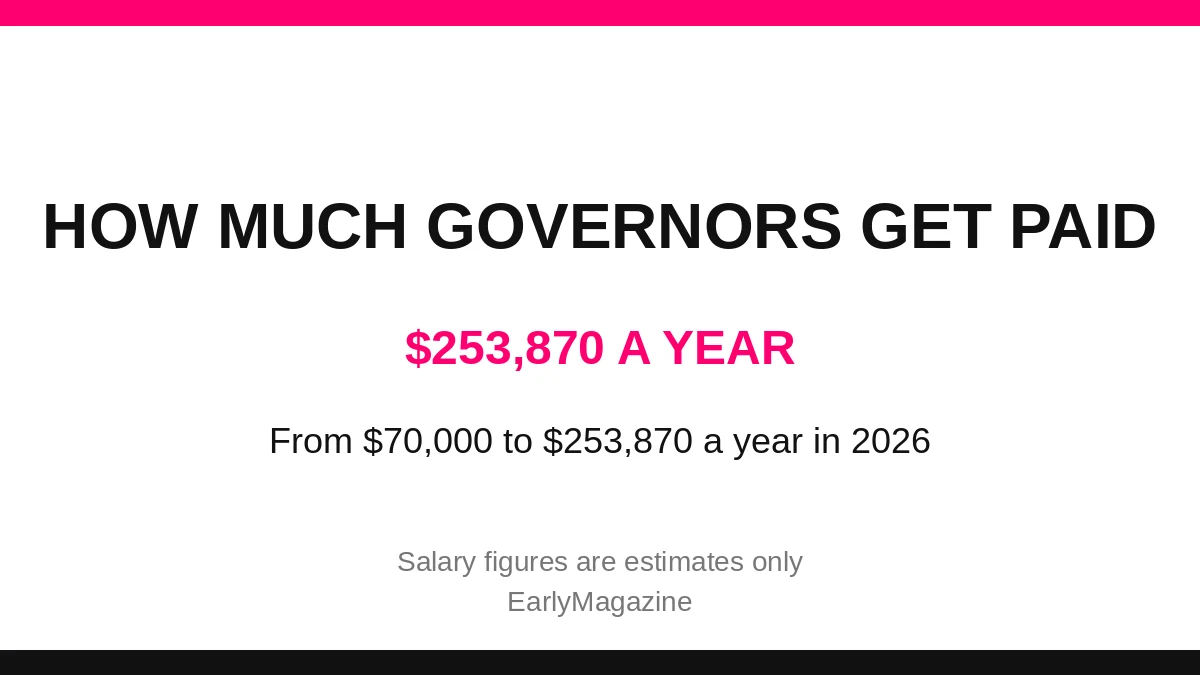
In 2026, the highest-paid governor in America is Pennsylvania Governor Josh Shapiro, who earns $253,870 a year. At the other end, Maine Governor Janet Mills receives just $70,000 a year, the lowest gubernatorial salary in the country. Across all 50 states, the average governor’s salary is $174,479 — so the best-paid governor earns more than 3.6 times what the lowest-paid governor makes.
The Highest-Paid Governors in America
Shapiro’s salary rose to $253,870 in January 2026, a 3.3% cost-of-living increase from $245,760 in 2025. New York Governor Kathy Hochul is second at $250,000. Utah ranks third, with Governor Spencer Cox earning $249,250, after Utah tied the governor’s pay to its chief justice’s salary. Tennessee is fourth at $246,108, followed by California at $245,929.
Strikingly, California Governor Gavin Newsom oversees nearly 40 million residents and one of the world’s largest economies, yet earns $3,321 less than Utah’s governor; California’s independent compensation commission sets the pay.
The Lowest-Paid Governors in America
Maine’s $70,000 figure has remained unchanged since 1987, making Governor Mills the lowest-paid in the country by a substantial margin. The second-lowest salary belongs to Arizona Governor Katie Hobbs at $95,000, followed by Oregon Governor Tina Kotek at $98,600. Nebraska Governor Jim Pillen receives $105,000, while South Carolina Governor Henry McMaster earns $106,078.
As monthly pay, the gap is stark: Pennsylvania’s salary works out to $21,156 a month, Maine’s to $5,833 — a difference of $183,870 a year between two people doing the same job.
Why Bigger States Don’t Always Pay More
If pay followed population or economic size, California, Texas, Florida and New York would top the list. They do not. Vermont Governor Phil Scott earns $243,520, sixth nationally, while Texas Governor Greg Abbott earns just $153,750 — Vermont pays its governor $89,770 more a year than Texas does. Florida Governor Ron DeSantis receives $141,400, ranking 39th, while Washington pays its governor $234,275.
The differences come down to state laws, compensation commissions, budgets and the politics of raising officials’ pay; some states adjust for inflation, others leave salaries untouched for decades, and governors cannot negotiate pay like corporate executives.
How Governors’ Salaries Are Set
There is no single national system. Pennsylvania uses a cost-of-living formula; California uses an independent commission; Utah ties the governor’s pay to its chief justice’s salary. Elsewhere the legislature votes directly, making a rise a political — and often unpopular — decision, which is why some salaries, like Maine’s, sit unchanged for decades.
The Governors Who Don’t Take Their Salaries
For some governors, a six-figure salary matters. For others, it is almost irrelevant next to fortunes made before entering politics. Illinois Governor JB Pritzker, a billionaire from the family behind the Hyatt hotel empire, has declined the state’s $205,700 salary. Connecticut Governor Ned Lamont, who built his wealth in telecommunications and investments, has likewise declined the $226,711 salary. Montana Governor Greg Gianforte donates his $141,517 salary to Montana charities, and Colorado Governor Jared Polis serves on a comparatively modest $134,632.
Salary and net worth are two different things: Jay Rockefeller, governor of West Virginia from 1977 to 1985, was worth $200 million at his death — inherited Rockefeller money, not pay from office. Read more: Jay Rockefeller Net Worth: $200M at His Death. The same contrast appears elsewhere: Teodorin Obiang reportedly spent over $500 million on luxury possessions while earning under $100,000 a year as a government minister. Read more: Teodorin Obiang: $500M Luxury Spending Scandal. And billionaire Mikhail Prokhorov, who ran for president of Russia in 2012, built a $13.5 billion fortune from metals and mining long before entering politics. Read more: Mikhail Prokhorov Net Worth: $13.5B.
Housing, Expenses and Other Benefits
Base salary is not the whole package: many states add an official residence, transport, security and expense allowances. Massachusetts authorises $65,000 a year for housing-related expenses on top of Governor Maura Healey’s $243,493 salary. Michigan pays a $54,000 annual expense allowance in addition to the $159,300 base salary, while Oregon’s governor receives $1,000 a month on top of the $98,600 salary.
Those allowances are not extra take-home pay — they are designated for housing or office expenses, and an official residence or security detail is not the same as its cash value.
Salaries Rising in 2027
Several states have already approved increases for 2027. The biggest is Maine: after four decades at $70,000, the governor’s salary jumps to $125,000 in January 2027, a rise of $55,000, or nearly 79%. New Mexico’s listed salary of $169,714 will apply from the next term, rather than to Governor Michelle Lujan Grisham’s current $110,000. Wisconsin’s governor is due a rise from $165,568 to $184,684, and Maryland has approved an increase to $195,000 at the start of the next term.
A salary written into law may not apply to the person already in office, so any ranking must state the year it measures.
How Governors’ Pay Compares With Other Jobs
The average governor’s salary of $174,479 is remarkably close to the $174,000 base salary of most members of the US House and Senate — yet a governor runs an entire state government. Even the highest-paid governor earns far less than the president, whose statutory salary is $400,000 a year: Pennsylvania’s $253,870 is about 63% of it, and Maine’s $70,000 just 17.5%.
Against corporate chief executives the gap is wider still: a governor may oversee tens of thousands of employees and billions of dollars a year, but without stock options, bonuses or multimillion-dollar packages. In 2026, official salaries range from $70,000 to $253,870. Some governors get expense allowances, some decline their paychecks, and some arrived with fortunes that dwarf anything public service could pay. The title is the same everywhere — the financial reality is not.
Salary figures are estimates only, based on public sources.
