

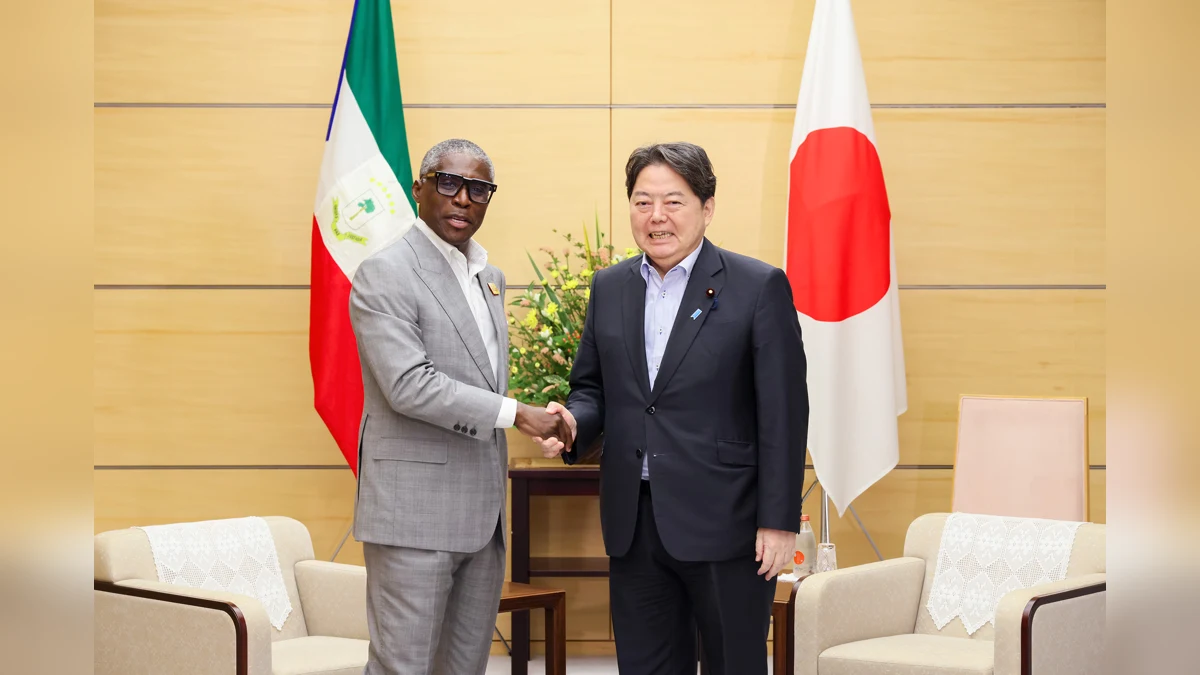
Teodorín Obiang, the First Vice President of Equatorial Guinea, reportedly spent more than $500 million on luxury possessions — a $30 million Malibu mansion, a $100 million Paris mansion, a $38 million private jet and dozens of supercars — while earning less than $100,000 a year as a government minister, according to the British government. American prosecutors alleged he accumulated more than $300 million in assets through corruption and money laundering, claims he has disputed.
The Malibu Student
In 1991, a 23-year-old Teodorín arrived in Malibu, California, to study English at Pepperdine University. An American oil company, Walter International, which had business interests in Equatorial Guinea, paid his $3,400-per-term tuition and covered his living expenses. He split his time between a rented Malibu house and a suite at the Beverly Wilshire Hotel in Beverly Hills, rarely attended class, and dropped out after five months — by which point the company had reportedly spent $50,000 on his brief American college experience.
His father, Teodoro Obiang Nguema Mbasogo, had ruled Equatorial Guinea since seizing power in a military coup in 1979. In 1993, the president awarded his 24-year-old son a 20-year concession to harvest timber from 61,000 acres of rainforest; another company controlled by Teodorín received a further 27,000 acres the following year. By the late 1990s, he held rights to harvest timber across 88,000 acres. His father then appointed him minister of forestry and environment — putting him in charge of regulating the very industry in which he held significant commercial interests.
The Forestry Payments
According to a U.S. Department of Justice investigation, Teodorín used that authority to demand personal payments from companies seeking permission to export timber — approximately 10% of the value of their exports, on top of the taxes they already owed. One timber company, Tromad Forestal, allegedly paid him about $700,000 a year between 1998 and 2003, some of it reportedly delivered in suitcases of cash. Businesses that refused, prosecutors alleged, could be denied export licenses. His official salary at the time was about $6,799 a month — $81,588 a year.
The $182 Million Highway
As Equatorial Guinea’s oil revenues exploded in the 2000s, Teodorín’s responsibilities expanded to infrastructure. According to a 2013 Justice Department court filing, a company he controlled, Somagui, received a $200 million government contract to build a highway between the cities of Ebebiyin and Mongomo. The government ultimately paid Somagui $182 million. Prosecutors alleged the company was not equipped to build the highway: it subcontracted the work to General Work for $44 million, yet paid the subcontractor only $15 million before construction stopped. The government cancelled the contract but, according to the federal complaint, never recovered the $182 million.
A Country in Poverty
Equatorial Guinea experienced one of the most extraordinary economic booms in modern African history after major offshore oil discoveries in the 1990s. Yet according to the World Bank, an estimated 57% of the country’s people lived below the $6.85-per-day poverty threshold in 2024. The contrast between the oil wealth and the ruling family’s lifestyle became a central focus of international anticorruption investigations. In 2014, the Justice Department alleged Teodorín had accumulated more than $300 million in assets through corruption and money laundering. The British government later cited investigations and reporting showing he had spent more than $500 million on luxury possessions since becoming a minister.
The Malibu Mansion
The most spectacular symbol was the Malibu mansion he bought in 2006 for $30 million — a nearly 15,000-square-foot residence at 3620 Sweetwater Mesa Road, with six bedrooms, eight bathrooms, a swimming pool, tennis court and a private three-hole golf course overlooking Malibu Lagoon and the Pacific Ocean. In November 2006, anticorruption group Global Witness called on American officials to investigate how a minister earning under $100,000 a year could afford it. The Justice Department pursued a civil forfeiture case, and in October 2014 he agreed to relinquish more than $30 million in property, including the mansion, a Ferrari and portions of his Michael Jackson memorabilia collection. The mansion sold in 2016 for $33.5 million, was flipped in March 2017 for $69.9 million, and sold again in June 2026 for $93.5 million — more than three times what Teodorín had paid.
The Paris Mansion and the French Conviction
At 42 Avenue Foch, one of Paris’s most prestigious addresses, he acquired a mansion valued at more than $100 million, with a private cinema, nightclub, Turkish bath and extensive artwork. French investigators began examining his finances in 2010. In October 2017, a French court convicted him of money-laundering offences, handing down a three-year suspended prison sentence, a suspended €30 million fine and an order confiscating his seized French assets, valued at about €150 million. The convictions were upheld on appeal in 2020, when the fine became payable, and confirmed by France’s highest appeals court in July 2021. Equatorial Guinea argued the mansion was diplomatic property; the International Court of Justice rejected that claim in 2020, and a further attempt to block the sale was rejected in September 2025. French authorities moved forward with marketing the building in 2026.
Jets, Supercars and Michael Jackson
In 2006, he bought a Gulfstream G-V private jet for $38.5 million. Swiss authorities began investigating his finances in 2016 and seized numerous luxury vehicles; 25 supercars were auctioned by Bonhams in Switzerland in September 2019 for about $27.2 million, including a white Lamborghini Veneno Roadster for about $8.3 million and a Koenigsegg One:1 for about $4.6 million. He also reportedly spent millions on Michael Jackson memorabilia, including a crystal-covered glove from the “Bad” tour reportedly bought for $275,000. The 2014 American settlement required him to relinquish certain pieces and pay an additional $1 million for collectibles he had already removed from the United States.
What Happened to the Recovered Money
The American settlement required recovered money to benefit the people of Equatorial Guinea rather than returning it to the government. About $20 million was allocated to charitable programmes and $10.3 million to the United States. In September 2021, the Justice Department announced agreements allocating $25.6 million in recovered funds to medical assistance — $19.25 million for a United Nations programme to buy and administer COVID-19 vaccines for at least 600,000 people, and $6.35 million to Medical Care Development International for medicines and supplies.
Another $86 Million Discovered
In May 2025, the International Consortium of Investigative Journalists published an investigation based on leaked documents involving Portuguese construction company Zagope, a subsidiary of Brazilian engineering giant Andrade Gutierrez. Zagope was awarded nearly $1.2 billion in Equatorial Guinean government construction contracts between 2009 and 2012, and the records showed it paid more than $86 million to Somagui between 2014 and 2018. French prosecutors had described Somagui as a shell company used to channel public money. In July 2025, Portugal’s Attorney General confirmed an investigation had been opened into possible corruption involving Zagope and its relationship with Teodorín; the announcement did not establish that a crime had occurred. Separately, a Brazilian federal investigation concluded in 2024 with an indictment involving Teodorín and others over alleged money laundering linked to a luxury property in São Paulo, after a 2018 incident in which Brazilian authorities found about $1.5 million in cash and luxury watches reportedly worth $15 million among his delegation’s possessions.
Still Vice President
Despite the seizures and the conviction, Teodorín remains First Vice President, a post he has held since 2016 after becoming Second Vice President in 2012, with responsibility for national defence and state security. He is widely regarded as a potential successor to his father, who has ruled since August 1979. In one of the more unusual developments, he also leads the country’s national anticorruption commission, created in 2022 as part of reforms connected to International Monetary Fund requirements. In July 2021, Britain imposed sanctions on him under its Global Anti-Corruption sanctions regime, citing alleged misappropriation of public funds, corrupt contracting and solicitation of bribes.
The figures in this article are drawn from government investigations, court records and reporting. Allegations are attributed to the authorities that made them; the French money-laundering conviction is a matter of court record, and Teodorín has disputed accusations that his fortune was obtained illegally. Net worth figures are estimates only, based on public sources.
Related: Ilham Aliyev, Michael Jackson, Recep Tayyip Erdoğan
