

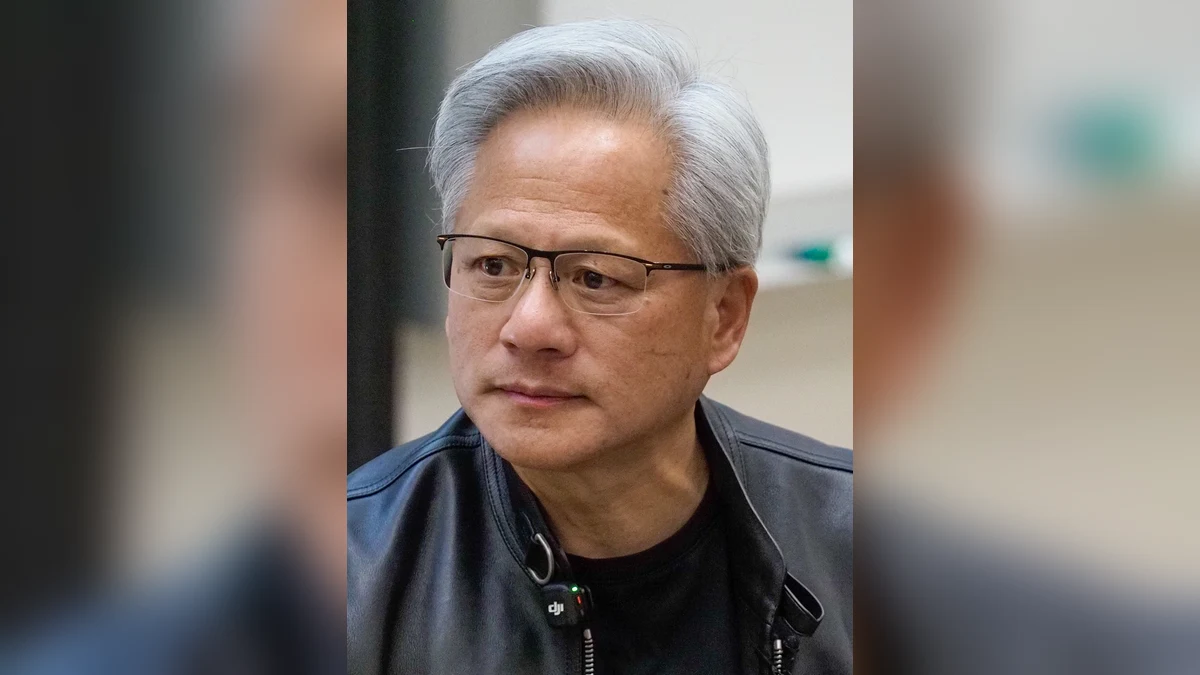
Eleven days after Jensen Huang lost the job he had held for 33 years, NVIDIA’s board unanimously voted to reinstate him as president and CEO — and in a matter of hours, the value of his NVIDIA shares soared by roughly $35 billion. The $35 billion is the gain in a single morning, not his total fortune: his stake climbed from about $102 billion on Friday to nearly $139 billion at Monday’s intraday peak.
| Quick Facts | |
| NVIDIA co-founder & CEO | Jensen Huang (b. 17 Feb 1963) |
| Shares held | 811,521,160 (per Sept 18, 2026 SEC filing) |
| Friday close | $125.53 — stake worth $101.9B |
| Monday open | $167.04 (+$41.51) — gain of $33.7B |
| Intraday high | $171.50 — gain of $37.3B; stake ~$139B |
| Resigned | November 12, 2026 |
| Reinstated | Monday, November 23, 2026 |
| NVIDIA all-time high | $239.24 (October 2026) |
How Jensen Huang Made $35 Billion in a Morning
According to Huang’s September 18, 2026 SEC filing, he holds 811,521,160 NVIDIA shares directly and through family trusts and related entities.
NVIDIA closed Friday at $125.53 per share, putting the market value of those holdings at $101.9 billion. On Monday morning, the stock opened at $167.04, a gain of $41.51 per share. Multiply that increase by Huang’s 811.5 million shares, and the gain comes to $33.7 billion.
The stock subsequently climbed as high as $171.50, at which point the gain in Huang’s holdings reached $37.3 billion compared with Friday’s closing price. Put another way, a man who entered the weekend with roughly $102 billion in NVIDIA stock watched that same position climb to nearly $139 billion at Monday’s intraday peak.
Of course, the rally was also a recovery of wealth that had evaporated during NVIDIA’s recent selloff. The stock reached an all-time high of $239.24 in October, and even Monday’s spectacular rebound left it well below that peak. Nevertheless, a $35 billion swing in personal wealth over a single morning is an extraordinary event, even by billionaire standards.
The Eleven Days Without a Job
The past two weeks have been among the strangest in Silicon Valley history.
On November 12, Huang resigned as NVIDIA’s president, CEO and a member of its board following revelations about extramarital relationships. One involved Alice Huang, an unrelated Chinese businesswoman who had worked for Singapore-based cloud computing company Megaspeed and was suspected of connections to Chinese intelligence.
Huang acknowledged being unfaithful to his wife, Lori. The Justice Department has not concluded that Alice Huang was a spy, and the allegations have not established that Jensen Huang engaged in criminal wrongdoing. Nevertheless, the potential national security implications created an enormous controversy for the company supplying much of the world’s advanced AI computing infrastructure. The full background is covered in our report on the affair and the board investigation.
NVIDIA appointed longtime CFO Colette Kress as interim CEO — the self-made billionaire who stepped into the top job — and Harvey C. Jones became board chairman. The company launched an independent investigation, and its directors initially rejected Huang’s subsequent offer to return.
Then the pressure started building. NVIDIA employees, investors, business partners and prominent Silicon Valley figures, including Elon Musk, pushed for Huang’s reinstatement. President Donald Trump joined the campaign, publicly supporting Huang and communicating with the people involved in the decision.
By Sunday, November 22, the board had reversed course. In Monday’s announcement, NVIDIA said the directors were satisfied with Huang’s candour and ability to lead the company. It also acknowledged receiving input from senior levels of the U.S. government, which gave the board confidence that Huang’s return would not pose a national security risk.
Trump was even more explicit about his involvement. Speaking to CNBC, he said: “The board decided to do what we wanted them to do.”
Just like that, Huang was back. Kress returned to her CFO duties, Jones remained chairman, and Wall Street celebrated.
One Man’s Return Just Added Nearly $1 Trillion to NVIDIA’s Value
There is something extraordinary about the market’s reaction that goes beyond Huang’s personal fortune.
NVIDIA shares exploded higher, gaining more than 30% and briefly adding over $1 trillion to the company’s market capitalisation. The rally spread across technology stocks, helping lift the Nasdaq 100 by as much as 7%.
NVIDIA is one of the most important companies in the global economy. It supplies the processors and computing systems used by companies spending hundreds of billions of dollars building artificial intelligence infrastructure. Its products are central to the business plans of Microsoft, Amazon, Google, Meta, OpenAI and countless others.
None of that changed on Monday morning. NVIDIA did not announce a breakthrough chip, a major new customer or a surprise earnings report. Its manufacturing capacity did not suddenly expand. Its competitive position in the AI market did not materially change. Its CEO came back — and investors responded by adding close to $1 trillion to the company’s market value.
Bloomberg columnist Matt Levine made a particularly interesting observation in his Monday morning “Money Stuff” newsletter. Much of the debate surrounding powerful technology founders involves how much formal control they should have over their companies. Founders sometimes demand special voting rights or large ownership stakes to protect themselves from boards that might eventually remove them.
Huang did not have that protection. He controls only a few percent of NVIDIA’s shares and has no special supervoting rights. The board was fully capable of accepting his resignation, and it did. But the market, employees, business partners and ultimately the president of the United States exerted enough pressure to bring him back anyway.
It is reminiscent of Sam Altman’s remarkable 2023 firing and reinstatement at OpenAI, where he returned to the CEO position just days after being removed. The lesson seems to be that a visionary founder does not necessarily need controlling voting power to exert enormous control over a company. Sometimes having enough influential people convinced that you are indispensable works just as well.
The Investigation Isn’t Over
There is one important complication to this otherwise spectacular comeback story: NVIDIA’s investigation into Huang’s relationships and the suspected foreign intelligence operation is still underway.
The company retained Joon Kim, a former federal prosecutor and partner at Wachtell, Lipton, Rosen & Katz, to lead an independent inquiry. That investigation was commissioned before Huang resigned and will continue following his reinstatement.
NVIDIA has also formed a separate National Security and Export Control Committee, is seeking additional outside expertise and plans to hire a chief compliance officer. Federal investigators and congressional committees are examining aspects of the controversy, including potential violations of restrictions on advanced NVIDIA chip exports to China.
That creates an unusual situation. The board has publicly expressed confidence in Huang and returned him to his position before its independent investigation has reached a conclusion. What happens if the investigators uncover additional damaging information? Could the board be forced to reconsider its decision yet again?
For now, the company has apparently decided that returning Huang to the CEO position is the best course of action. Wall Street certainly agrees.
He Was Going to Make $811 Million a Year Even Without the Job
On November 12, shortly after Huang resigned, CelebrityNetWorth published an article explaining that even without being NVIDIA’s CEO, Jensen Huang would still generate more than $800 million a year in dividends from his shares.
In May, NVIDIA increased its quarterly dividend from one cent to 25 cents per share. At an annualised rate of $1 per share, Huang’s 811.5 million non-foundation shares would generate $811.5 million in annual dividends — more than $2.2 million per day when averaged over a full year. The full breakdown is in our report on Huang’s $811M dividend income.
For comparison, Huang’s most recent annual base salary as NVIDIA CEO was $1.5 million. His entire fiscal 2026 compensation package, including stock awards, bonuses and security expenses, was valued at $36.3 million.
Silicon Valley’s Strange Thanksgiving Tradition
Here is a bizarre coincidence: almost exactly three years ago, another one of the world’s most powerful AI executives was abruptly removed from his job, only to make a triumphant return just before Thanksgiving.
On November 17, 2023, OpenAI’s board shocked Silicon Valley by firing CEO Sam Altman, saying it had lost confidence in his leadership. The decision triggered an extraordinary revolt. Employees threatened to quit, Microsoft offered Altman a new job and investors demanded his return. By November 21, just two days before Thanksgiving, OpenAI had announced an agreement to bring him back as CEO with a restructured board.
Three years later, here we are again. Another extraordinarily influential AI founder loses his job in November. Another board discovers that firing the person most closely associated with its company’s success is easier than replacing him. Employees, investors and powerful outsiders rally around the ousted executive. And just before Thanksgiving, the founder gets his job back.
There are differences, of course. Altman’s ouster lasted only four days before an agreement was reached, while Huang’s ordeal stretched across eleven. Huang also had something Altman did not: a publicly traded company whose stock price offered an almost instantaneous verdict on his return.
In Huang’s case, that verdict was worth roughly $35 billion to him personally.
Sources: CelebrityNetWorth; NVIDIA SEC filing, September 18, 2026; Bloomberg “Money Stuff,” November 23, 2026.
