

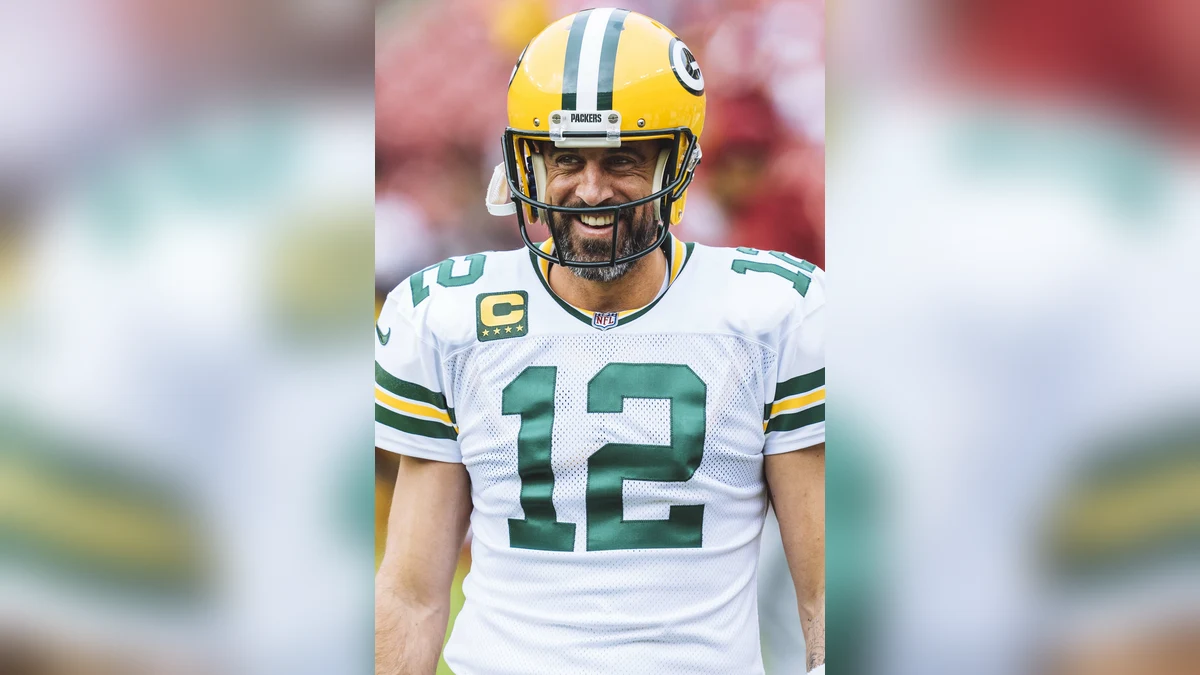












Quick Facts
| Full name | Aaron Charles Rodgers |
| Born | December 2, 1983, Chico, California |
| Age | 42 |
| Net worth | $250 million (CNW estimate) |
| 2026 contract | $25 million max (Steelers) |
| Career NFL earnings | $395.8 million before 2026 |
| Teams | Packers, Jets, Steelers |
| Super Bowl | XLV champion and MVP |
| NFL MVPs | 4 (2011, 2014, 2020, 2021) |
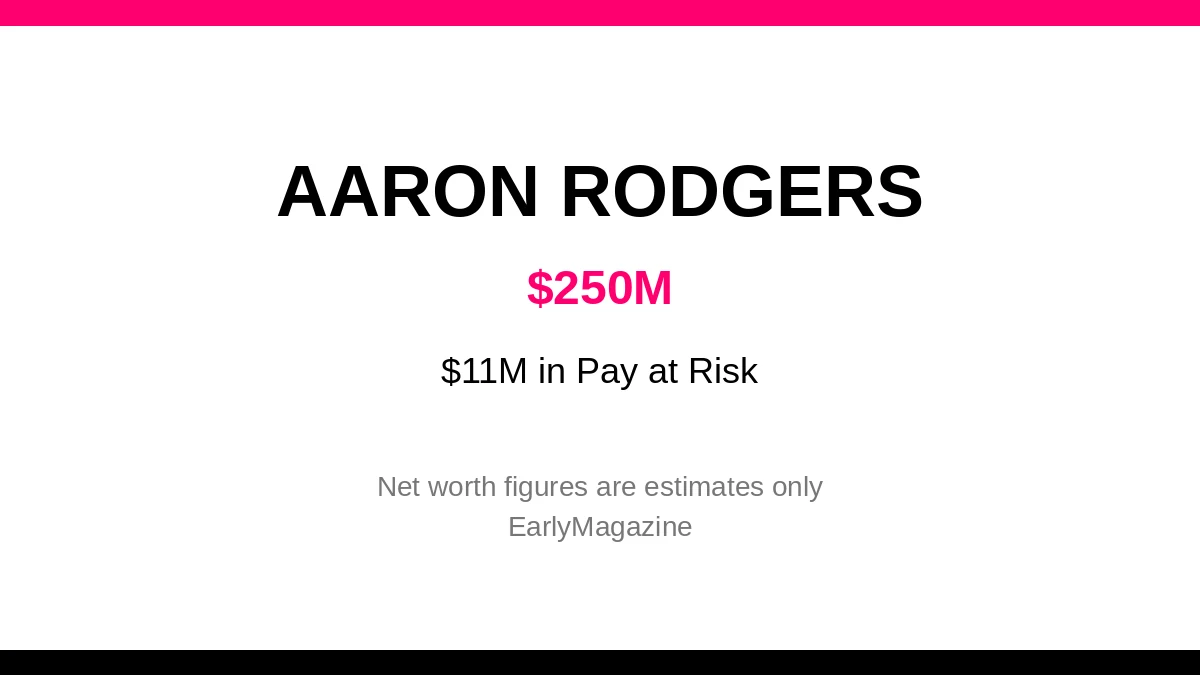
Aaron Rodgers has an estimated net worth of $250 million — but one television interview may have just cost him as much as $11 million in potential compensation, in what could be the most expensive farewell of his 22-season NFL career.
Six months ago, Rodgers signed what was supposed to be the final contract of his NFL career. The four-time MVP would return to the Pittsburgh Steelers for one last season, reunite with the coach who helped him win his only Super Bowl, and potentially collect another $25 million before riding off into retirement. Instead, two days before Thanksgiving, he went on national television, publicly attacked his head coach, and effectively ended his employment with the Steelers.
On Tuesday night, the Steelers announced that Rodgers was being benched in favour of Mason Rudolph. Pittsburgh were 6-4 and still in playoff contention, but consecutive losses to Cincinnati and Philadelphia had apparently convinced the coaching staff that a change at quarterback was necessary. Less than 24 hours later, Rodgers appeared on The Pat McAfee Show and launched an extraordinary public attack on Steelers head coach Mike McCarthy.
Rodgers alleged that McCarthy had repeatedly fallen asleep during team meetings, missed scheduled meetings and walkthroughs, and struggled to keep up with film preparation. Perhaps the most bizarre allegation was that McCarthy had accidentally referred to the Steelers as the Packers while breaking a huddle at half-time of Sunday’s game against Philadelphia. According to Rodgers: “Alright, 1, 2, 3 Packers. That’s what he broke it down on in the locker room.” Rodgers also claimed that concerns about McCarthy had been circulating internally for months and that other players shared his frustrations. He made it clear he had no intention of returning to Pittsburgh.
McCarthy had not publicly responded to the specific allegations at the time of the interview, and Rodgers’ claims had not been independently established. McCarthy did respond later the same day, telling reporters that at least one of Rodgers’ claims was “not accurate”, while confirming that Rodgers had been released and that he had the full support of general manager Omar Khan and owner Art Rooney II. Multiple NFL sources subsequently corroborated several of Rodgers’ allegations, including that McCarthy had fallen asleep during meetings and had mistakenly invoked the Packers nickname at half-time, according to ESPN via Reuters.
The Steelers had originally intended to keep Rodgers on the roster despite benching him, according to NFL Network’s Ian Rapoport. That plan changed after his television appearance, and Pittsburgh moved to release him within hours. McCarthy confirmed the release and said the benching had been his decision, after Rodgers delivered an ultimatum demanding he relinquish play-calling duties. That is where things get financially interesting. See also: Daniel Jones Colts release.
The $25 Million Contract
In May 2026, Rodgers signed a one-year contract with the Steelers that was structured to reward him handsomely if his final NFL season ended with a championship. Unlike many NFL contracts, which feature enormous signing bonuses and relatively modest base salaries, his deal was remarkably straightforward. He received a fully guaranteed $22 million base salary, two relatively small roster bonuses, and a series of performance incentives tied to Pittsburgh’s postseason success.
Here was the full breakdown of his 2026 contract, according to contract details obtained by Sports Illustrated: guaranteed base salary $22 million; August 7 roster bonus $250,000; Week 1 roster bonus $250,000; maximum postseason incentives $2.5 million; maximum potential earnings $25 million. Rodgers had already earned both roster bonuses. His $22 million base salary, however, was spread across the NFL’s 18-week regular-season schedule — a weekly paycheck of $1,222,222. With seven weeks remaining in the regular season, he still had $8,555,556 in guaranteed base salary left on his contract when he went on McAfee’s show.
Under normal circumstances, the Steelers would owe Rodgers that money whether he started every remaining game, sat on the bench, or was released. These are not normal circumstances.
When Guaranteed Money Isn’t Guaranteed
Shortly after Rodgers’ interview, ESPN NFL insider Jeremy Fowler raised the possibility that Pittsburgh could pursue disciplinary action against Rodgers for conduct detrimental to the team. NFL insider Jordan Schultz subsequently reported that the Steelers were working through Rodgers’ contract situation before finalising his release, specifically raising the possibility that some of his remaining compensation could be voided.
The NFL’s collective bargaining agreement allows teams to impose significant financial penalties on players whose behaviour is deemed detrimental to their organisation. Under the league’s rules, the maximum ordinary disciplinary punishment for such conduct is a fine equal to one week’s salary and a four-week suspension without pay. For Aaron Rodgers, that would translate into a one-week salary fine of $1,222,222 and a four-week unpaid suspension of $4,888,889 — a total potential disciplinary penalty of $6,111,111.
The collective bargaining agreement also provides a mechanism for teams to deny certain termination-pay protections in particularly severe cases, subject to arbitration. Separately, the specific language in Rodgers’ individual contract could determine whether Pittsburgh has grounds to void his remaining salary guarantees. None of this means the Steelers can simply declare themselves free of their $8.6 million obligation. Rodgers would almost certainly have grounds to challenge any disputed withholding through the NFL Players Association’s grievance process. The ultimate outcome could range from Rodgers collecting his entire remaining salary to a negotiated settlement or a substantial forfeiture of his guaranteed compensation.
Another $2.5 Million Out the Window
Beyond his guaranteed salary, Rodgers also had an opportunity to earn another $2.5 million if he led the Steelers to a Super Bowl victory. His contract contained four postseason incentives: wild-card round victory or first-round bye $625,000; divisional round victory $625,000; AFC Championship victory $625,000; Super Bowl victory $625,000. To qualify, Rodgers needed to participate in at least 75% of Pittsburgh’s regular-season offensive snaps and, for each playoff victory, at least half of the team’s offensive snaps in that game.
Prior to being benched, Rodgers had participated in roughly 97% of Pittsburgh’s offensive snaps. He was well on his way to satisfying the regular-season playing-time requirement. Obviously, winning the Super Bowl was far from a certainty for the Steelers. But at 6-4, Pittsburgh was very much alive in the AFC playoff race. Being benched already put those incentives in serious jeopardy. Being released would eliminate his opportunity to earn them with Pittsburgh entirely. Add the $8.56 million in potentially disputed salary to the $2.5 million in postseason incentives, and Rodgers has as much as $11.06 million in potential compensation on the line.
Early Life
Aaron Charles Rodgers was born on December 2, 1983, in Chico, California. Lightly recruited out of Pleasant Valley High School, he played a season at Butte College before transferring to the University of California, Berkeley, where he starred for two seasons. Despite being projected as a possible first overall pick, he waited in the green room as 23 players were selected before him in the 2005 NFL Draft, finally going 24th overall to the Green Bay Packers. He sat behind Brett Favre for three seasons before becoming the starter in 2008.
Career
Rodgers led the Packers to victory in Super Bowl XLV at the end of the 2010 season, beating the Pittsburgh Steelers and winning Super Bowl MVP. He won four NFL MVP awards, in 2011, 2014, 2020 and 2021 — only Peyton Manning has won more. He set an NFL record with 402 consecutive passes without an interception. After 18 seasons in Green Bay, he was traded to the New York Jets in 2023, tore his Achilles tendon after just four snaps, and returned for a full season in 2024. He joined the Steelers in 2025, won the AFC North, and returned in 2026 for what he said would be his final season, reuniting with McCarthy, who had coached him to the Super Bowl in Green Bay. The Steelers hired McCarthy in January 2026 after Mike Tomlin, the team’s coach for 19 seasons, stepped down following a playoff loss to the Houston Texans.
A $400 Million Career
Of course, if there is one NFL player who can financially withstand a multimillion-dollar dispute on the eve of retirement, it is Aaron Rodgers. He earned $395.8 million in NFL compensation before the 2026 season began. If he ultimately receives the full $22.5 million in regular-season compensation from Pittsburgh this year, his career earnings will reach $418.3 million. Those figures do not include the tens of millions of dollars he has earned through endorsement deals with companies such as State Farm and Adidas, or the value of his various business investments, including his minority ownership stake in the Milwaukee Bucks. Even if Pittsburgh successfully voided every dollar of his remaining salary, Rodgers would still finish with nearly $410 million in career NFL earnings. See also: Aaron Rodgers profile and the Highest-paid NFL players of all time list.
Personal Life
There is also a chance that Rodgers has not played his final NFL game. Because his release came after the trade deadline, he will be subject to waivers. If he goes unclaimed, he will become a free agent and could theoretically finish his career with another franchise. But if Rodgers is indeed done playing football, what an extraordinary way to go out. After 22 seasons, four MVP awards, a Super Bowl championship, more than $400 million in career earnings, and countless hours talking to Pat McAfee, one final appearance on McAfee’s show may prove to be the most expensive interview of Aaron Rodgers’ life.
