


 Stephen Thompson
$3 million
 Kirk Cousins
$180 million
 Josh Allen
$100 million
 Carson Wentz
$45 million
 Adrian Peterson
$12 million
 Justin Jefferson
$50 million
 Caleb Williams
$14 million
 Michael Andretti
$80 million
 Michael Wilbon
$18 million
 Bill Belichick
$70 million
 Max Verstappen
$300 million
 Paul Pierce Earned $245 Million — Now His Lawyer Says He's "Drowning Financially"
$40 million
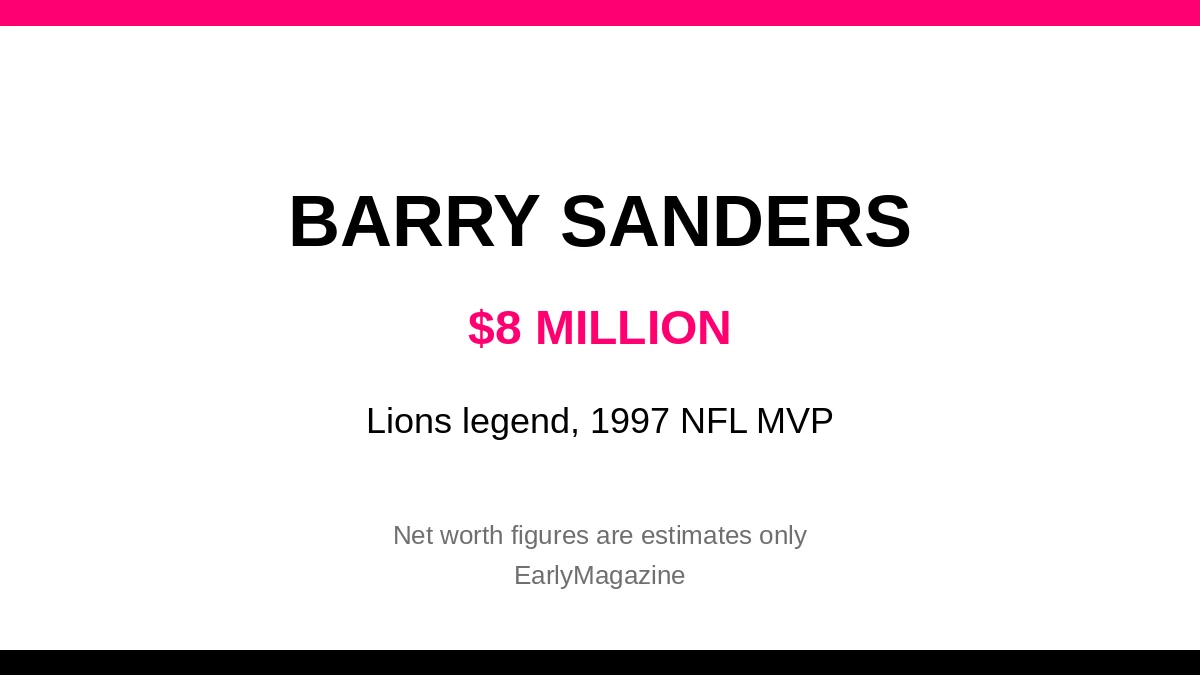
Barry Sanders has an estimated net worth of $8 million — a modest fortune for a player widely regarded as the most elusive running back in NFL history, and a figure shaped as much by his sudden retirement in 1998 as by the $30 million-plus he earned on the field.
Quick Facts
| Full name | Barry Sanders |
| Born | 16 July 1968, Wichita, Kansas |
| Age | 58 |
| Net worth | $8 million (estimate) |
| Position | Running back |
| Team | Detroit Lions (1989–1998) |
| College | Oklahoma State |
| Heisman Trophy | 1988 |
| NFL MVP | 1997 |
| All-time rushing | 4th in NFL history |
Early Life and College
Barry Sanders was born on 16 July 1968 in Wichita, Kansas. During his high school years he established himself as a natural athlete, playing alongside his brother, and by the time he was a senior it was clear he was a natural running back.
After graduation, Sanders received scholarship offers from numerous colleges and chose Oklahoma State University. He had an incredible season in 1988, setting numerous college records and winning the Heisman Trophy, which made him a target for many NFL teams.
Detroit Lions Career
In 1989, Sanders was picked up by the Detroit Lions and immediately made an impact despite initial concerns about his short stature. He proved both strong and quick, with a low centre of balance that made him almost impossible to take down, and he won Rookie of the Year in his first season.
During his ten-season NFL career, Sanders established himself as one of the most talented and elusive runners in football history. He led the league multiple times in rushing yards, won NFL Offensive Player of the Year twice and was named league MVP in 1997. He averaged more than 1,500 rushing yards per season, and it was not unheard of for him to rack up as many as 1,900 or 2,000 yards in a season, especially in 1994 and 1997.
During the 1990s, Sanders helped the Lions reach the playoffs five times. It was one of the biggest tragedies of his career that he never reached the Super Bowl, and he is considered one of the best players ever not to play in one. Despite his stardom, he was consistently humble — rarely engaging in over-the-top celebrations, unlike so many stars of his era.
Contracts and Career Earnings
After being drafted in 1989, the Lions initially offered Sanders a $2.6 million contract. At his father’s insistence, he refused the offer and did not turn up to pre-season camp. People laughed when his father said publicly that he believed Barry was worth $10 million — until Sanders subsequently signed a five-year, $9.5 million contract with the Lions.
In 1997, Sanders signed the largest contract for a running back up to that point: a six-year, $34.5 million deal that came with a record-smashing $11 million signing bonus. The deal made him the highest-paid player in the NFL.
CNW puts his career NFL salary at a little over $30 million before tax — although that number may include the $7.5 million signing bonus paid in 1998 that he was eventually ordered to repay after his sudden retirement. If that is the case, his career earnings were closer to $22.5 million.
The Sudden Retirement
Sanders’ career came to an abrupt end when he retired suddenly in 1998. He was only a few yards short of breaking the NFL rushing record, and he currently ranks fourth in all-time rushing yards.
He retired unexpectedly just two years into his six-year contract. That prompted the Lions to sue, demanding he repay a portion of the signing bonus. A judge eventually sided with the Lions, and Sanders was forced to pay back roughly $7.5 million of the bonus. To make the payment, he reportedly liquidated various stocks.
He has publicly stated that he has lived a modest life since retirement, admitting that he only owns one car after leaving football behind.
Post-Retirement Finances
After financial difficulties following his retirement, Sanders stated that he mostly lives off the interest from $7 million in tax-exempt municipal bonds. He also stated that he has over $750,000 invested in stocks, mostly in various banks. Other forms of wealth include four real estate investments, although the exact nature and location of these properties are difficult to ascertain. Sanders has admitted that he continues to earn money from autograph shows.
In 2002, it was reported that Sanders was requesting a modification of his child support payments, claiming that his early retirement had caused a dip in his income. Court documents revealed that his income had dropped from $6.4 million per year to just $851,000 per year after his retirement. He asked a judge in Oklahoma County to eliminate a $7,000-per-year child support payment and to reduce a separate $4,000-per-month payment. Sanders also purchased a $200,000 home for his son to live in with his mother, and paid for the furnishings, property taxes and home insurance.
Real Estate
In 2003, Sanders paid $532,000 for a home in West Bloomfield Township, Michigan. He sold the home in December 2017 for $510,000.
Today, his primary residence is a two-bedroom condo on a golf course in Detroit. He also owns a 7,000-square-foot lakefront mansion set on more than 10 acres in Wichita, Kansas, worth around $1.5 million. His parents lived there full-time for the last several decades; his father died in 2011, and his mother continues to live there all year round.
Personal Life
Sanders has kept a relatively low profile since leaving football, living what he has described as a modest life in Detroit. He remains closely associated with the Lions and with Wichita, where his family home still stands, and he continues to appear at autograph shows and fan events.
Most observers consider him the most agile runner the NFL has ever seen and one of the best players of all time — a legacy built in just ten seasons, and one that ended, by his own choice, while he was still at the very top of the game.
Net worth figures are estimates only, based on public sources.
Related: Adrian Peterson Net Worth, Jahmyr Gibbs Just Became the Highest-Paid Running Back in NFL History, Le’Veon Bell Earned $45 Million in the NFL
