

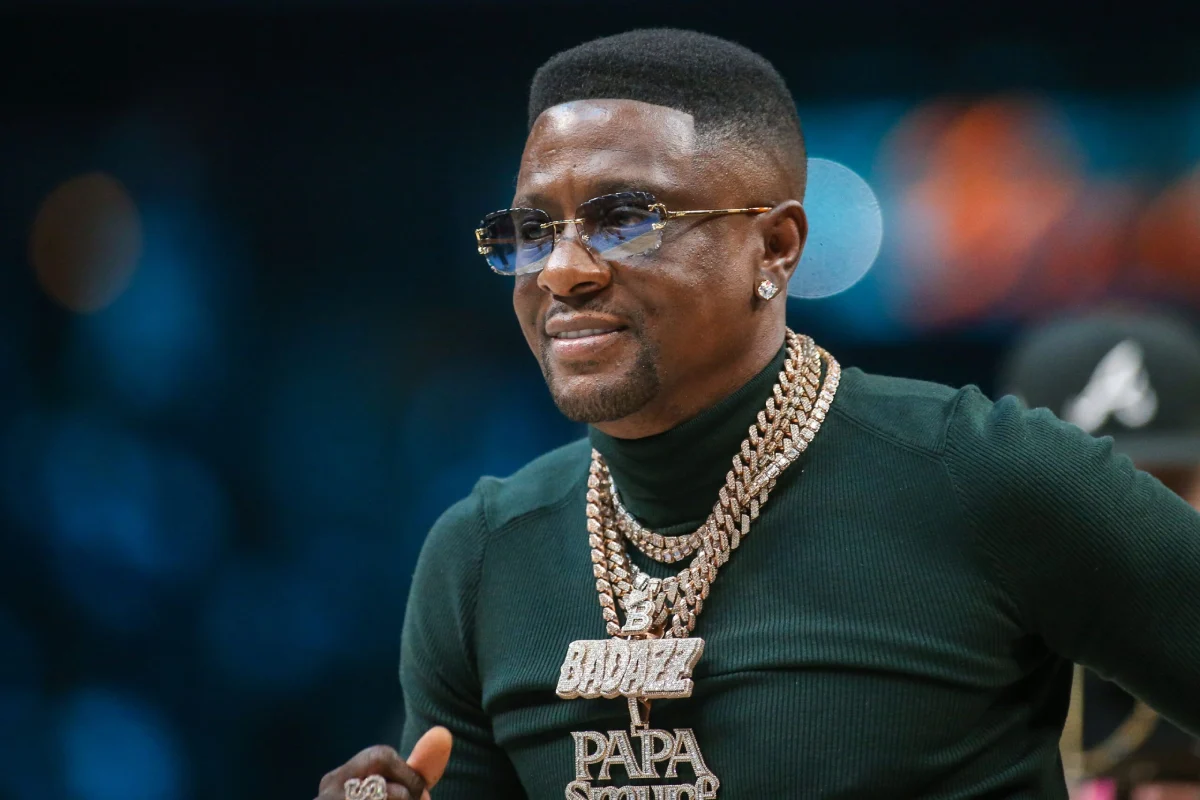
Rapper Boosie Badazz has been in and out of legal trouble for most of his career. He’s done federal drug time, beaten a murder charge, and more recently admitted to a serious gun crime. So when he found himself staring down another possible prison sentence, he did something most people never get the chance to do: he tried to buy his way to a presidential pardon.
He paid $600,000 to a pair of political operatives who promised to get Donald Trump to sign off on his freedom. What happened next reads like a plot twist nobody saw coming — broken promises, a missing $300,000, and a brand-new felony case that could send Boosie right back to federal prison anyway.
Here’s the full story, broken down step by step.
Why Boosie Was Even Looking for a Pardon
Boosie’s real name is Torrence Hatch. Back in the early 2010s, he was convicted of felony drug charges in Louisiana and served roughly five years behind bars before walking free in 2014.
That conviction came with a permanent consequence: as a felon, he legally lost the right to own a gun.
Fast forward to 2023. Federal agents in San Diego accused Boosie of having a Glock handgun in his possession. The case dragged on, got dropped, then got refiled. Eventually, Boosie pleaded guilty to being a felon in possession of a firearm.
On paper, that charge could have landed him up to 15 years behind bars. In reality, federal sentencing guidelines meant his actual exposure was much smaller. Still, any prison time was too much for Boosie, so while he waited to be sentenced, he started chasing a pardon.
What a Pardon Could — and Couldn’t — Fix
Here’s an important detail: a president has zero power over state-level convictions. That meant Trump could never erase Boosie’s old Louisiana drug case, no matter what.
But the federal gun charge was a different story. That one was fully within presidential reach. A pardon wouldn’t have wiped the conviction from Boosie’s record, but it could have canceled out the punishment tied to it.
Inside the $600,000 Pardon Deal
According to a detailed investigation by NOTUS, Boosie signed on with Jacob Wohl and Jack Burkman, two political operatives running a firm called JM Burkman & Associates. He hired them in September 2025 after being told they had a track record of landing pardons for other clients.
There was just one problem: that track record didn’t hold up under scrutiny.
NOTUS combed through federal lobbying disclosures and could only confirm one client of the firm who actually received clemency — and a White House official said Wohl and Burkman had nothing to do with that particular case.
Boosie later admitted the pitch was convincing at the time. He described the duo as coming across like they had a direct line to the president himself.
A six-page contract reviewed by outlets, dated September 30, 2025, laid out the deal. For $600,000, the firm agreed to:
- Build and file Boosie’s official pardon petition
- Push it through the Justice Department’s Office of the Pardon Attorney
- Lobby the White House Counsel’s Office
- Advocate directly with senior White House staff — and possibly the president
The contract was careful to cover the firm legally, stating clearly that only the president can grant clemency, and that no pardon was guaranteed. But buried in the fine print was a clause that would later become the center of a major dispute.
The $300,000 “Money-Back” Promise
Boosie’s $600,000 payment was split into two chunks.
The first $300,000 was non-refundable, earned the moment it landed in the firm’s account. The second $300,000 was labeled a “contingent refundable portion” — meaning it was supposed to come back to Boosie if the pardon didn’t happen by a set deadline.
Sounds simple enough. Except the contract had a glaring mistake.
Even though it was signed in September 2025, the deadline written into the document was January 31, 2025 — a date that had already passed before the ink was even dry. Boosie’s legal team says the real intended deadline was clearly meant to be January 2026, but that typo is now fueling a legitimate legal fight.
On top of that, there was no separate escrow or trust account set up for the refundable portion. The entire $600,000 went straight into the firm’s general operating account — a detail that matters a lot once refund time comes around.
JM Burkman & Associates now disputes that any refund was ever actually agreed to, and claims its lawyer never even saw the signed retainer agreement until after arbitration had already started. Boosie’s team strongly disagrees with that version of events.
Did Trump Actually Sign a Pardon?
Between September 2025 and January 2026, Wohl and Burkman reportedly kept Boosie’s legal team updated with a steady stream of good news. According to messages reviewed by NOTUS, they claimed the pardon petition had already reached the Justice Department and was sitting with the White House for review.
They also allegedly name-dropped several high-profile conservative figures as supporters of the pardon, including commentator Mike Cernovich, activist Erika Kirk, and House Speaker Mike Johnson.
Every single one of those claims was later denied. Kirk’s team said she’d never even heard of Boosie. Cernovich said he never pushed for a pardon. Johnson’s office flatly denied any involvement at all.
Then came the boldest claim of all. On New Year’s Eve, Burkman reportedly texted Boosie’s attorney that Trump was holding the signed pardon in his hands, ready to go. The very next day, the operatives allegedly said on a phone call that Trump had already signed it — and that the White House just needed to make it official.
The Pardon That Never Was
As Boosie’s sentencing date got closer, his real criminal defense attorney decided to check the story out for himself.
He found nothing. An assistant U.S. attorney searched the federal system and came up empty. A White House aide said the administration hadn’t even seen Boosie’s application, and a separate White House official later confirmed the clemency team had no record of ever hearing from Wohl or Burkman.
When NOTUS asked the pair directly about the claim that they told Boosie’s lawyer the pardon had been signed, they didn’t give a straight answer. Instead, their firm insisted it had run a “major advocacy campaign” on Boosie’s behalf across Congress, the executive branch, and conservative media — and that they still believed he deserved clemency.
A Surprisingly Light Sentence Anyway
Here’s the twist: even without a pardon, Boosie ended up catching a huge break.
In January 2026, a federal judge sentenced him to just 10 days in jail — all of which was already covered by time he’d previously served — plus three years of supervised release.
In plain terms, Boosie spent $600,000 chasing a pardon he never got, for a sentence that ultimately required zero additional days behind bars.
Unfortunately, that supervised release would soon become a much bigger headache than the original case ever was.
A Nightclub Fight Threatens Everything
In May 2026, Boosie was arrested and charged with felony aggravated assault after an incident at a Houston nightclub.
Prosecutors say Boosie hit a security guard in the head with the glass base of a hookah while the guard was walking Boosie’s niece out of the venue. The guard reportedly needed eight staples to close the wound.
Boosie has pushed back hard, calling the whole thing a “money grab” and asking people to hold off judgment until surveillance footage and witness statements are reviewed. Under the law, he’s presumed innocent unless proven guilty.
If this case moves forward as a standard second-degree aggravated assault under Texas law, Boosie could be looking at two to 20 years in prison.
That’s not even the scariest part for him. Because Boosie is currently on federal supervised release, this new case could trigger a revocation hearing — and those hearings use a much lower burden of proof than a normal criminal trial. That means a judge could revoke his supervision even without a Texas conviction, potentially sending him back to federal prison for up to two more years.
So Where’s the $300,000?
Once it became painfully clear no pardon was coming, Boosie’s team formally demanded the $300,000 refund promised in the contract.
Burkman’s response, according to messages reviewed by NOTUS, wasn’t reassuring. He reportedly claimed the firm was “essentially bankrupt,” carrying more than $6 million in debt tied to robocall penalties and other legal trouble.
That’s not a small detail either — Wohl and Burkman have a documented history here. Both previously pleaded guilty in Ohio over an illegal robocall scheme that targeted Black voters, a case that led to further lawsuits, settlements, and steep financial penalties.
Per the original contract, any dispute now has to go through binding arbitration with the American Arbitration Association in Washington, D.C. Whoever wins that fight could also be entitled to recover their legal costs. So far, no arbitrator has ruled that Wohl, Burkman, or their firm actually broke the agreement or committed fraud.
In the meantime, Boosie’s real attorney has taken matters into his own hands and filed a new pardon application directly with the White House. The administration confirmed it received the paperwork — but was quick to add that receiving it doesn’t mean a pardon is coming.
The Bottom Line
Right now, Boosie has no pardon, is fighting to get $300,000 back from a firm that says it can’t pay, and is staring down a brand-new felony charge that could put him back in federal prison. What started as a $600,000 shortcut has turned into one of the messiest legal sagas of his career — and it’s still far from over.
For more real stories behind the headlines, keep it locked with EarlyMagazine UK.
