

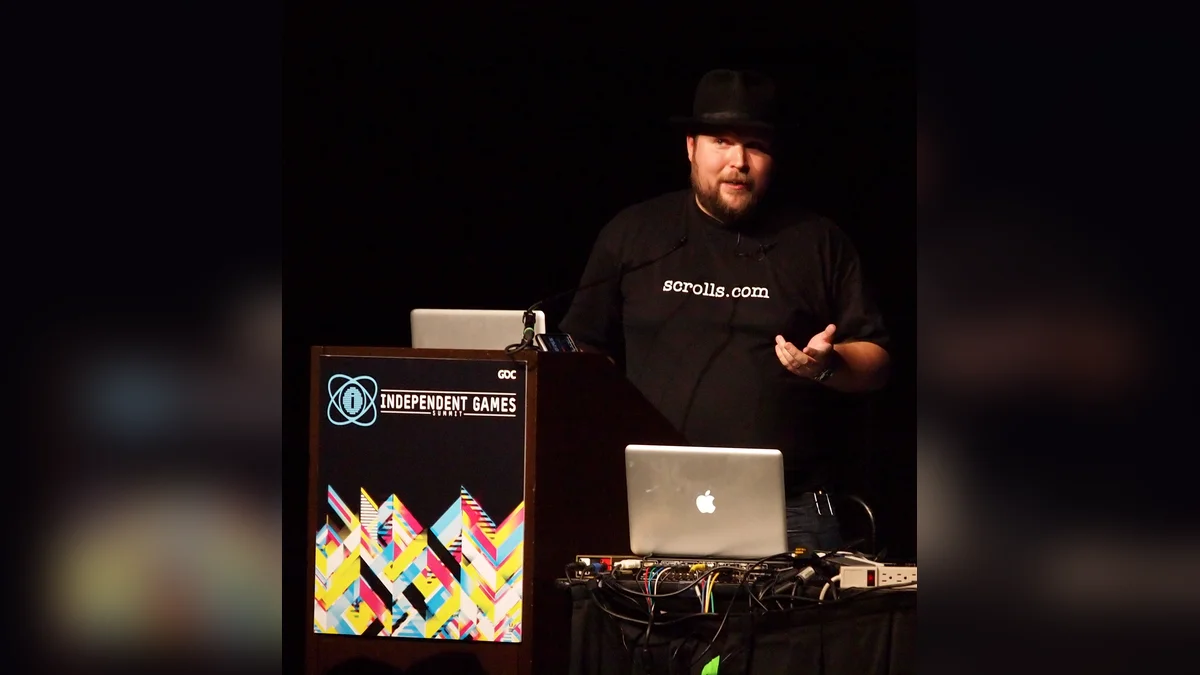
In February 2013, someone posted a story on Reddit about a Swedish programmer who had earned $101 million in personal income the previous year. The programmer was Markus Persson, known simply as “Notch.” The game he created is “Minecraft.” Persson himself joined the discussion. His opening assessment was blunt: “It’s weird as fuck.”
He went on to explain that he grew up in a relatively poor family, never really worried about money once he had a decent job — and then, “as a result of how modern society works,” somehow earned a fortune from something he created once and kept getting paid for over and over. If you build a car, you sell it once, he noted. If you create software that is essentially free to reproduce, you keep getting paid perpetually.
A year or so after that Reddit discussion, Microsoft bought his business for $2.5 billion, making him a billionaire.
A Programmer With a Side Project
Persson grew up in Sweden and began programming on his family’s Commodore 128 at seven; by eight he had created a text-based adventure game. Computers were an absorbing escape during a difficult childhood that included his parents’ divorce and his father’s struggles with substance abuse. He did not finish high school, but he developed skills that landed him professional programming work. In 2004, he joined Midasplayer — the company later known as King — where he made browser games and met fellow developer Jakob Porsér, and helped create “Wurm Online,” a multiplayer game built around a world players could reshape.
In 2009, Persson moved to the photo-sharing company Jalbum and kept experimenting with games in his spare time. One project involved a landscape made of blocks that players could remove, rearrange and use to build things. He called it “Minecraft” and released an early public version in May 2009. The prototype came together quickly; turning it into the game millions would buy took years of updates and an expanding team.
“Minecraft” looked nothing like the expensive, cinematic games dominating the industry. Its graphics were blocky, and it gave players freedom: build a small house, explore caves, or spend weeks constructing a city. That freedom became the sales pitch — screenshots, videos and tutorials spread the game across the internet, each remarkable build advertising what someone else might create. Persson sold access while still developing, bringing in money before the finished 1.0 release. He left his day job and established Mojang with Porsér and Jalbum executive Carl Manneh in 2010. “Minecraft” passed one million paid copies in January 2011 and two million that April; its full release did not arrive until November. Mobile editions and a 2012 Xbox 360 release brought in further audiences.
The $101 Million Payment — Then Another $129 Million
Persson’s financial arrangement put him in an exceptionally lucrative position. He owned the intellectual property behind “Minecraft” through a separate company, while Mojang paid licensing fees to develop and sell the game — and he also owned a majority stake in Mojang itself.
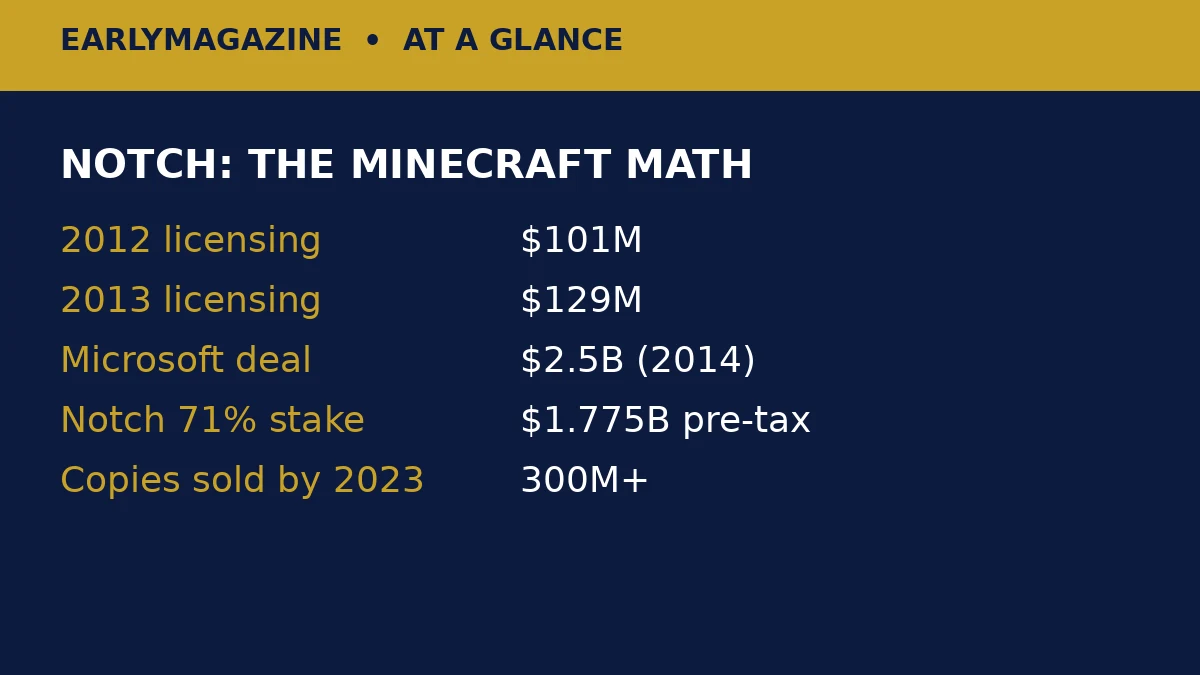
In 2012, Mojang paid 640 million Swedish kronor in licensing fees, equivalent to $101 million at the exchange rates used in contemporary reporting. Mojang’s revenue that year reached 1.5 billion kronor; its biggest expense was paying for the rights to the game that generated its business. The following year brought an even larger payment: 821 million kronor, equivalent to $129 million. That put the licensing payments for those two years alone at $230 million — before counting earlier payments, and before his ownership stake. Mojang’s 2013 revenue reached 2.07 billion kronor (about $330 million) with 816 million kronor in profit. Each additional digital copy cost Mojang almost nothing to produce, so at millions of sales, the economics were spectacular.
Mojang’s success also gave its founders independence: the business generated enough cash to operate without venture capital, and when investors came calling — Sean Parker among them — the founders declined. Persson shared some early wealth with employees, distributing his $3 million dividend for 2011 among Mojang’s staff. Yet money did not eliminate the pressure of being “Notch”: after handing the lead developer role to Jens Bergensten in late 2011, Persson remained the person fans contacted when they disliked something about “Minecraft.”
The Tweet That Helped Trigger a $2.5 Billion Deal
In June 2014, frustrated with the attention and criticism, Persson publicly asked whether anyone wanted to buy his share of Mojang. The message drew interest from potential buyers, including Microsoft, which already had a successful relationship with Mojang through the Xbox version. Microsoft announced the $2.5 billion all-cash acquisition in September and completed it on November 6, 2014. Persson’s 71% ownership stake represented $1.775 billion of the announced purchase price before taxes. Porsér and Manneh owned the remaining shares, and all three founders left.
“Minecraft” kept growing under Microsoft: by 2023 it had surpassed 300 million copies sold, and in April 2025 “A Minecraft Movie,” starring Jack Black and Jason Momoa, opened to $162.8 million in the United States and Canada — the biggest domestic opening ever for a video game adaptation — on its way to $960 million worldwide against a $150 million production budget. Sixteen years after Persson released his block-building experiment, audiences were spending nearly a billion dollars just to watch a movie based on it.
It is the same founder-to-billionaire arc as tech’s other famous names — from Mark Zuckerberg’s empire to the fortune debated around whether LeBron James is really a billionaire — except Persson’s exit was cleaner than most: one game, one company, one cheque. Even Randi Zuckerberg’s career shows how a tech fortune ripples outward; Persson’s simply started with blocks.
Sources and notes: Licensing payments, revenues and deal terms per Swedish financial reporting and contemporary coverage as summarised by Celebrity Net Worth; SEK-to-dollar conversions use contemporary rates. The “around $300 million in royalties” shorthand covers the documented $230 million across 2012–2013 plus earlier licensing payments.
