

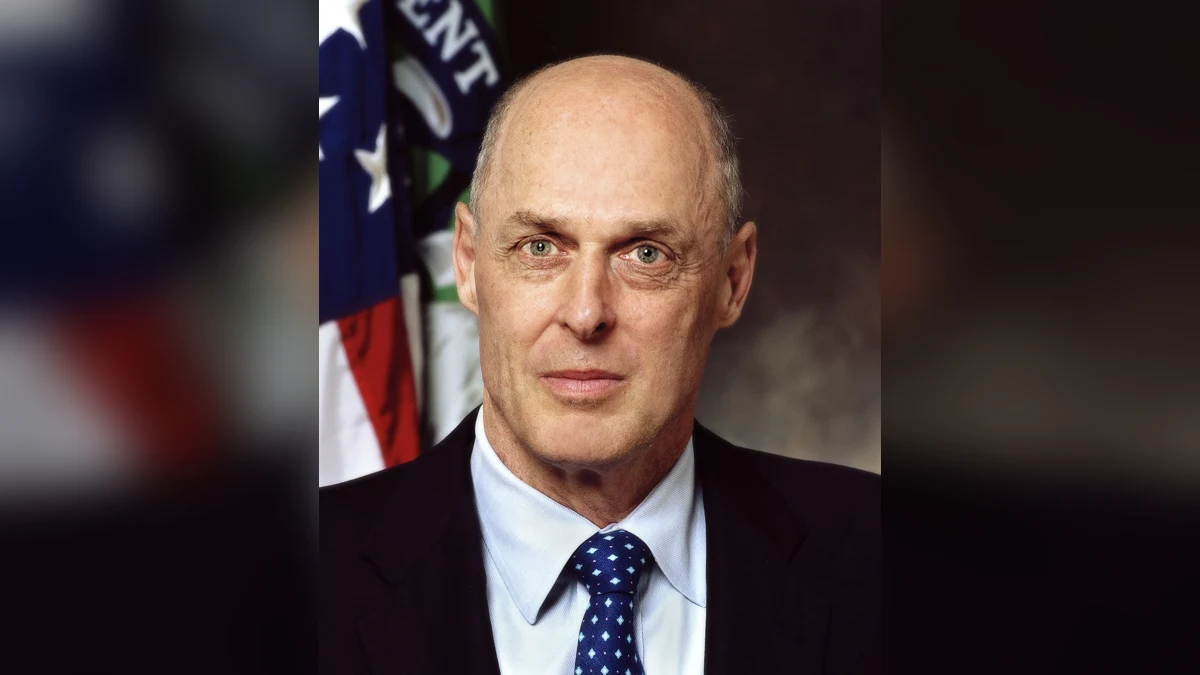
On May 30, 2006, President George W. Bush announced his choice to replace John Snow as the 74th Secretary of the Treasury: Henry Paulson, the chairman and CEO of Goldman Sachs. The nomination was an enormous honor. It also came with a few rather expensive catches.
First, Paulson would have to leave one of the most lucrative jobs on Wall Street. His compensation at Goldman had totaled approximately $38.8 million the previous year. His new government salary would be $183,500, a pay cut of more than 99%. Second, he would have to unwind his financial interests in the company where he had spent the previous 32 years building his fortune. His Goldman common stock alone was worth nearly $500 million, and he would be selling while Wall Street was still enjoying the boom that preceded the financial crisis.
Why on earth would someone agree to that? Public service, influence, and the opportunity to help shape the world’s largest economy certainly have their appeal. Well, as it turns out, the financial sacrifice also came with a remarkable consolation prize.
Henry Paulson Quick Facts
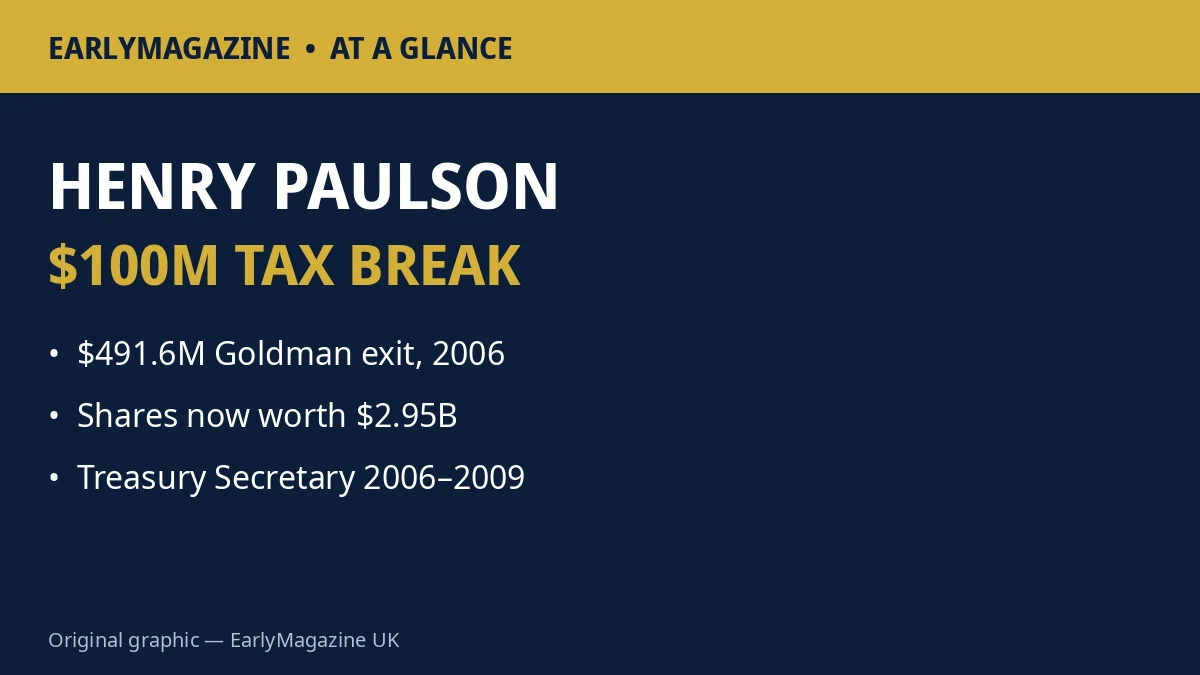
| Goldman Sachs pay (2005) | $38.8 million |
| Treasury Secretary salary | $183,500 |
| Goldman shares sold (2006) | 3,230,024 shares, worth $491.6 million |
| Estimated tax bill deferred | More than $100 million |
| Those shares at Oct 27, 2026 price | $2.95 billion |
| Sworn in | July 10, 2006 |
From Goldman Sachs to a Government Paycheck
Before becoming Treasury Secretary, Paulson spent 32 years climbing the ranks of Goldman Sachs. He joined the firm’s Chicago office in 1974 and became a partner in 1982. He subsequently led its investment banking business in the Midwest, became managing partner of the Chicago office, and moved into increasingly senior leadership roles. By 1994, he was president and chief operating officer. When Goldman went public in 1999, he became chairman and CEO.
That last development was particularly important to his personal balance sheet. Goldman had spent generations as a private partnership. Its transformation into a publicly traded company gave its partners valuable stock in a business that was becoming a global financial powerhouse. By the time Washington came calling, Paulson owned 3,230,024 Goldman common shares, along with additional stock units and options. His $38.8 million compensation package was impressive. The fortune he had accumulated in Goldman equity was in another league entirely. Taking the Treasury job meant separating himself from both.
The Tax Break That Softened the Blow
A Treasury Secretary who owns hundreds of millions of dollars in a major investment bank presents an obvious conflict of interest. Decisions affecting the financial system could also have enormous consequences for his personal fortune. In Paulson’s case, the Office of Government Ethics required him to divest his interests in Goldman.
There is not a blanket rule requiring every senior government official to sell every investment and put the proceeds into a blind trust. The requirements depend on the position and the assets involved. For Paulson, however, keeping his Goldman holdings was incompatible with his new job.
That created another problem. Selling a stock position accumulated over decades can trigger an enormous tax bill. Requiring that sale as the price of entering government could discourage wealthy executives from accepting public-service positions. Congress addressed that problem in 1989 with a provision now found in Section 1043 of the tax code.
Under the provision, an eligible official can obtain a certificate of divestiture before selling assets that create a conflict. If the proceeds are reinvested in permitted investments, such as qualifying diversified funds or U.S. government obligations, within 60 days, the official can defer the capital gain. For someone with a few thousand dollars in stock, that is a useful accommodation. For someone with $491.6 million in Goldman Sachs stock, it is an extraordinary financial benefit.
A Nine-Figure Tax Bill — Postponed
There is one crucial distinction: tax-deferred does not mean permanently tax-free. The deferred gain carries over into the replacement investments through a reduced tax basis. Selling those investments later can bring the postponed gain back into the tax calculation. But postponing a nine-figure tax bill is still a very big deal because it allows money that would otherwise go to the government to remain invested.
It has been estimated that Paulson’s potential tax bill for a complete divestiture without relief was more than $100 million. The benefit was especially valuable because it allowed him to diversify: instead of keeping an enormous portion of his wealth tied to one investment bank, he could move the sale proceeds into qualifying investments without immediately surrendering a large chunk to capital-gains taxes.
The $491.6 Million Exit
On June 29, 2006, Goldman filed a registration statement covering 3,230,024 common shares owned by Paulson. At that day’s closing price of $152.20, those shares were worth $491.6 million. And the common stock was only part of his financial departure. Goldman’s subsequent disclosures show that Paulson received an $18.7 million cash bonus for his work during the first half of 2006. The firm also paid him $110.1 million to cash-settle previously awarded restricted stock units and options. Those payments were separate from his common-share holding, and the $110.1 million represented the settlement of existing equity awards, rather than a new nine-figure signing bonus for going to Washington.
He was sworn in as Treasury Secretary on July 10, 2006.
First, Selling Looked Like a Mistake
For a while, the market made leaving Goldman look very expensive. The firm’s shares continued climbing after Paulson’s departure, reaching an intraday high of $250.70 on October 31, 2007. At that price, the 3.23 million shares he had owned would have been worth $810 million. That is $318 million more than their value at the June 2006 filing price, before counting dividends or any additional compensation he might have earned by staying. On paper, he had traded a Wall Street fortune that was still growing rapidly for a government salary and a much more complicated job. Then came 2008.
Then, Selling Looked Brilliant
Bear Stearns collapsed into an emergency sale. Lehman Brothers filed for bankruptcy. Credit markets seized up, and Paulson found himself at the center of the effort to prevent a full-scale financial catastrophe. Goldman survived, but its shareholders endured a brutal collapse. On November 21, 2008, the stock traded as low as $47.41, a decline of 81% from its 2007 peak. At that price, Paulson’s former block of shares would have been worth $153 million.
What Would Those Shares Be Worth Now?
Of course, the story did not end at the bottom of the financial crisis. Goldman recovered, and over the following years, its stock climbed far beyond its pre-crisis peak. At the October 27, 2026 closing price of $911.77, Paulson’s former 3,230,024 shares would have been worth $2.95 billion. And that figure excludes dividends. At Goldman’s quarterly dividend rate of $5 per share, a holding that size would generate $16.15 million every quarter, or $64.6 million annually if the rate remained unchanged. The annual dividend income alone would exceed his entire 2005 Goldman compensation package.
That does not mean taking the Treasury job cost Paulson the difference between $491.6 million and $2.95 billion. The money from his departure did not disappear. It could be reinvested, and a proper comparison would have to account for what those investments earned, along with taxes, dividends, spending, and charitable giving. But as a Wall Street what-if, it is a spectacular set of numbers. In 2007, leaving Goldman meant missing a huge rally. In 2008, it meant escaping a devastating collapse in his former employer’s stock. Two decades later, the shares he gave up would represent a $2.95 billion holding. Hindsight is 20/20. In Henry Paulson’s case, it also depends on which year you choose to look back from.
For more money-and-power stories, see our Joe Biden profile, Daniel Lubetzky billionaire story and Is David Beckham really a billionaire pieces.
