

One of the first articles Celebrity Net Worth ever published was a ranking of the richest people of all time, adjusted for inflation. Every time a new version goes viral, the same email arrives: “WHAT ABOUT KING SOLOMON?!!” — sometimes with “READ THE BIBLE!” attached. The objection is always the same: the Bible describes Solomon as a king of unmatched wealth, so how could any richest-ever list leave him off?
It is a fair question — and it deserves a proper hearing. So set the scepticism aside for a moment, follow the gold, and see what happens when biblical wealth is translated into modern dollars. Along the way there is a queen who arrived with tons of gold, a court where silver barely deserved a second glance, and a fortune that has somehow acquired a $3 trillion price tag.
A King Who Asked for Wisdom
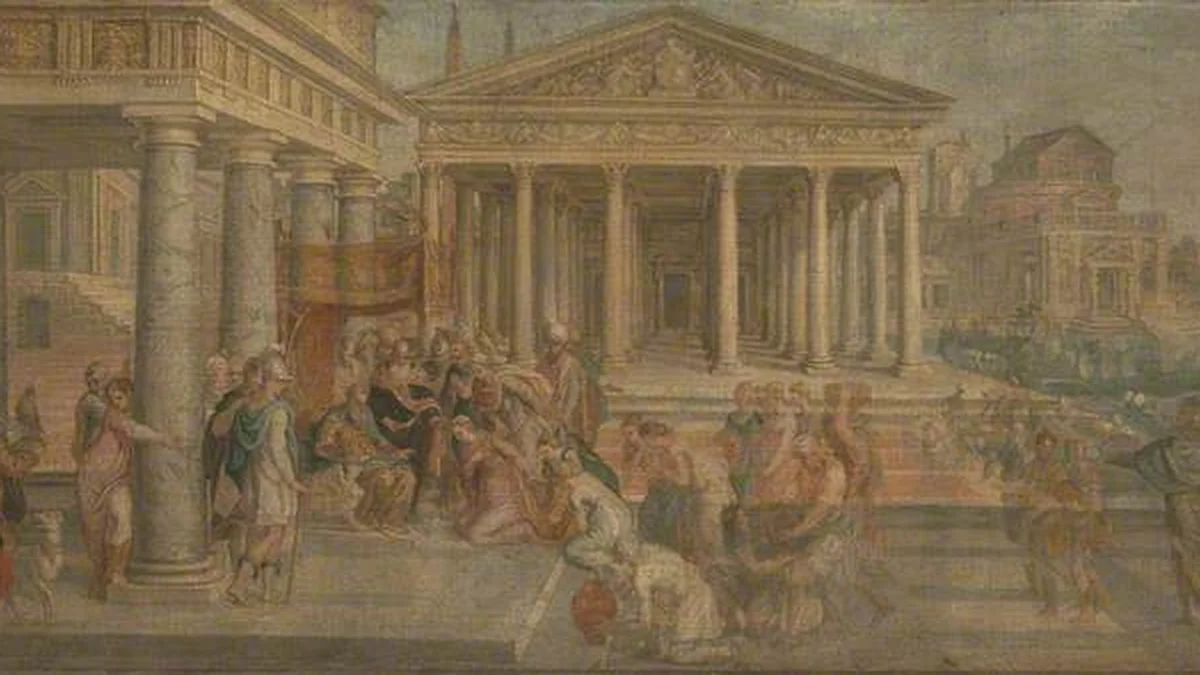
According to the biblical account, Solomon succeeded his father David as king of Israel, with his reign traditionally placed in the 10th century BC. Given the opportunity to ask for anything, he did not ask for money — he asked God for wisdom to govern. God, pleased that he chose understanding over riches, long life or the destruction of his enemies, granted the wisdom — along with wealth and honour on a legendary scale.
The descriptions are spectacular. First Kings describes a great ivory throne overlaid with gold, golden drinking vessels and hundreds of gold shields. Silver is so abundant in Jerusalem that the text compares it to stones. Ships bring precious metals and exotic cargo; visitors arrive with valuable gifts. The Queen of Sheba’s contribution alone is staggering: 120 talents of gold, plus spices and precious stones. Using a common estimate of 75 pounds per talent, that one royal gift weighed about 9,000 pounds — diplomacy on a scale that requires a caravan.
Does the Bible Actually Say He Was the Richest Ever?
The argument has a real basis in the text. First Kings 10:23 describes Solomon as surpassing the other kings of the earth in wealth and wisdom, and 1 Kings 3:13 promises riches and honour unequalled among the kings of his lifetime. But 2 Chronicles 1:12 goes further: God promises riches, wealth and honour unmatched by the kings before him, adding, in the King James Version, “neither shall there any after thee have the like.” Someone reading that promise as establishing Solomon’s unmatched wealth has a clear reason for doing so.
What these passages do not supply is a dollar valuation. They establish extraordinary standing within the biblical account. Getting from that account to a $3 trillion personal fortune requires a separate set of assumptions about gold, ownership, spending and the value of wealth across thousands of years.
The Number Behind the Fortune: 666 Talents of Gold
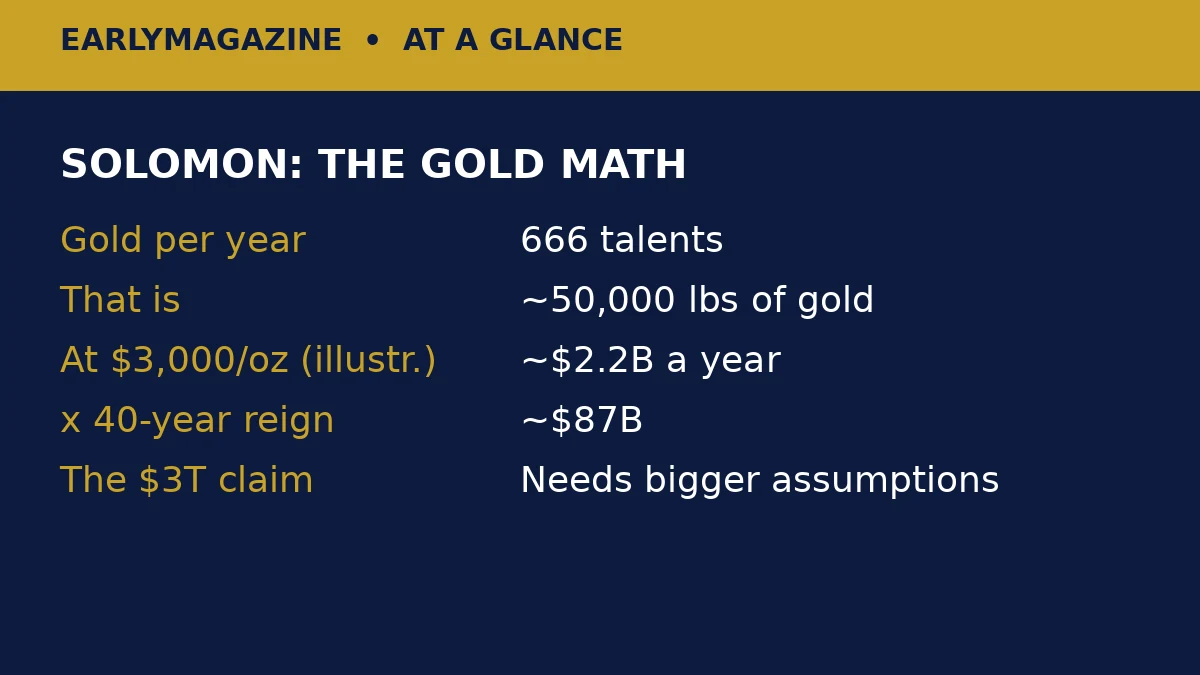
The most useful number appears in 1 Kings 10:14, which describes 666 talents of gold coming to Solomon in a year. A talent was a unit of weight that varied across ancient societies; using the common biblical estimate of 75 pounds, 666 talents works out to almost 50,000 pounds of gold — about 25 US tons, or 22.7 metric tonnes, roughly 728,000 troy ounces.
For a simple illustration, use a gold price of $3,000 per troy ounce. This is a round-number assumption, not a live market quote. At that price, the gold described in the passage would be worth about $2.2 billion for one year. First Kings gives Solomon a 40-year reign; multiply that annual amount by 40 and the result is about $87 billion at the same assumed price. The arithmetic is straightforward; the historical assumptions are much less secure. It assumes the same quantity arrived every year for four decades and that every ounce accumulated without being spent or given away.
How Does That Become $3 Trillion?
The Bible never assigns Solomon a trillion-dollar fortune. Figures like $2 trillion and $3 trillion are modern estimates, and their usefulness depends entirely on how they were calculated. Consider the often-repeated claim that he possessed 500 tons of gold: even interpreting that as 500 metric tonnes, the metal would be worth about $48 billion at the illustrative $3,000 gold price. To turn that pile into $3 trillion, you need something beyond bullion value — an estimate of ancient purchasing power, additional assets, or another economic comparison. The weight alone does not produce the headline.
Buying power is where the exercise gets complicated. Gold that buys a certain amount of labour or farmland in one society will not necessarily buy the same amount in another. A king’s command of workers, agricultural production and tribute cannot be converted into dollars simply by pricing the metal in his treasury. There is no continuous consumer-price index stretching from Solomon’s Jerusalem to the present.
Then there is the archaeology. In the Timna Valley in southern Israel, researchers led by Tel Aviv University’s Erez Ben-Yosef dated material from a major smelting camp to the 10th century BC, the period traditionally associated with Solomon. The finds reveal sophisticated production and trade — but these were copper operations run by local operators, likely early Edomites, not the discovery of a trillion-dollar gold hoard, and they do not establish that Solomon personally owned the mines. The biblical account describes gold arriving from a place called Ophir; it provides no map to a single lost mine. Much of the “King Solomon’s Mines” image comes from H. Rider Haggard’s 1885 adventure novel, not the Bible.
What Can Historians Establish?
Solomon’s kingdom remains a subject of serious historical debate. Archaeologists disagree about the dates and royal patrons of monumental structures associated with him, including remains at Megiddo, Hazor and Gezer, and no generally accepted contemporary inscription naming Solomon has settled those questions. Some scholars see the biblical account as preserving substantial historical information about a powerful ruler; others envision a smaller kingdom whose achievements were expanded in later writing. None of this justifies declaring that Solomon certainly never existed — but establishing the scale of his kingdom, much less the contents of his personal treasury, requires evidence we do not currently have.
Then Why Include Mansa Musa?
This is the obvious follow-up. Celebrity Net Worth’s all-time list ranks Mansa Musa of the Mali Empire very highly, at $400 billion. Musa’s wealth has support outside a single religious narrative: the medieval writer al-Umari collected accounts from people in Cairo who encountered him during his famous pilgrimage. Those accounts establish the extraordinary impression made by his gold and spending, though they still do not establish a precise modern net worth. Solomon presents an especially difficult combination: debate over the scale of the kingdom, limited independent evidence for personal wealth, and no dependable way to turn the biblical descriptions into a total fortune. Assigning him $3 trillion would make a ranking look more complete without making it more reliable.
There is a revealing final turn in the biblical story. After Solomon dies, his subjects ask his son Rehoboam to lighten the burden imposed by his father. Rehoboam refuses, and the kingdom divides. The narrative that gives us the magnificent court also gives us people who paid a heavy price to sustain it. Was he the richest person who ever lived? The Bible gives readers a basis for believing his wealth was unsurpassed. The historical evidence does not give us a reliable dollar figure or a way to rank him against every fortune that followed. Leaving Solomon unranked is an acknowledgment that we cannot responsibly price his fortune.
Modern “richest” lists face the same problem on a smaller scale — whether ranking the richest lawmakers in Washington, the richest supermodels in the world, or the richest players at the 2026 World Cup, every figure is an estimate built on assumptions. Solomon’s is simply the oldest — and the hardest — version of that problem.
Sources and notes: Biblical passages cited from 1 Kings and 2 Chronicles (King James Version wording where quoted); gold-weight conversions and the $3,000/oz illustration per Celebrity Net Worth; Timna Valley research per Tel Aviv University; historical debate as summarised by archaeologists. All biblical wealth figures are attributed to the biblical account, not established historical fact.
