

 Curtis Priem: Nvidia Co-Founder Who Gave Away $550B
$30 million
 Jensen Huang Admits Affair as Nvidia Board Investigates
$145 billion
 Blanket Jackson Inheritance: $1B by Age 40
$2.5 billion
 Naked Cowboy
$500,000
 Bridgit Mendler
$200 million
 Timbaland Sues Ex-Managers for $15M After $134M Earnings
$134 million
 Richest Singers in the World in 2026, Ranked by
$2 billion
| Quick Facts | Lou Pai |
|---|---|
| Full Name | Lou Pai |
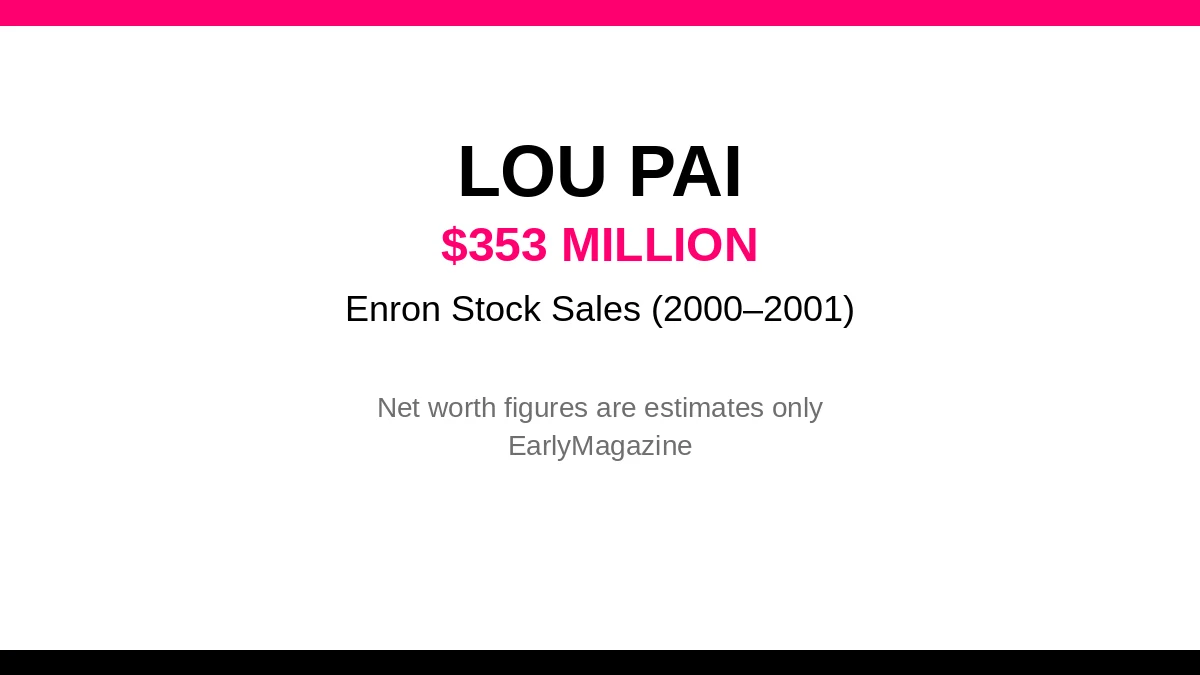
| Net Worth | $353 million |
| Source of Wealth | Enron stock sales (2000–2001) |
| Born | 1947, Nanjing, China |
| Education | Economics degrees, University of Maryland |
| Known For | CEO of Enron Energy Services; selling ~$353M of Enron stock before the collapse |
| Former Employer | Enron (joined 1987) |
| Former Spouse | Lanna Pai (divorce finalised 21 August 2000) |
| Spouse | Melanie Fewell Pai |
| Notable Assets | Taylor Ranch, Colorado (77,000 acres); Wellington, Florida equestrian estate |
Lou Pai net worth is $353 million, built almost entirely from Enron stock he sold before the company collapsed. Pai was not an Enron founder or a household name, but he walked away from what was then the biggest corporate failure in American history with hundreds of millions in the bank, while most colleagues and thousands of employees lost almost everything. That timing is why his name is still remembered.
One note on the figure: the Celebrity Net Worth article about Pai carries $350 million in its URL, but its own maths puts his proceeds at $353 million, so $353 million is used here — the total he took out of Enron shares, sold in stages before the collapse. What makes the story striking is not just the sum, but why he was selling, how fast Enron then fell apart, and the fact that Pai, unlike several men he worked alongside, was never criminally convicted over Enron.
Early Life
Lou Pai was born in Nanjing, China, in 1947, and moved to the United States as a child. Little about his early years is on the public record. What is known is that he studied economics at the University of Maryland, where he earned economics degrees that would shape the rest of his working life. Pai has kept a low profile for most of his life, rarely giving interviews.
Career
Pai joined Enron in 1987, when the company was still building itself into one of the largest energy companies in America. Over the next decade he rose through its ranks, and in March 1997 he was appointed chief executive of Enron Energy Services, the division set up to sell energy directly to businesses and other large customers. It was a senior role at the heart of the company’s expansion.
In 1997 Enron’s shares were climbing and its executives were being rewarded with large holdings of stock. Pai’s wealth was tied up in those shares, but it only became real money when they were sold — and selling meant giving up further gains if the price kept rising.
For Pai, the decision to sell was forced on him by events in his private life. His marriage was coming to an end, and the divorce settlement would require a division of the couple’s assets. To fund that division, he began selling large blocks of Enron stock in early 2000. On 22 March 2000 alone, Pai sold 1,760,500 shares at $74.57 each, taking in more than $131 million in a single day.
He did not stop there. By the time he had finished, his total proceeds from Enron stock sales stood at around $353 million. The timing could hardly have been better for him, or worse for anyone who held on. Enron’s shares had reached $90.56 in August 2000, but the company’s finances were built on accounting that would soon unravel. By late November 2001 the share price had fallen to around $1, and on 2 December 2001 Enron filed for bankruptcy, then the largest in American history.
Pai had sold out before almost any of that happened. While Enron employees saw retirement savings held in company stock wiped out and investors lost billions, Pai kept the cash. That contrast has defined his reputation ever since: one of the luckiest executives in corporate history, whose personal crisis accidentally saved him from a corporate disaster.
The SEC Case
The sales did not go unexamined. In July 2008, the Securities and Exchange Commission charged Pai with insider trading over Enron stock he sold in May and June 2001, alleging he sold while in possession of non-public information. Pai settled, agreeing to pay $31.5 million without admitting or denying the allegations, and accepting a five-year ban on serving as an officer or director of a public company.
The settlement closed the civil case, but Pai was never criminally convicted over Enron. No criminal charges were brought against him and he served no prison sentence, unlike some executives who ran the company alongside him. The $31.5 million was a small fraction of the roughly $353 million he had taken out of Enron stock, and it left his fortune largely intact.
Personal Life
Pai’s personal life is inseparable from the story of his fortune, because it was his divorce that set the stock sales in motion. While married to his first wife, Lanna, Pai had an affair with Melanie Fewell, a stripper. The affair produced a daughter, born in April 1997. Lanna learned about the affair in 1998, and the marriage did not survive it.
Pai filed for divorce in March 2000, and it was finalised on 21 August 2000. The terms were later set out in a 2007 decision of a Texas appeals court, which put the couple’s marital estate at $193.6 million. Lanna received $110,536,269 of that estate, more than 57 per cent of the total. It was to fund that division that Pai sold the Enron shares, including the $131 million block on 22 March 2000.
Pai later married Melanie Fewell, and the couple turned their attention to horses. Pai became known as a horse farmer and breeder, and he has stayed largely out of public view since leaving Enron. In 1999, he bought the Taylor Ranch in Colorado, a vast 77,000-acre property, for around $23 million, and sold it in 2004 for around $60 million. Then, in May 2022, he bought an equestrian estate in Wellington, Florida, for $8.2 million.
Those purchases tell the second half of the Lou Pai story. The first half was about timing: selling $353 million of Enron stock before a $90 share became a $1 share. The second was about what he did with it — converting paper wealth into land and horses, and staying out of the corporate world that had made him rich. He was never criminally convicted, settled the one civil case against him for a fraction of what he had made, and kept the bulk of the fortune. For the thousands who lost money when Enron collapsed, that is the part that still stings, and why his name is still remembered more than two decades later.
Related: Elon Musk Net Worth, Nicolas Cage Net Worth, Jay Rockefeller Net Worth
Net worth figures are estimates only.
