

 Gary Sinise
$50 million
 Colette Kress
$1 billion
 Jensen Huang Still Earns $811M a Year After Resigning
$138 billion
 NVIDIA Co-Founders: One Gave Away a $768B Fortune
$30 million
 Matt Lucas
$14 million
 Olivier Martinez
$500,000
 Ron Jeremy
$895,000,
 Chris Malachowsky
$400 million
 Lou Pai
$353 million
 Curtis Priem: Nvidia Co-Founder Who Gave Away $550B
$30 million
 Jensen Huang Admits Affair as Nvidia Board Investigates
$145 billion
 Blanket Jackson Inheritance: $1B by Age 40
$2.5 billion
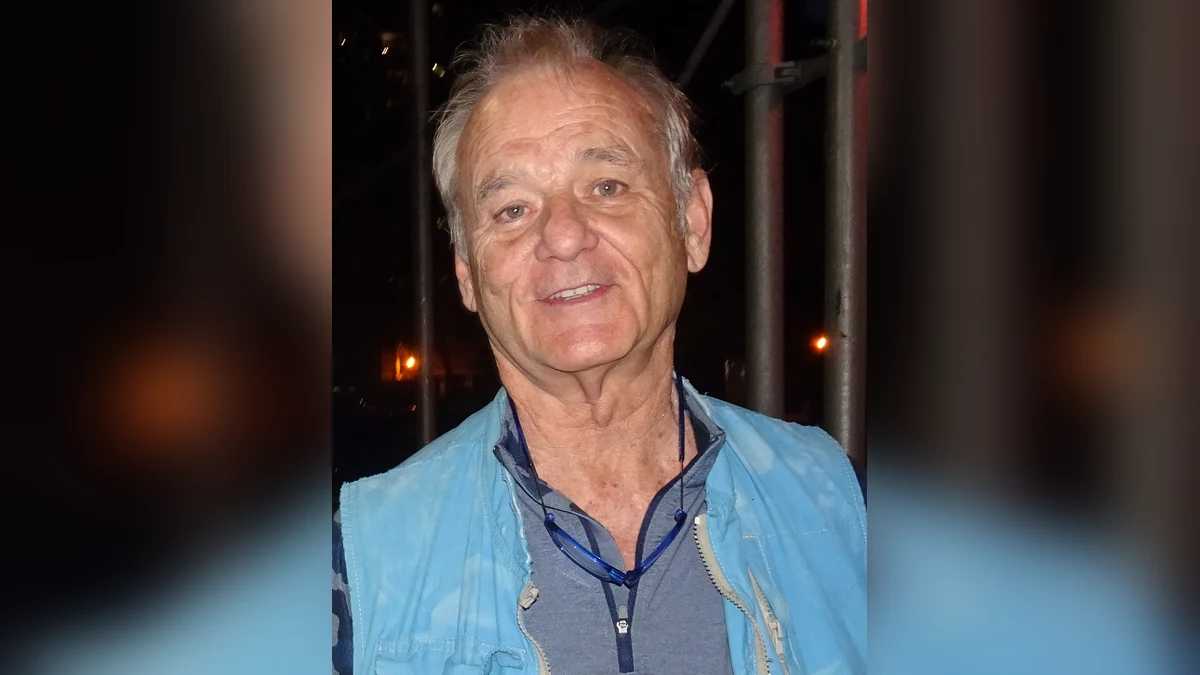
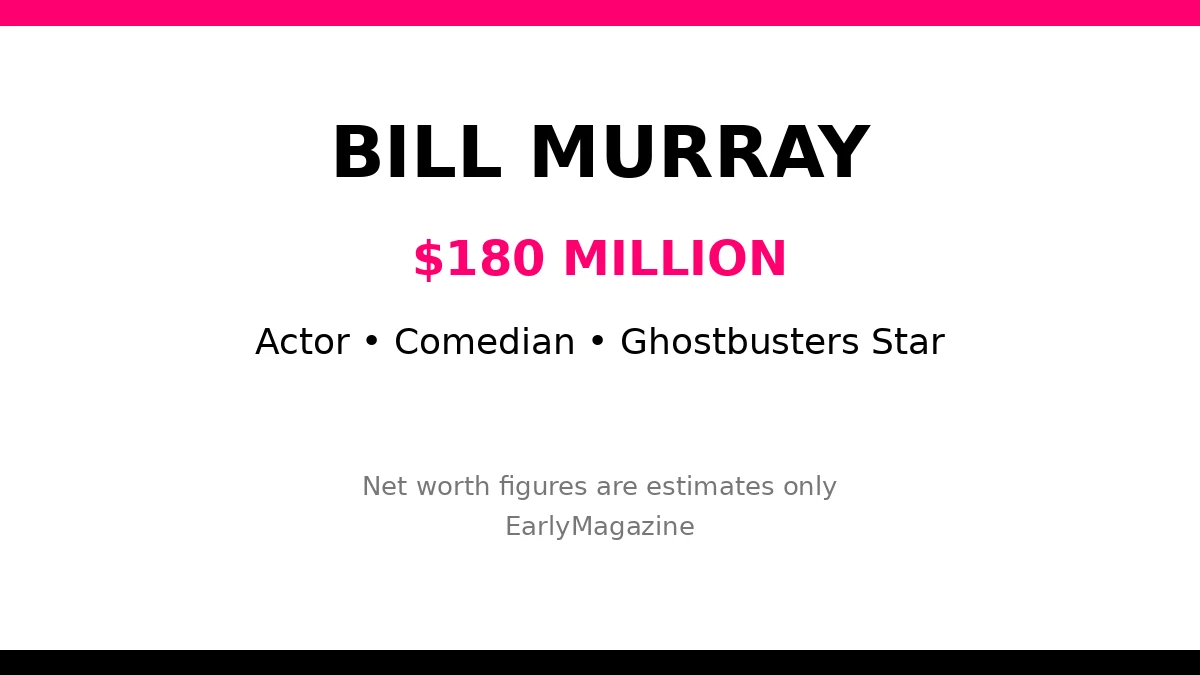
Bill Murray is an American actor, comedian, writer and producer who has a net worth of $180 million. He has spent more than five decades moving between broad comedy, blockbuster franchises, eccentric independent films and understated dramatic performances, and his greatest commercial windfall came from “Ghostbusters”, a deal that may have earned him around $125 million from the first two films alone.
| Quick Facts | Bill Murray |
|---|---|
| Full Name | William James Murray |
| Net Worth | $180 million |
| Born | 21 September 1950, Evanston, Illinois, USA |
| Age | 76 |
| Occupation | Actor, comedian, writer, producer |
| Best Known For | Saturday Night Live, Ghostbusters, Groundhog Day, Lost in Translation |
| Spouses | Margaret Kelly (1981–1996), Jennifer Butler (1997–2008) |
| Children | Six sons |
| Source of Wealth | Film salaries, Ghostbusters profit participation, baseball investments, real estate |
Early Life
William James Murray was born on 21 September 1950 in Evanston, Illinois, and grew up in nearby Wilmette in a large Irish Catholic family. He was the fifth of nine children. His father, Edward, worked as a lumber salesman, while his mother, Lucille, worked in a mailroom. His brothers Brian Doyle-Murray, Joel Murray and John Murray also pursued acting careers. Bill and several of his siblings worked as golf caddies when they were young, helping pay tuition at Loyola Academy. His father died when Murray was 17. After high school, Murray enrolled at Regis College in Denver with plans to study pre-med. At age 20, he was arrested at Chicago’s O’Hare International Airport after authorities discovered roughly 10 pounds of marijuana in his luggage. He was convicted and received probation, soon abandoned his medical studies and returned to the Chicago area.
Early Comedy Career
Murray’s older brother Brian Doyle-Murray encouraged him to try improvisational comedy, and Bill joined Chicago’s Second City. The training gave him the foundation for the deadpan, improvisational style that would eventually become his trademark. He later moved to New York and joined “The National Lampoon Radio Hour”, working alongside John Belushi, Gilda Radner and Dan Aykroyd. His breakthrough came after Chevy Chase left NBC’s “Saturday Night Live”: Murray joined the cast in January 1977 during the show’s second season. He initially faced resistance from viewers accustomed to the original cast, but characters such as lounge singer Nick the Lounge Singer quickly made him one of the show’s stars. Murray remained with “Saturday Night Live” through 1980 and shared an Emmy Award with the show’s writing staff in 1977.
1980s Film Stardom
Murray’s movie career began taking off while he was still associated with “Saturday Night Live”. He starred in 1979’s “Meatballs”, directed by Ivan Reitman, followed by “Where the Buffalo Roam” in 1980. That same year, he played groundskeeper Carl Spackler in “Caddyshack”; although his role was relatively small, his highly improvised performance became one of the most memorable parts of the film. He reunited with Reitman for “Stripes” in 1981, appeared opposite Dustin Hoffman in “Tootsie” in 1982, and then came “Ghostbusters” in 1984. As Dr. Peter Venkman, Murray delivered one of his defining performances and helped turn the supernatural comedy into one of the decade’s biggest movies. He also co-wrote and starred in 1984’s “The Razor’s Edge”, which performed poorly at the box office. Disappointed and exhausted by Hollywood, he largely stepped away from acting and spent time in France, studying philosophy and history at the Sorbonne. He returned to leading roles with “Scrooged” in 1988 and reunited with Aykroyd, Ramis and Reitman for “Ghostbusters II” in 1989.
The Ghostbusters Paydays
“Ghostbusters” did much more than make Bill Murray one of the biggest movie stars of the 1980s. It also produced one of the most lucrative compensation arrangements of his career. When Columbia Pictures secured the project, CAA co-founder Michael Ovitz negotiated an unusually generous deal for Murray, Dan Aykroyd, Harold Ramis and director Ivan Reitman. The four principals collectively received 30% of revenues from the box office, home video and television licensing. The first “Ghostbusters” earned nearly $300 million at the worldwide box office, and according to Ovitz’s account the four-way participation eventually generated approximately $300 million, or roughly $75 million apiece. For “Ghostbusters II”, each of the four received a $6 million upfront salary while collectively participating in 35% of the film’s gross. Celebrity Net Worth has conservatively estimated that Murray ultimately earned around $50 million from the sequel, giving him approximately $125 million from the first two “Ghostbusters” movies alone — the foundation of his $180 million fortune.
Groundhog Day, Rushmore and Lost in Translation
Murray entered the 1990s with “Quick Change”, which he co-directed, followed by “What About Bob?” in 1991. One of the defining films of his career arrived in 1993 with “Groundhog Day”, in which he starred as cynical television weatherman Phil Connors, trapped reliving the same day over and over. The film became regarded as a modern comedy classic. It also marked the end of Murray’s long creative partnership with Harold Ramis: the two reportedly clashed during production and remained estranged for more than two decades before reconciling shortly before Ramis’ death in 2014. His career took another important turn in 1998, when he played wealthy industrialist Herman Blume in Wes Anderson’s “Rushmore”, beginning one of the longest director-actor partnerships of his career. Murray reached a new level of critical acclaim with Sofia Coppola’s 2003 film “Lost in Translation”, playing Bob Harris, an ageing movie star visiting Tokyo who forms an unexpected friendship with a younger American woman played by Scarlett Johansson. The performance earned him the Golden Globe and BAFTA Award for Best Actor and his first Academy Award nomination; he ultimately lost the Oscar to Sean Penn for “Mystic River”. He became a regular member of Wes Anderson’s ensemble, appearing in “The Royal Tenenbaums”, “The Life Aquatic with Steve Zissou”, “The Darjeeling Limited”, “Fantastic Mr. Fox”, “Moonrise Kingdom”, “The Grand Budapest Hotel”, “Isle of Dogs” and “The French Dispatch”, and in 2025 he returned with a cameo as God in “The Phoenician Scheme”.
Salaries, Later Career and Controversy
Murray has often made unconventional choices when negotiating salaries. He was reportedly paid $6 million to star in 1988’s “Scrooged”, an enormous salary for a comedy actor at the time. A decade later, he went in the opposite direction for “Rushmore”, agreeing to work for the Screen Actors Guild minimum; Anderson later estimated Murray earned only about $9,000 in acting salary for the film, although he also received a share of the profits. Murray was so committed that when Disney declined to pay for a helicopter shot Anderson wanted, he reportedly wrote the director a $25,000 check to cover it himself. Anderson did not cash the check. His later films included “Broken Flowers”, “Zombieland”, “Hyde Park on Hudson”, “St. Vincent”, “The Jungle Book” and Sofia Coppola’s “On the Rocks”. His performance in HBO’s “Olive Kitteridge” earned him the 2015 Emmy for Outstanding Supporting Actor, his second Emmy. He returned as Peter Venkman in 2021’s “Ghostbusters: Afterlife” and 2024’s “Ghostbusters: Frozen Empire”, and joined the Marvel Cinematic Universe in 2023’s “Ant-Man and the Wasp: Quantumania”. In 2022, Murray was filming Aziz Ansari’s “Being Mortal” when Searchlight Pictures suspended production after a complaint about his behaviour on set. Murray acknowledged his conduct had caused the complaint, describing it as a “difference of opinion”. Later reporting alleged he had kissed and straddled a female production employee and subsequently reached a settlement with her worth slightly more than $100,000. Production did not resume. The incident renewed attention on earlier accounts of Murray being difficult on sets, including Lucy Liu’s account from “Charlie’s Angels” and Geena Davis’s from “Quick Change”.
Baseball, Real Estate and Personal Life
Baseball has been one of Murray’s biggest interests outside acting. A lifelong Chicago Cubs fan, he became part-owner of the Charleston RiverDogs following the 1989 season and remains a co-owner, holding the title “Director of Fun”. He was inducted into the South Atlantic League Hall of Fame in 2012. Over the decades, Murray has owned homes in Southern California, Martha’s Vineyard, the Hudson Valley and Charleston, South Carolina. One memorable former property was an eight-acre estate in Palisades, New York, with a roughly 15,000-square-foot mansion; as a tribute to the Cubs, he had the team’s logo incorporated into the bottom of the swimming pool. Murray has been married twice and has six sons. He married Margaret “Mickey” Kelly in 1981 after meeting her during the production of “Stripes”; they had two sons, Homer and Luke, before divorcing in the 1990s. He married costume designer Jennifer Butler in 1997, and they had four sons — Caleb, Jackson, Cooper and Lincoln — before Butler filed for divorce in 2008, making allegations including domestic abuse, infidelity and addiction. For years, Murray has operated without a conventional full-time agent and has been notoriously difficult for filmmakers to reach, sometimes requiring directors to leave messages on a dedicated voicemail number and wait to see whether he responds.
Net worth figures are estimates based on public sources and are not confirmed financial disclosures.
Related: Jim Carrey Net Worth, Dan Aykroyd’s Ghostbusters Deal, Sigourney Weaver Net Worth
