

Dan Aykroyd grew up in a house where the paranormal was dinner-table conversation. His grandfather claimed to communicate with the dead through the radio; his mother said she could see ghosts; his father, a civil engineer who advised Canadian Prime Minister Pierre Trudeau, wrote a book about it all called “A History of Ghosts.” That upbringing became the most lucrative idea in comedy history — not because of what Aykroyd wrote, but because of the deal he refused to sign without.
From SNL to the Blues Brothers
Aykroyd was the youngest member of the original “Saturday Night Live” cast, leaving in 1979 after four seasons. The following year he and his best friend John Belushi co-starred in “The Blues Brothers,” which Aykroyd co-wrote; it earned over $115 million on a $27 million budget.
While filming it, Aykroyd began sketching his paranormal idea. The original pitch was Aykroyd, Eddie Murphy and Belushi chasing ghosts around New York. That version died with Belushi, who died of a drug overdose on 5 March 1982. Friends later recalled Aykroyd barely laughed for a year.
The Phone Call That Changed Hollywood Contracts
In early 1983, Aykroyd called his agent, Michael Ovitz — the most powerful agent in Hollywood and head of Creative Artists Agency. The pitch had become Aykroyd, Bill Murray and Harold Ramis chasing ghosts. Ovitz loved it. Aykroyd and Ramis wrote the screenplay in two weeks, and Ivan Reitman — director of “Stripes” — signed on to direct.
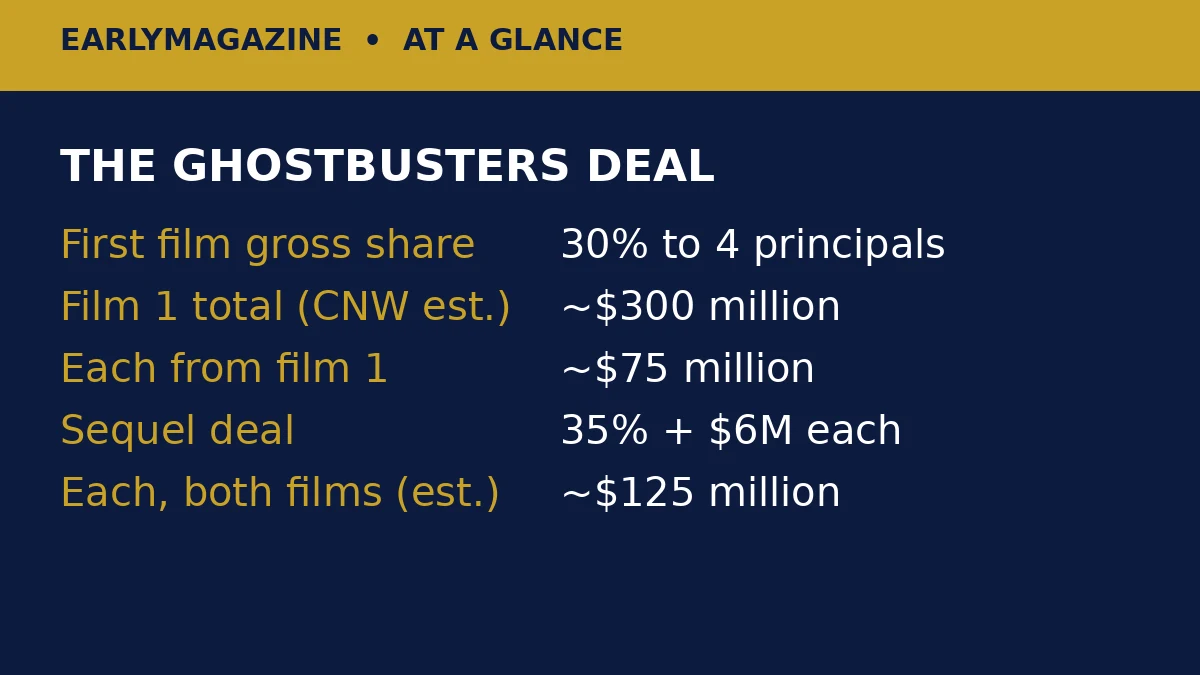
Columbia Pictures wanted the film, then titled “Ghostbusters.” Ovitz and CAA had one non-negotiable condition: Columbia had to give 30% of the film’s gross participation to Aykroyd, Murray, Ramis and Reitman, with CAA taking 3% itself for packaging the deal.
What 30% Was Worth
“Ghostbusters” grossed $295 million at the box office in its original run, then became a phenomenon on VHS and television licensing for decades. According to Ovitz’s memoir, CAA’s 3% stake ultimately generated $30 million for the agency. By the same arithmetic, the four principals’ 30% stake generated roughly $300 million over the years — about $75 million each in mid-1980s money, or roughly $200 million each in today’s money.
That is the difference between a salary and ownership, and it is the exact lesson in reverse of Roseanne Barr’s story: the back-end she signed away may have cost her $100 million, while the back-end the Ghostbusters team kept paid them for decades. It is also the principle behind Michael Jackson’s catalog fortune and John Paul DeJoria’s empires — own the asset, don’t just rent out your time.
The Sequel Paid Even Better
Five years later, Columbia was desperate for a follow-up and the four men were even bigger stars. For “Ghostbusters II,” Ovitz negotiated an even sweeter deal: 35% of the box office gross, plus $6 million upfront salaries each.
The sequel grossed $215 million theatrically and performed similarly on home video and television. Celebrity Net Worth conservatively estimates each principal earned around $50 million from the sequel from all sources — an estimate, not a disclosed figure, but consistent with the sequel’s stronger percentage on a slightly smaller gross.
Add the two films together and each man conservatively earned about $125 million before inflation — roughly $310 million each in today’s money, by Celebrity Net Worth’s calculation.
The One Star Left Out
There is a footnote the celebration usually skips. Ernie Hudson, the fourth Ghostbuster on screen as Winston Zeddemore, was not part of the ownership deal. He has spoken since about being paid far less than his co-stars and barely featured in the marketing — a reminder that even the shrewdest deal in Hollywood history had a sharp edge.
Ramis died in 2014 and Reitman in 2022, so their shares now benefit their families and estates. Aykroyd and Murray are still collecting. Forty years after a phone call about ghosts, the deal Ovitz cut remains the gold standard for what talent can demand when it walks in owning the idea.
Sources and notes: Deal terms and CAA proceeds from Michael Ovitz’s memoir “Who Is Michael Ovitz?” as reported by Celebrity Net Worth; box office figures from Box Office Mojo and contemporary reporting ($295.2M original run for Ghostbusters; $215M for Ghostbusters II); sequel per-person figures and inflation adjustments are Celebrity Net Worth estimates, not disclosed payments. Participation payouts depend on private contract definitions and distribution costs.
