

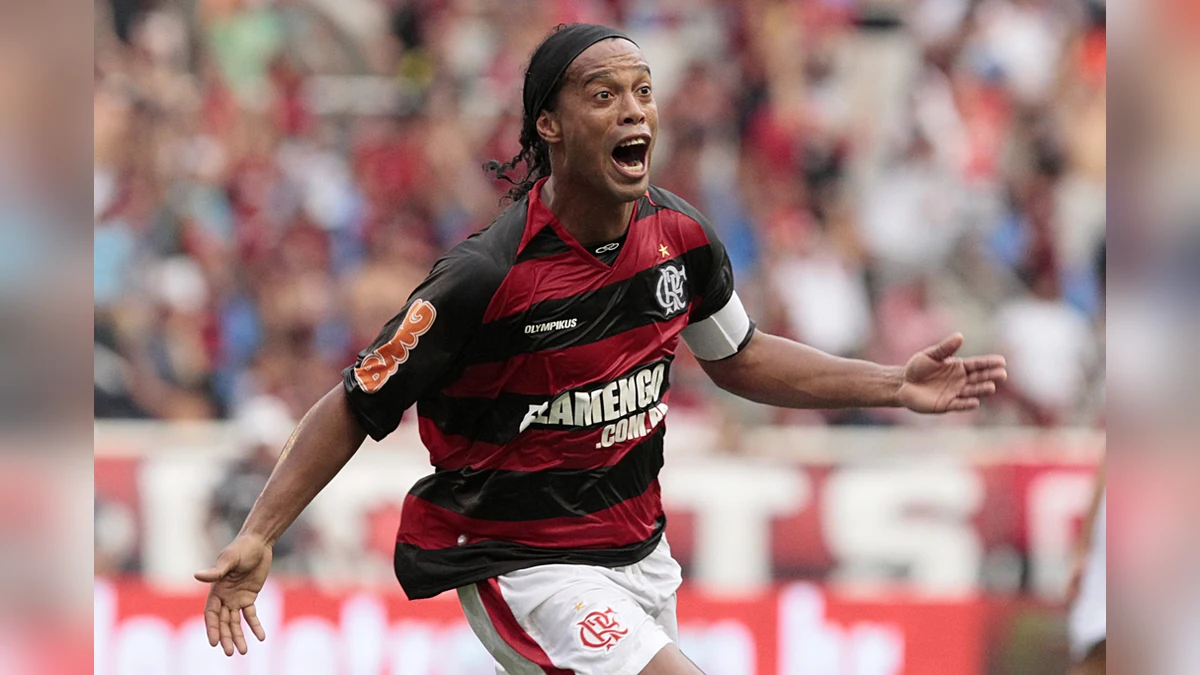










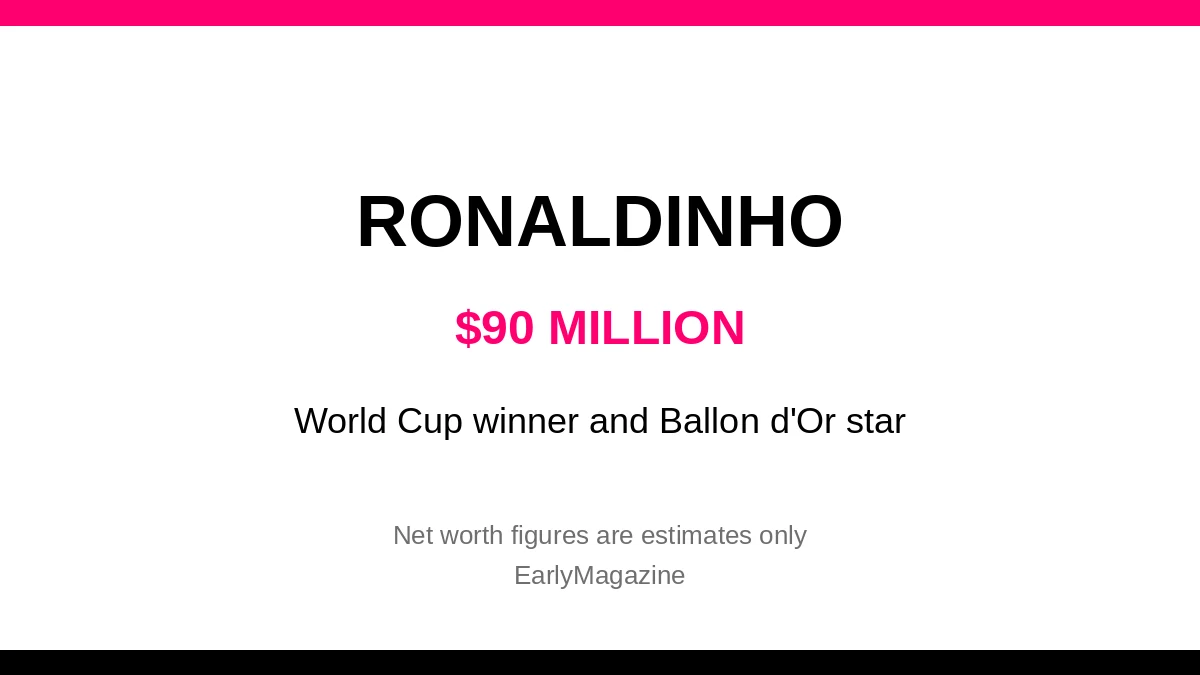
Ronaldinho has an estimated net worth of $90 million. The retired Brazilian footballer is widely regarded as one of the most gifted and entertaining players of his generation — a World Cup winner, Ballon d’Or winner and the defining star of FC Barcelona’s mid-2000s resurgence, whose dribbling, no-look passes and permanent smile made him one of the most marketable athletes on the planet.
Quick Facts
| Full name | Ronaldo de Assis Moreira |
| Born | 21 March 1980, Porto Alegre, Brazil |
| Age | 46 |
| Net worth | $90 million (estimate) |
| Position | Attacking midfielder / winger |
| Clubs | Grêmio, Paris Saint-Germain, Barcelona, AC Milan, Flamengo, Atlético Mineiro, Querétaro, Fluminense |
| Brazil | 97 caps, 33 goals |
| Honours | 2002 World Cup, 2005 Ballon d’Or, FIFA World Player of the Year 2004 and 2005, 2006 Champions League |
| Peak annual earnings | $37 million (Forbes estimate, 2007–08) |
| Retired | 2018 |
Early Life
Ronaldo de Assis Moreira was born on 21 March 1980 in Porto Alegre, Brazil. The nickname Ronaldinho — “little Ronaldo” — was initially used to distinguish him from older players named Ronaldo, and with the Brazilian superstar Ronaldo already established internationally, he was also widely known as Ronaldinho Gaúcho.
Football ran through the family. His father, João de Assis Moreira, worked at a shipyard and played amateur football, while his older brother Roberto Assis became a professional player and later served as Ronaldinho’s manager and agent. As a child he played futsal and beach soccer, two forms of the game that helped develop the close control, rapid changes of direction and improvisational style that became his trademarks. He entered the youth system of Grêmio, one of Porto Alegre’s major clubs, and was already attracting international attention by his late teens.
Grêmio and Paris Saint-Germain
Ronaldinho made his senior debut for Grêmio in 1998. His international breakthrough came in 1999, when he made his senior Brazil debut, played in the Copa América — which Brazil won — and starred at the FIFA Confederations Cup, scoring six goals as Brazil reached the final. A complicated transfer dispute eventually ended with him moving to Paris Saint-Germain in 2001, where he spent two seasons and strengthened his reputation as one of the most exciting young players in world football.
2002 World Cup
Ronaldinho entered the 2002 FIFA World Cup as part of an extraordinary Brazilian attack featuring Ronaldo and Rivaldo. The trio helped Brazil win all seven of its matches en route to the country’s fifth World Cup championship.
His most famous moment came against England in the quarterfinals. With Brazil trailing 1-0, he created Rivaldo’s equalising goal, then early in the second half sent a free kick from more than 35 yards over goalkeeper David Seaman for the winner. Whether he intended the shot or had attempted a cross became an immediate subject of debate; Ronaldinho has always maintained that he meant to shoot. He was sent off seven minutes later and missed the semifinal through suspension, but returned for the final, where Brazil defeated Germany 2-0. Winning the World Cup at 22 transformed him into one of soccer’s biggest global stars.
The Barcelona Peak
In 2003 Barcelona acquired Ronaldinho from Paris Saint-Germain for €25 million upfront, with another €5 million available through performance-related variables; Manchester United had also pursued him. The club had gone several seasons without a major trophy, and Ronaldinho became the centrepiece of its rebuild under new president Joan Laporta.
He was named FIFA World Player of the Year in 2004 and again in 2005, and won the Ballon d’Or in 2005. One defining performance came against Real Madrid at the Santiago Bernabéu in November 2005, when he scored twice in a 3-0 Barcelona victory and received a standing ovation from sections of the Real Madrid crowd — an extremely rare tribute for a Barcelona player. The 2005-06 season was his peak: a second consecutive La Liga title and victory over Arsenal in the UEFA Champions League final. Across all competitions he scored 94 goals in 207 official matches for Barcelona, overlapping with the emergence of a teenage Lionel Messi, who would eventually inherit both the No. 10 shirt and the team’s dominant role.
Salary and Endorsements
At his financial peak Ronaldinho was one of the highest-paid athletes in the world. Forbes estimated he earned $26 million between June 2005 and June 2006, then ranked him the highest-paid soccer player in the world the following year at $30 million — about $11 million from salary and roughly $19 million from endorsements. His earnings rose again to an estimated $37 million between June 2007 and June 2008.
Nike was one of his most important sponsors. His “Touch of Gold” advertisement — repeatedly striking the crossbar while juggling a ball — became an early viral internet phenomenon. Other major sponsors included Pepsi, EA Sports, Lenovo and Cadbury. In 2011 he signed a Coca-Cola endorsement deal in Brazil worth R$1.5 million per year, but Coca-Cola terminated it in July 2012 after less than a year, shortly after Ronaldinho appeared at an Atlético Mineiro press conference with cans of Pepsi in front of him.
AC Milan and Return to Brazil
Ronaldinho joined AC Milan in 2008 for a fee of €21 million, with another €4 million potentially payable through incentives. He never consistently reproduced his Barcelona peak, but his most productive season came in 2009-10, when he became one of Serie A’s leading assist providers, playing alongside Andrea Pirlo and Clarence Seedorf.
He returned to Brazil with Flamengo in 2011, then signed with Atlético Mineiro in June 2012. The move proved one of his best late-career decisions: Atlético won the Copa Libertadores for the first time in club history in 2013, with Ronaldinho playing a central role throughout. He later played in Mexico for Querétaro and briefly for Fluminense before his brother and agent Roberto confirmed his retirement in January 2018. For Brazil he played 97 official matches and scored 33 goals, also winning the 1999 Copa América and the 2005 Confederations Cup, and a bronze medal at the 2008 Olympics.
Legal Issues
Ronaldinho faced significant legal problems after his playing career. Brazilian authorities temporarily seized his passport in connection with a case involving an environmental violation stemming from construction on protected land in Porto Alegre; it was eventually returned in 2019.
A more serious episode occurred in March 2020, when Ronaldinho and his brother Roberto travelled to Paraguay using Paraguayan passports containing false information. Authorities arrested the brothers in Asunción. Ronaldinho initially spent time in a high-security jail before being transferred to house arrest at a hotel, with his detention lasting approximately five months in total. Ronaldinho maintained that the documents had been given to him and that he had not knowingly sought to use fraudulent passports. In August 2020 a Paraguayan judge approved an agreement allowing the brothers to return to Brazil; Ronaldinho received a suspended sentence, and the brothers were ordered to pay a combined $200,000 in fines.
Legacy
Ronaldinho’s period at the absolute top of the sport was relatively short compared with later superstars such as Messi and Cristiano Ronaldo, but at his peak he combined elite production with a style — the elastico, disguised passes, backheels, stepovers, chips, long-range free kicks and no-look assists — that made even routine moments unpredictable. For Barcelona supporters in particular, his legacy extends beyond his individual awards: he arrived when the club had gone years without a major trophy and departed after helping restore it to the summit of European football, setting the stage for the Messi era that immediately followed.
Net worth figures are estimates only, based on public sources.
Related: Lionel Messi Net Worth, Cristiano Ronaldo Net Worth, Is David Beckham Really a Billionaire?
