


Fifteen days before her death, Voletta Wallace changed the documents governing who would oversee her estate and trust. She removed her grandson, C.J. Wallace, and a longtime friend from those roles, leaving Biggie’s former manager Wayne Barrow in charge. The changes helped set the stage for a family dispute involving her daughter-in-law, Faith Evans, and millions of dollars generated by her late son’s music and other rights.
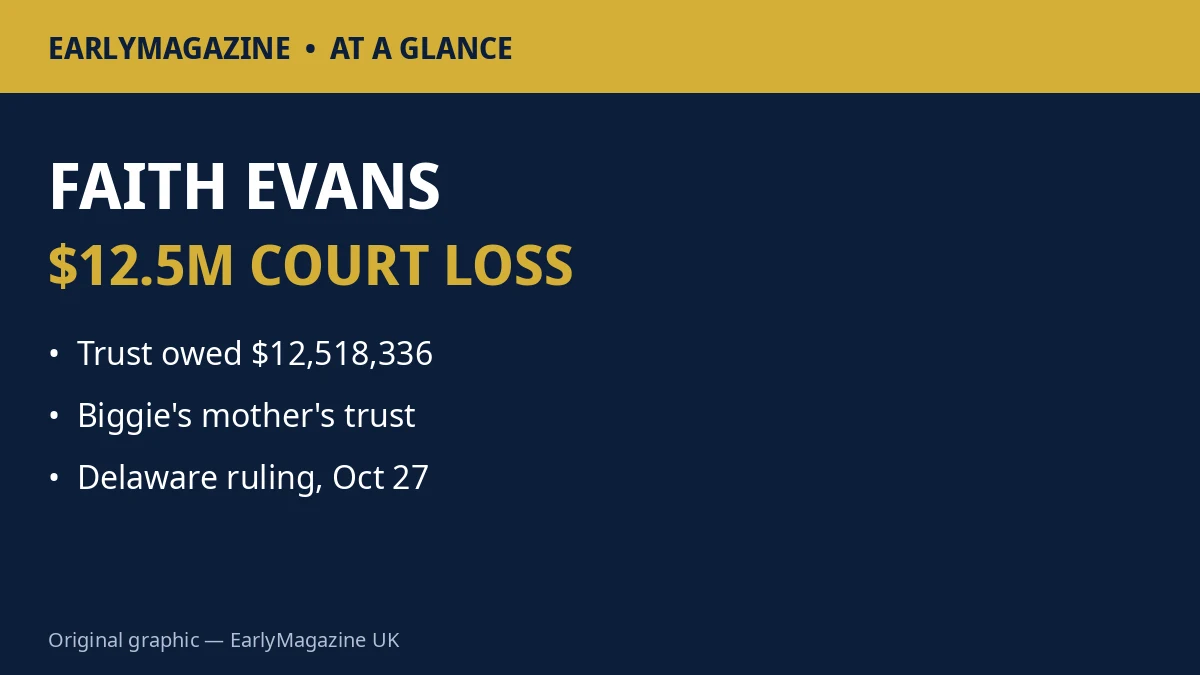
Now, a Delaware judge has ruled that Voletta’s trust is entitled to $12,518,336 in company distributions, plus interest. The October 27 decision rejected arguments from Evans and Notorious B.I.G., LLC that only $48,612 should be paid to the trust while a separate challenge to Barrow’s authority proceeded in Pennsylvania.
The dispute concerns a business Faith and Voletta built together to manage the intellectual property of The Notorious B.I.G. For years, they shared ownership and management responsibilities. After Voletta’s death, Faith became sole manager, and the question of who could exercise Voletta’s rights became a matter for the courts.
Faith Evans Court Loss at a Glance
| Amount owed to the trust | $12,518,336, plus interest |
| Breakdown | Three $4 million distributions + $469,724 + $48,612 |
| What Evans and the LLC argued | Pay only $48,612 now; deposit the rest with the court |
| Judge | Chancellor Kathaleen St. J. McCormick, Delaware |
| Decision date | October 27, 2026 |
How Faith Evans Became Entitled to Biggie’s Business Income
Faith’s financial connection to Biggie stretches back decades. They married in 1994 and had a son, Christopher “C.J.” Wallace, in 1996. Although separated, they remained legally married when Biggie was murdered in March 1997, leaving behind a young family and a catalog that would continue generating income for decades.
In 2007, Faith and Voletta formed Notorious B.I.G., LLC to manage his intellectual property. A March 2023 operating agreement, described in the Delaware court’s earlier ruling, provides a detailed picture of how the family’s financial interests were divided. Faith and Voletta each owned 50% of the company’s membership units and were its two managers. Each also assigned half of her rights to distributions to one of Biggie’s children. That left Faith, Voletta, C.J., and Biggie’s daughter, T’yanna Wallace, each entitled to 25% of the company’s distributions.
Faith’s right to that income therefore came through her own company interest. Voletta’s trust inherited Voletta’s separate interest after her death. The lawsuit concerns the payments associated with that inherited share, while Faith’s own distribution rights existed alongside it.
The Business Behind the Money
Biggie released just one studio album during his lifetime, “Ready to Die.” His second, “Life After Death,” arrived shortly after his murder. Those recordings, songs such as “Juicy,” “Big Poppa,” and “Hypnotize,” and the continued commercial appeal of his name and image supported a business that grew long after his death.
Voletta played a central role in that growth. She helped oversee the estate, participated in the development of the 2009 biopic “Notorious,” and worked to secure greater control over her son’s music rights. Faith maintained her own recording career while also participating in the company managing Biggie’s intellectual property.
In March 2025, Primary Wave confirmed a partnership involving Biggie’s publishing, recordings, and certain name, image, and likeness rights. The Wall Street Journal reported that Primary Wave acquired a 50% interest in a transaction valuing Biggie’s life’s work at more than $200 million. Voletta had approved the deal before her death the previous month; the purchase price was not publicly disclosed.
The partnership brought a major outside music-rights investor into the business. Within months, however, the family company was facing litigation over whether Voletta’s trust could receive its share of the proceeds.
The Changes That Sparked the Family Dispute
Voletta’s original estate documents named C.J., her friend Carol Sampson, and Barrow as successor trustees and executors. Her February 6, 2025, amendments removed C.J. and Sampson, leaving Barrow as the sole successor in both roles. Voletta died on February 21, 2025.
The amendments also changed the charitable provisions. They removed a specific gift of her company interest to the Voletta Wallace Foundation and directed assets not otherwise specifically bequeathed to the Christopher Wallace Memorial Foundation.
Barrow accepted his appointment as trustee and received authority to act as executor. Faith disputed the trust’s company membership and withheld distributions. Barrow sued Faith and the LLC in July 2025 to establish the trust’s rights.
C.J. filed his own Pennsylvania challenge in February 2026, alleging that Barrow had exercised undue influence over his grandmother and challenging his appointment. The Delaware proceedings did not decide those allegations. In August, however, Chancellor McCormick ruled that the trust qualified as a member of the company and was entitled to distributions. Barrow’s attorney, Jay W. Freiberg, told Rolling Stone after that ruling that “Mama Wallace wanted Wayne to steward the legacy of the Notorious B.I.G. after she was gone.” Faith and the company’s position was that the dispute over his authority warranted delaying payment of the contested funds.
What the $12.5 Million Represents
The October ruling supplied the amount owed: three $4 million distributions, another $469,724, and $48,612, totaling $12,518,336. These amounts were attributable to Voletta’s economic interest in the company.
Faith and the LLC argued that only the $48,612 should be paid to the trust. They offered to deposit the disputed balance with the Delaware court while C.J.’s Pennsylvania challenge proceeded. McCormick rejected that proposal. Although the trust formally became a company member on December 12, 2025, its entitlement to the distributions reached back to Voletta’s death. The challenge to Barrow’s appointment did not suspend those economic rights.
The judge also awarded interest at the statutory rate, compounded quarterly from the dates the distributions were made. Barrow was instructed to submit a final proposed order within 20 days. The decision establishes the trust’s right to the company distributions; it does not document their subsequent collection.
For more music and celebrity estate stories, see our Taylor Swift net worth, Dua Lipa net worth and Michael Jackson profiles.
