

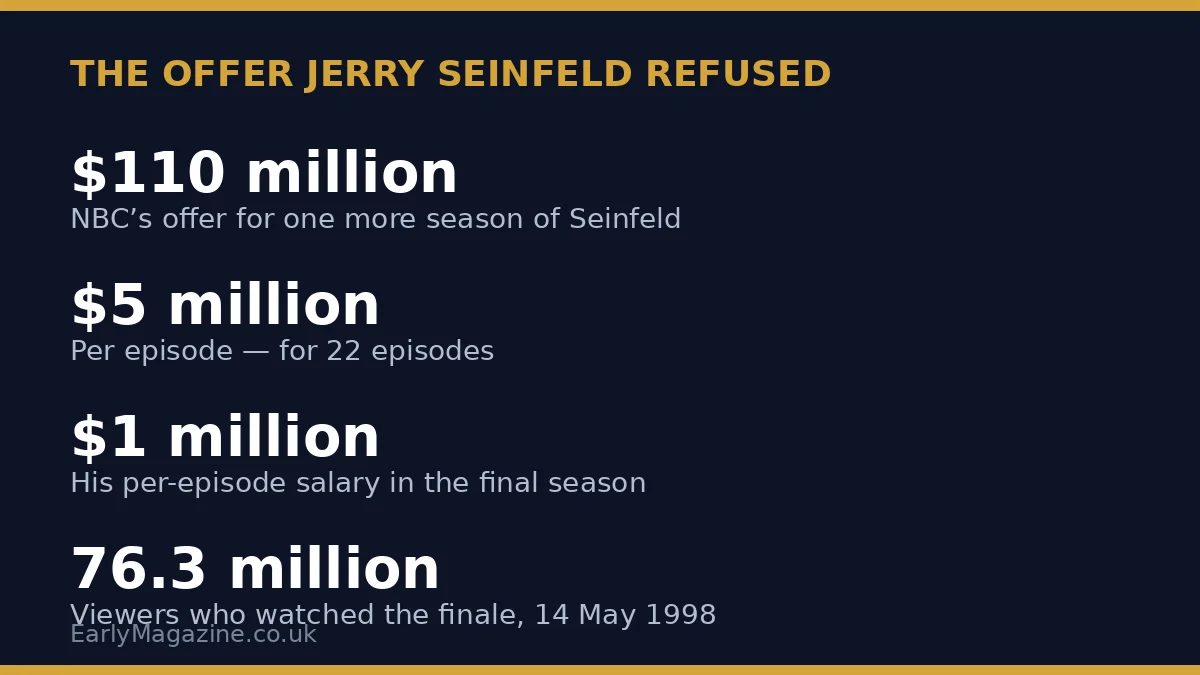
In late 1997, the most powerful man in American television sat down to breakfast and wrote a number on a small piece of paper. The number was NBC’s offer to Jerry Seinfeld: $5 million per episode for 22 more episodes of “Seinfeld” — $110 million for a single season, by far the richest one-season salary ever offered to a TV actor.
Jerry Seinfeld turned it down. According to one NBC executive, General Electric chief Jack Welch — whose company owned the network — “just went numb.”
From $20,000 an Episode to $1 Million
The offer looks even more extraordinary against where Jerry started. For the show’s first five-episode season he earned $20,000 per episode. His pay rose to $40,000 for seasons two and three, then $100,000 for seasons four to six, and $500,000 for seasons seven and eight.
By the ninth season he had reached $1 million per episode — about $24 million for the year, and the top of the television salary ladder. NBC wasn’t offering a raise so much as a ransom: “Seinfeld” anchored the network’s “Must See TV” Thursday nights and, according to an account published by the Television Academy, contributed roughly $200 million a year to NBC’s profits at a time when the network was generating about $1 billion annually.
The Breakfast, the Paper, and the “Couple of B’s”
The decisive meeting took place months before the final episode aired. Jerry and his managers, George Shapiro and Howard West, joined Welch and NBC president Bob Wright for an elaborate breakfast in Wright’s apartment above Central Park — engraved menus, charts showing the show’s enduring popularity, and then Welch’s handwritten figure: five times Jerry’s already record salary.
West later recalled that Welch also floated a broader package involving stock, talking in terms of “a couple of B’s” — billions in potential upside rather than guaranteed pay. Former NBC Entertainment president Warren Littlefield remembered the confidence in the room: “We didn’t mess around. What we put on the table was unheard of.” Jerry, he recalled, explained that he had no life outside the show — no marriage, no kids — and that in the end it was a quality-of-life decision.
The Bench in Central Park
Shapiro’s favorite part of the story came afterward. The three men walked into Central Park and sat on a bench near 81st Street and Central Park West — the same bench where a young Jerry had once told his father he wanted to become a stand-up comedian.
There, Jerry explained his reasoning in a comic’s terms: when a set earns a standing ovation, you don’t stay on stage for another 15 minutes and risk wearing out your welcome. You leave them wanting more. He felt “Seinfeld” had reached that moment, whatever the money said.
NBC announced on 25 December 1997 that season nine would be the last. The finale aired on 14 May 1998 to 76.3 million viewers, with advertisers paying an average of about $1.7 million per 30-second spot — some reportedly as much as $2 million. Even the goodbye was a bonanza.
Why He Could Afford to Say No
Jerry wasn’t only an actor waiting on a salary. He and co-creator Larry David each held a backend ownership stake in the show — initially 7.5% of its profit participation, later increased to 15% apiece. Reruns had begun airing in syndication in 1995, while the show was still in production, and the library has since generated billions across broadcast and cable reruns, home video and streaming — including a reported $130–180 million from Hulu in 2015 and more than $500 million from Netflix for global rights from 2021.
In other words, Jerry didn’t need another season to keep earning from the 180 episodes he’d already made. His salary would stop; the ownership money wouldn’t. It is the same lesson, learned the hard way in reverse, as Roseanne Barr’s experience on “The Conners,” where signing away back-end rights may have cost her $100 million — and the same principle behind Reese Witherspoon’s nine-figure payday for selling a company she owned rather than a salary she earned.
Ownership, not wages, is also what turned Michael Jackson’s purchase of a music catalog into one of entertainment’s great fortunes. Jerry Seinfeld’s net worth is estimated at $900 million, and most of it traces back to the stake he kept rather than the $110 million he refused.
He has said since that he has no regrets — that knowing how long a joke should last is the whole craft. The ovation ended in 1998. The checks never did.
Sources and notes: Negotiation details and quotations from the Television Academy’s account and interviews with George Shapiro, Howard West and Warren Littlefield, as widely reported; salary history, finale audience and streaming deal values as reported by the Los Angeles Times, TheWrap and Nielsen. Net worth estimate per Celebrity Net Worth.
