

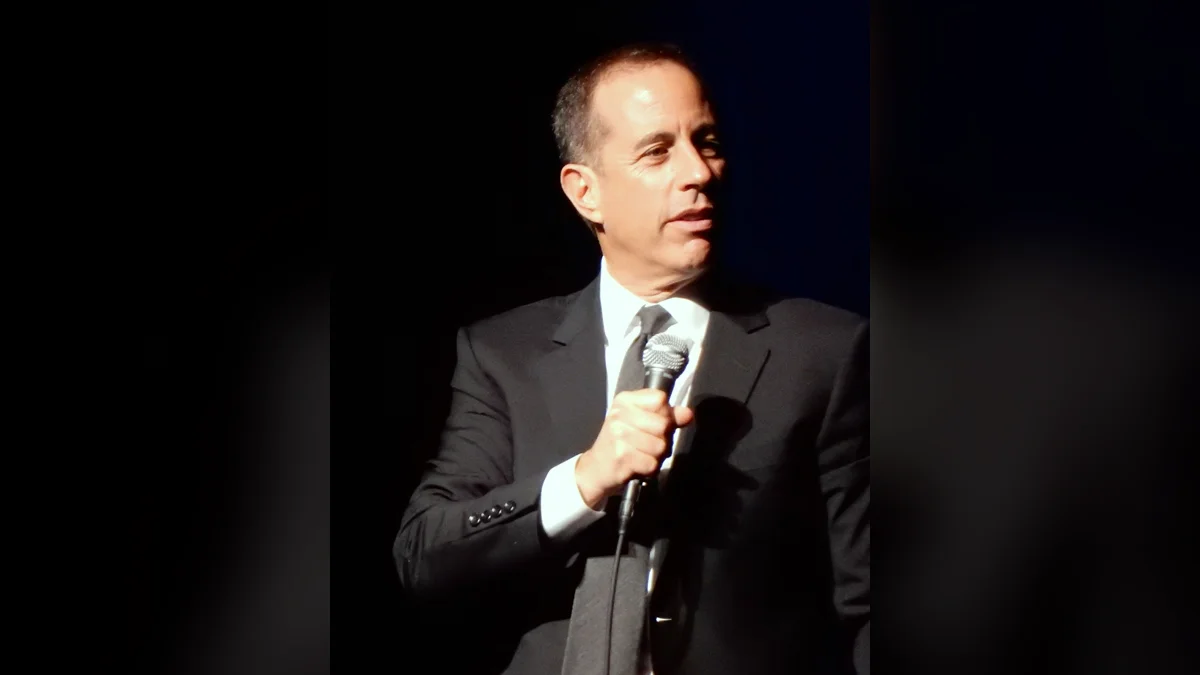
Jerry Seinfeld’s acting salary on “Seinfeld” made him rich. His ownership stake in the show made him something else entirely. Add up the paychecks, the syndication cycles, the cable renewals and the streaming auctions, and Jerry is estimated to have earned $750 million to $800 million from the “show about nothing” — against roughly $60 million for actually appearing in it.
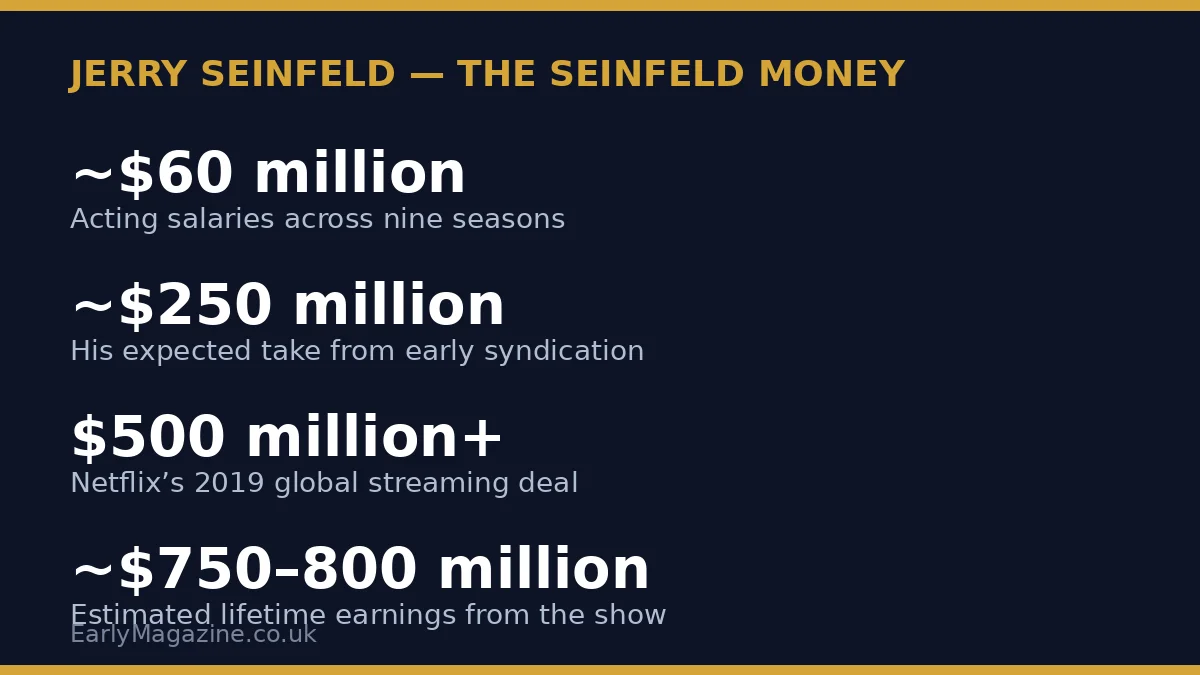
The Salary Years: About $60 Million
“Seinfeld” was not an overnight hit, and neither was its star’s pay. Jerry earned $20,000 per episode for the five-episode first season ($100,000 in total), $40,000 per episode across seasons two and three (about $1.4 million), and $100,000 per episode for seasons four to six (about $7 million). The jump to $500,000 per episode for seasons seven and eight added roughly $23 million.
The final season made history: $1 million per episode, about $24 million for the year, making Jerry the first TV actor to reach the million-per-episode mark. His co-stars Julia Louis-Dreyfus, Jason Alexander and Michael Richards finished on a reported $600,000 per episode — superb money, but with no ownership attached.
Total acting pay across nine seasons: approximately $55.5 million, usually rounded to $60 million.
The Deal That Mattered: 15% of the Backend
From the start, Jerry and co-creator Larry David each held 7.5% of the show’s backend equity — the right to share in profits every time the episodes were sold again. As the show became a phenomenon they renegotiated, partly by buying out an early participant who wanted to cash in, and emerged with 15% each — 30% combined.
That single negotiation is the difference between a wealthy actor and a fortune approaching a billion. It is also the mirror image of Roseanne Barr’s story on “The Conners”: the back-end she signed away may have cost her $100 million, while the back-end Jerry kept has paid him for three decades.
1998: The $250 Million Syndication Windfall
Reruns began on local stations in September 1995, while new episodes were still airing. By 1998, the rights frenzy around the show was valued at roughly $1.7 billion, with Jerry and Larry each in line for approximately $250 million in backend proceeds over time.
That year Forbes ranked Jerry the highest-paid entertainer in the world, crediting him with an estimated $225 million in earnings — nearly four times his entire nine-year acting salary, in a single year, from a show that had just ended.
Cycle After Cycle After Cycle
The library kept being resold. Time Warner later disclosed figures from the show’s licensing business: $598 million from the first broadcast syndication cycle, $984 million from the second and $703 million from the third, plus $379 million from the first three cable cycles — about $2.7 billion combined, before streaming existed. A 2003 TBS cable renewal alone was worth more than $200 million to the show, implying over $30 million for Jerry at 15% before fees.
The Streaming Auctions
In 2015, Hulu paid a reported $130–180 million for exclusive US streaming rights — an implied $20–27 million for Jerry on a simple 15% calculation. The bigger auction came in 2019, when Netflix, about to lose “Friends” and “The Office” to rival platforms, paid a reported $500 million-plus for worldwide rights from 2021. TheWrap, citing people familiar with the deal, reported that Jerry and Larry would each receive $100 million to $125 million, possibly more.
And the buyers are still calling: in August 2026, Sony renewed the show’s Netflix arrangement in the US and Canada for five more years and Paramount’s basic-cable rights for three — with Nielsen reporting that nearly 60 million Americans watched “Seinfeld” in the first half of 2026 alone.
The Payday That Never Ended
Put together — roughly $60 million in salary, about $250 million from early syndication, nine figures from the Netflix era and decades of everything else — the estimated lifetime total lands between $750 million and $800 million, the engine behind Jerry Seinfeld’s estimated $900 million net worth. His co-stars, without ownership points, never saw comparable windfalls; they received salaries, residuals and later some DVD-related compensation.
It is entertainment’s clearest case study in ownership over wages — the same principle that let Reese Witherspoon sell a company for $900 million and that turned John Paul DeJoria’s equity in his own brands into billions. NBC once offered Jerry $110 million for one more season. The 180 episodes he already owned turned out to be worth several times that — and they are still being sold.
Sources and notes: Salary history, syndication cycle values and streaming deal figures as reported by Forbes, Time Warner disclosures, the Los Angeles Times and TheWrap; lifetime earnings and net worth estimates per Celebrity Net Worth. Participation calculations are illustrative — actual payouts depend on private contract terms and distribution fees.
