

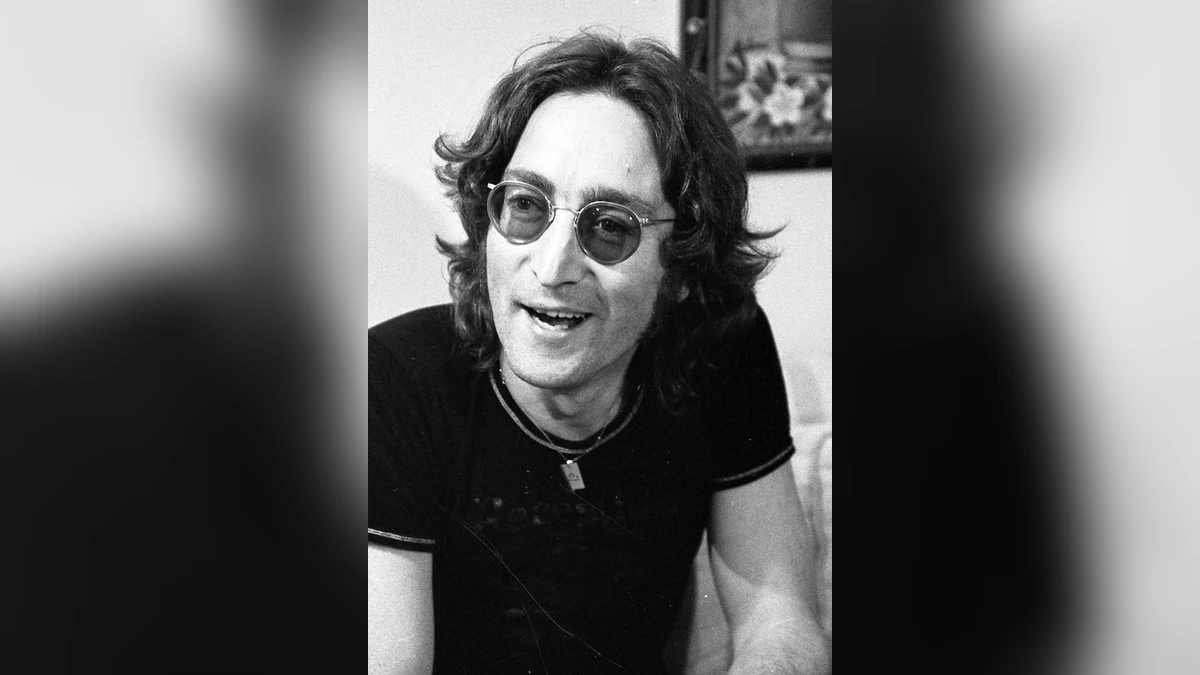



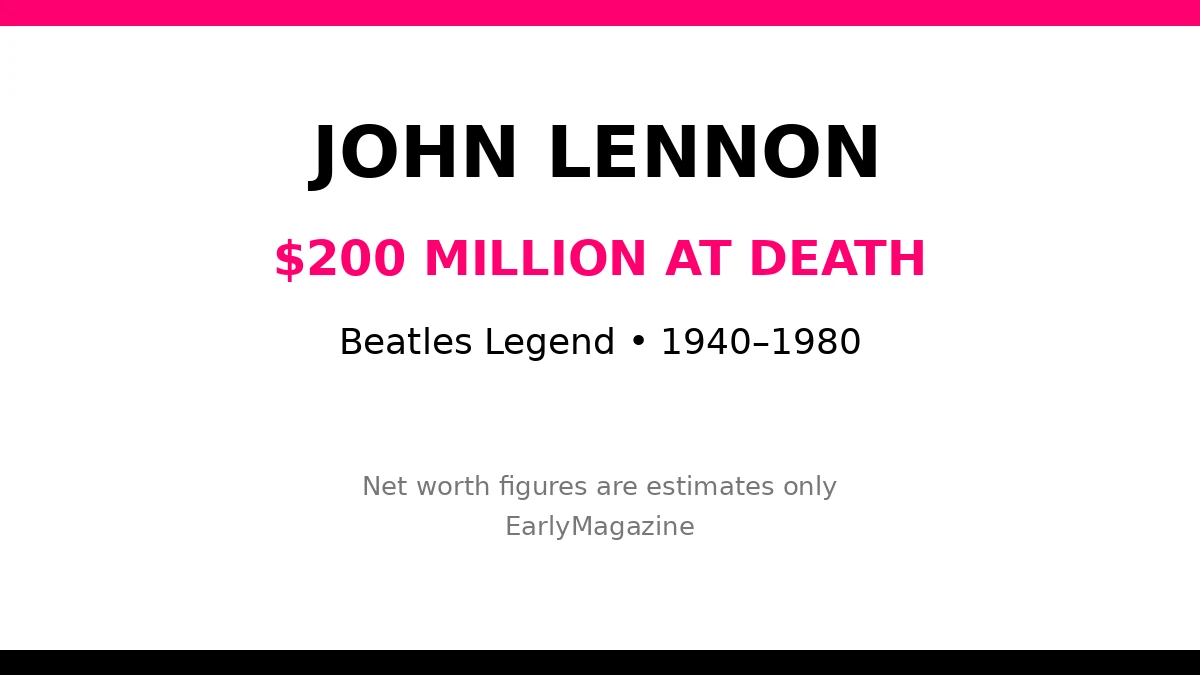
John Lennon was an English musician, singer, songwriter, artist and activist who had a net worth of $200 million at the time of his death in 1980. That was equivalent to $810 million in today’s dollars. Some contemporary reports estimated his fortune at $235–$250 million, which would have been equal to as much as $1.1 billion today.
| Quick Facts | John Lennon |
|---|---|
| Full Name | John Winston Lennon |
| Net Worth at Death | $200 million (1980; ~$810 million today) |
| Born | 9 October 1940, Liverpool, England |
| Died | 8 December 1980, New York City, USA (aged 40) |
| Occupation | Musician, singer, songwriter, artist, activist |
| Best Known For | The Beatles, “Imagine”, Lennon–McCartney songwriting |
| Spouses | Cynthia Powell (1962–1968), Yoko Ono (1969–1980) |
| Children | Julian Lennon, Sean Lennon |
| Source of Wealth | Beatles recordings and royalties, solo career, music rights, real estate, investments |
Early Life
John Winston Lennon was born on 9 October 1940 in Liverpool, England. His father, Alfred Lennon, was a merchant seaman who was frequently absent, while his mother, Julia Lennon, eventually arranged for John to be raised primarily by her sister Mimi Smith and Mimi’s husband George. Lennon grew up in the Liverpool suburb of Woolton, where his aunt Mimi provided a relatively stable household. Julia encouraged his interest in music, taught him banjo chords and helped him obtain his first guitar. In 1956, Lennon formed a skiffle group called The Quarrymen. His mother’s death in July 1958, after she was struck by a car driven by an off-duty police officer, had a profound effect on him and influenced some of his most personal songs. He attended Liverpool College of Art but became increasingly focused on performing and songwriting.
The Beatles
Lennon met Paul McCartney in July 1957 after The Quarrymen performed at a church fête in Woolton, Liverpool. McCartney impressed Lennon with his musical knowledge, soon joined the group, and subsequently introduced Lennon to his younger friend George Harrison. The band went through several names and personnel changes before settling on the Beatles. Their extended Hamburg performances transformed them into a professional live band, and their fortunes changed after Liverpool record-store manager Brian Epstein became their manager in 1962. Epstein reshaped their image and landed them a recording agreement with EMI’s Parlophone label, where producer George Martin became another crucial figure. Pete Best was replaced by Ringo Starr in 1962, establishing the classic line-up. By 1963, Beatlemania had swept Britain, and the following year their appearances on “The Ed Sullivan Show” launched them in the United States. They went on to achieve a record 20 number-one singles on the Billboard Hot 100.
Lennon–McCartney and the Publishing Rights
At the centre of the Beatles’ success was the songwriting partnership between Lennon and McCartney. Their compositions were generally credited jointly, regardless of which musician had written most of an individual song. Lennon was the primary writer behind “Help!”, “Strawberry Fields Forever”, “Come Together” and “I Am the Walrus”, while McCartney was the primary writer of “Yesterday”, “Hey Jude” and “Let It Be”. The partnership produced one of the most commercially valuable bodies of songwriting in music history, but the way the Beatles’ publishing business was structured meant Lennon and McCartney did not retain ownership of many of the copyrights they created. In 1963, Epstein and publisher Dick James established Northern Songs to publish the Lennon–McCartney catalogue; after it went public in 1965, Lennon and McCartney each owned 15%. In March 1969, James sold the controlling interest to Lew Grade’s ATV without offering Lennon and McCartney the chance to buy it. They tried to gain control themselves, failed, and later that year sold their remaining shares, surrendering direct ownership of most of their Beatles publishing catalogue — though they kept valuable songwriting royalty interests.
Beatlemania, Yoko Ono and the Breakup
By the middle of the 1960s, the Beatles had become the most famous entertainers in the world. Lennon’s 1966 comment that they had become “more popular than Jesus” caused a major controversy in the United States, with boycotts, record burnings and threats during their tour. They stopped touring after August 1966 and became an increasingly experimental studio band, producing “Sgt. Pepper’s Lonely Hearts Club Band”, the White Album and “Abbey Road”. Lennon met Japanese artist Yoko Ono in London in November 1966. He had been married to Cynthia Powell since 1962, and their son Julian was born in 1963. John and Cynthia divorced in 1968, and he married Ono in Gibraltar on 20 March 1969. The band’s final years were marked by business disagreements and personal tensions. Lennon privately told the others in September 1969 that he wanted to leave, and McCartney announced his own departure the following year, effectively confirming the end of the Beatles.
Solo Career and “Imagine”
Even before the Beatles formally ended, Lennon and Ono had begun releasing experimental recordings together. His first major post-Beatles album, “John Lennon/Plastic Ono Band”, arrived in 1970 and included “Mother”, “Working Class Hero” and “God”. He followed it in 1971 with “Imagine”, which reached number 1 in Britain, while its title track became his signature solo composition and one of the most recognisable songs in popular music. Although Lennon initially received sole songwriting credit for “Imagine”, he later acknowledged Ono’s contribution, and in 2017 the National Music Publishers’ Association formally recognised Ono as a co-writer. Lennon and Ono moved permanently to New York City in 1971, where political activism became intertwined with their music. He released “Some Time in New York City” in 1972, “Mind Games” in 1973, “Walls and Bridges” in 1974 and “Rock ‘n’ Roll” in 1975, and collaborated with David Bowie on the 1975 hit “Fame”, which became Bowie’s first number-one single on the Billboard Hot 100. Lennon became an outspoken opponent of the Vietnam War: he and Ono staged their famous “Bed-Ins for Peace” in 1969, and the Montreal event produced “Give Peace a Chance”. The US government later tried to deport him over an earlier British marijuana conviction, and he spent years fighting the case before receiving permanent resident status in 1976.
Retirement, “Double Fantasy” and Death
Lennon and Ono separated for 18 months beginning in 1973, a period he later called his “Lost Weekend”. His 1974 album “Walls and Bridges” included “Whatever Gets You Thru the Night”, featuring Elton John — his only number-one solo single on the Billboard Hot 100 during his lifetime. They reconciled in 1975, and their son Sean was born on 9 October that year, sharing his father’s birthday. Lennon then stepped away from music for five years to raise Sean while Ono managed the family’s business affairs. The couple returned to recording in 1980 with “Double Fantasy”, released in November, just three weeks before his murder; after his death it reached number 1 on the Billboard 200 for eight weeks. On 8 December 1980, as Lennon approached the Dakota apartment building in Manhattan, Mark David Chapman shot him four times. He was pronounced dead at Roosevelt Hospital at age 40. Chapman had asked him to autograph a copy of “Double Fantasy” earlier that day; he later pleaded guilty to murder and was sentenced to 20 years to life. In 1985, Ono helped establish Strawberry Fields, the Central Park memorial whose “Imagine” mosaic became a lasting tribute to his music and peace activism.
Estate, Inheritance and Posthumous Earnings
Contemporary accounts placed his worldwide fortune between $150 million and $250 million: “TIME” estimated $235 million in December 1980 and UPI cited $250 million in February 1981. Celebrity Net Worth uses $200 million as a reasonable valuation. Probate filings disclosed far smaller sums — $30 million in New York and more than $5.5 million in Britain — because they covered particular jurisdictions, not his whole portfolio. His final will, signed on 12 November 1979, gave Yoko Ono a substantial direct inheritance, perhaps around $100 million, and placed the remainder in a private trust. How he provided for his sons became controversial: Julian, born during his marriage to Cynthia, was not named in the public will, and for decades the narrative was that John had left almost everything to Yoko and Sean. The reality was more complicated — an earlier £100,000 trust from the 1968 divorce left Julian £50,000 after Sean’s birth in 1975, but that was separate from the much larger 1979 trust. Julian challenged the arrangements and reached a confidential settlement with Yoko in 1996; newspapers claimed £20 million, but Julian later said the real figure was far smaller. In October 2026, Sean publicly stated that he and Julian had inherited essentially the same amount. His music kept earning after his death — Forbes estimated $22 million in 2005, $17 million in 2024 and $12 million in 2025 — and the family retained interests in Apple Corps and songwriting royalties, though not the Beatles publishing copyrights, which passed through ATV to Sony. Lennon and Ono also owned the Dakota apartments, a SoHo building (sold in 2024 for $5.5 million), a 600-acre farm in upstate New York, and El Solano, a Palm Beach mansion bought for $725,000 in 1980 and sold by Ono in 1986 for $3.15 million.
Net worth figures are estimates based on public sources and are not confirmed financial disclosures.
Related: Roger Taylor Net Worth, Pattie Boyd Net Worth, Richest Singers in the World
