

 Trip Hawkins Made $100M at EA, Then Lost It All
$100 million
 Sam Bankman-Fried's $70B Fortune That Never Was
$25 billion
 Cooper Manning
$13 million
 Lou Pai
$353 million
 Sutton Stracke
$50 million
 Leonid Radvinsky
$4.7 billion
 Clifford Beaver
$200,000
 Douglas Fregin
$1 billion
 Mike Lazaridis
$600 million
 D Wayne Lukas
$50 million
 Fabiana Flosi
$20 million
 Mike Markkula
$1.2 billion
Quick Facts
| Full name | Carl Celian Icahn |
| Born | February 16, 1936, Brooklyn, New York |
| Age | 90 |
| Net worth | $1.3 billion (Bloomberg Billionaires Index, Nov 2026) |
| Peak net worth | $26 billion (Dec 2013) |
| Decline | 95% |
| Company | Icahn Enterprises (founder and chairman) |
| Known for | Corporate raider, activist investing, the “Icahn Lift” |
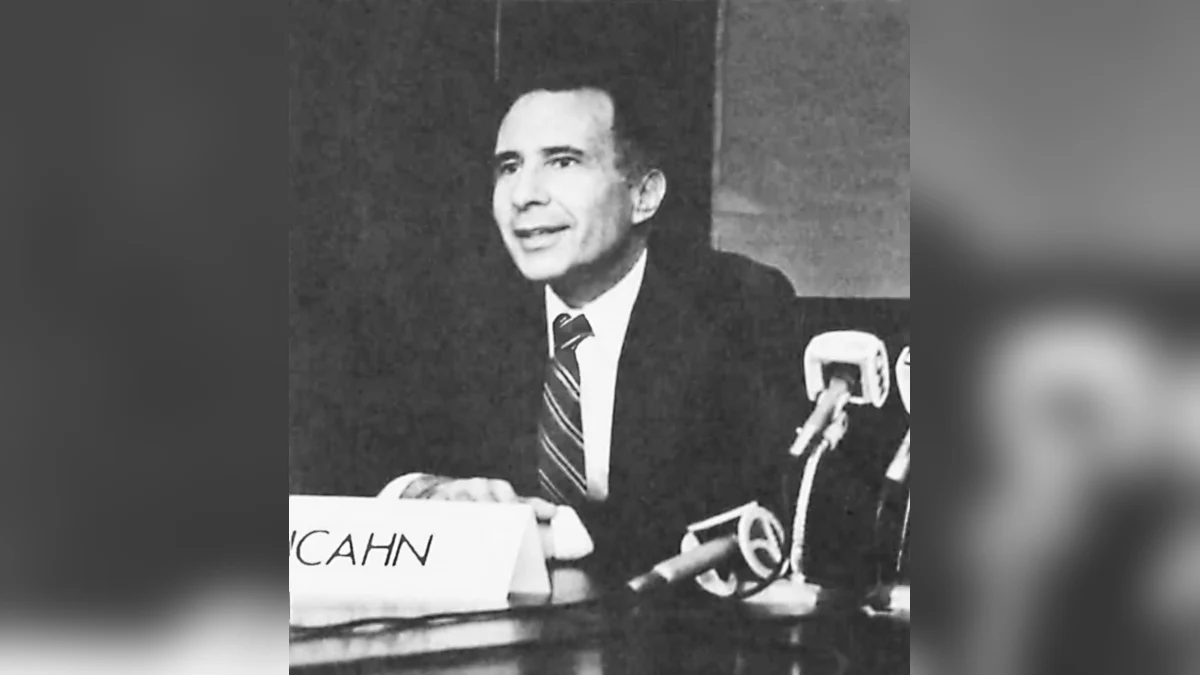
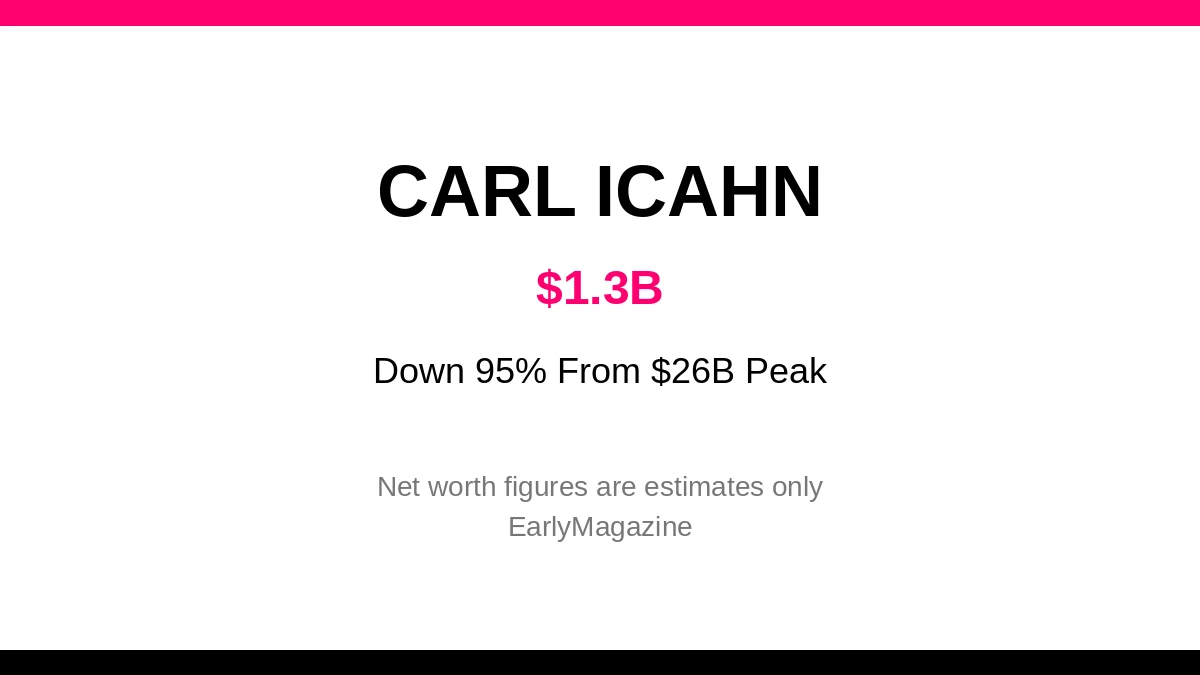
Carl Icahn has an estimated net worth of $1.3 billion, according to the Bloomberg Billionaires Index — a staggering 95% decline from the $26 billion fortune he held in December 2013, leaving the legendary corporate raider just $300 million away from losing his billionaire status altogether.
For most of the last five decades, few phone calls were more terrifying to a Fortune 500 CEO than one from Carl Icahn. The legendary corporate raider built one of the largest personal fortunes in American history by identifying vulnerable companies, acquiring enormous stakes in them, and forcing management to make changes that would enrich shareholders. Frequently, those changes enriched Carl Icahn more than anyone else. In December 2013, he was worth $26 billion — richer than nearly every other hedge fund manager, private equity titan and real estate developer on the planet — riding high from extraordinarily successful investments in companies like Netflix and Herbalife.
Fast-forward to November 2026, and the man who spent decades exposing weaknesses in other people’s businesses is facing a potentially existential financial crisis of his own. According to the Bloomberg Billionaires Index, Icahn’s net worth sank to $1.2 billion on Friday, November 20, before recovering to $1.3 billion on Monday. Over the last five years alone, roughly $21 billion of his personal wealth has evaporated. And at the age of 90, Carl Icahn is facing the very real possibility that he could cease to be a billionaire altogether.
Early Life
Carl Celian Icahn was born on February 16, 1936, in Brooklyn, New York, and raised in the Far Rockaway neighbourhood of Queens. He graduated from Princeton University in 1957 with a degree in philosophy. He briefly attended medical school before dropping out and eventually finding his way to Wall Street. In 1968, with financial assistance from an uncle, he purchased a seat on the New York Stock Exchange and established his own brokerage firm.
Icahn discovered that enormous amounts of money could be made by buying shares in companies whose assets were worth more than their stock market valuations suggested. Rather than patiently waiting for other investors to recognise that value, he would acquire enough shares to pressure management into doing something about it. He might demand that a company sell itself, dispose of underperforming businesses, replace its CEO, or return billions of dollars to shareholders. Sometimes, the mere disclosure that Icahn had purchased a stake in a company was enough to send its share price soaring. Wall Street eventually came to call this phenomenon the “Icahn Lift.”
The Original Corporate Raider
Long before billionaire activist investors were regularly appearing on CNBC and issuing demands to corporate boards on social media, there was Carl Icahn. His controversial takeover of Trans World Airlines in the 1980s cemented his reputation as one of America’s most feared corporate raiders. Icahn was part of the generation of financiers that inspired the fictional Gordon Gekko character in the 1987 movie “Wall Street.” Over the ensuing decades, he took on some of the biggest names in corporate America, including Texaco, Motorola, Time Warner, Yahoo, Dell and Apple. See also: Trip Hawkins.
The $26 Billion Peak
In retrospect, 2013 was a particularly spectacular year to be Carl Icahn. In 2012, he had accumulated a stake of nearly 10% in Netflix when the company was struggling with the transition from DVD rentals to streaming. His average purchase price was $58 per share, before subsequent stock splits. Just 14 months later, Netflix shares had risen 457%. In October 2013, Icahn sold roughly half his position, realising between $700 million and $800 million in profits while retaining a substantial ownership stake.
Around the same time, Icahn was engaged in one of the most entertaining billionaire feuds in Wall Street history. In December 2012, hedge fund manager Bill Ackman announced that he had placed a $1 billion bet against nutritional supplement company Herbalife. Ackman publicly accused Herbalife of operating an illegal pyramid scheme and predicted that its stock would eventually become worthless. Icahn took the opposite side of the trade. He began buying enormous quantities of Herbalife stock and eventually became its largest shareholder. In January 2013, the two billionaires famously got into a shouting match on live television.
Icahn ultimately won. Ackman abandoned his campaign against Herbalife in 2018, and Icahn exited the last of his investment in 2021. Icahn’s total profit from Herbalife has been estimated at $1.3 billion, while Ackman’s losses approached $1 billion. Ironically, $1.3 billion is now roughly the value of Icahn’s entire personal fortune.
The $9 Billion Mistake
For all his success identifying undervalued companies, Icahn made an extraordinarily expensive mistake when he attempted to predict the direction of the broader stock market. He became convinced that financial markets were vulnerable to a major collapse. Through his investment funds, he established enormous short positions against stocks and other financial assets. At one point, the securities he was betting against were valued at more than $15 billion. Unfortunately for Icahn, the American stock market kept going up.
According to a 2023 analysis by the Financial Times, Icahn’s bearish positions generated nearly $9 billion in losses between 2017 and early 2023. Roughly $1.8 billion was lost in 2017 alone. Even the COVID-19 pandemic, which initially appeared to validate his pessimism, ultimately worked against him. The Federal Reserve’s aggressive intervention helped produce a remarkably fast stock market recovery, inflicting billions of dollars in additional losses on his short positions. Making the situation particularly frustrating, his traditional activist investments were still generating substantial profits during this period. The Financial Times calculated that those investments had produced roughly $6 billion in gains, only to be overwhelmed by his losses betting against the market. Icahn acknowledged that he had made a mistake. He had spent years telling people that accurately predicting short-term market movements was nearly impossible, only to disregard his own advice.
The Hunter Becomes the Hunted
On May 2, 2023, short-selling firm Hindenburg Research published a report targeting Icahn Enterprises, the publicly traded holding company that serves as the foundation of Icahn’s fortune. Hindenburg alleged that Icahn Enterprises was dramatically overvalued, that some of its underlying investments were assigned inflated valuations, and that its unusually generous shareholder distributions were being supported by an unsustainable financial structure. Most consequentially for Icahn personally, the report drew attention to the enormous amount of money he had borrowed against his ownership stake in the company.
Icahn vehemently rejected Hindenburg’s allegations, accusing the firm of attempting to profit at the expense of his company’s shareholders. Nevertheless, Icahn Enterprises lost more than half its market value in the weeks following the report. The controversy eventually attracted the attention of the Securities and Exchange Commission. In August 2024, Icahn and Icahn Enterprises agreed to pay a combined $2 million in penalties to settle charges involving inadequate disclosures of his personal margin loans. According to the SEC, Icahn had pledged between 51% and 82% of the company’s outstanding securities as collateral for billions of dollars in personal borrowing. Neither Icahn nor the company admitted or denied the SEC’s findings as part of the settlement. The $2 million penalty was relatively insignificant compared to the billions of dollars in personal wealth that had already disappeared.
Borrowing Billions Against Billions
One of the biggest problems facing Carl Icahn is that he didn’t simply own billions of dollars’ worth of Icahn Enterprises stock. He also borrowed billions of dollars against that stock. Borrowing against shares is a common strategy among billionaires. It allows them to access substantial amounts of cash without selling their investments and potentially triggering large capital gains tax bills. The danger arises when the value of the underlying shares collapses.
According to Bloomberg, Icahn still has roughly $1.3 billion in outstanding personal loans. His stake in Icahn Enterprises remains his primary asset, but entities connected to his New York and Hamptons real estate holdings, as well as his investment in Swedish asset manager Cevian Capital, have also been identified as loan guarantors. Icahn has renegotiated his borrowing arrangements several times, including changing how the collateral supporting his loans is valued. Those changes have helped give him breathing room, but they haven’t eliminated the underlying debt.
The $4.4 Billion Problem
Compounding Icahn’s personal financial troubles is the fact that Icahn Enterprises itself owes enormous amounts of money. The holding company has roughly $4.4 billion in outstanding debt, including $1.4 billion in bonds that mature in May 2027. In its November 2026 quarterly financial filing, the company acknowledged that there was no guarantee it would be able to refinance those bonds on acceptable terms, or refinance them at all. Some of the company’s bonds due in 2029 were subsequently trading at yields exceeding 30%. Such extraordinarily high yields suggest that investors are demanding substantial compensation for the risk that they might not be repaid in full.
Meanwhile, Icahn’s investment funds lost 43.8% of their value during the first nine months of 2026. Shares of CVR Energy, a refining company that represents one of Icahn Enterprises’ most valuable investments, fell roughly 40% following the announcement of a refinery acquisition in November. Icahn Enterprises is not without resources. At the end of September, its holding company had $921 million in cash and $1.4 billion invested in its investment funds. It has also been selling businesses, including automotive service chain Pep Boys. Management maintains that it believes the company has sufficient liquidity to meet its obligations over the following 12 months. But using those resources to repay existing creditors would leave considerably less money available for future investments and other business needs.
When Even the Corporate Raider Can’t Close a Deal
Perhaps the most revealing indication of how much Icahn’s financial circumstances have changed came during the 2026 battle to acquire Caesars Entertainment. Icahn competed against billionaire Houston Rockets owner Tilman Fertitta, who agreed to acquire the casino giant in a transaction valued at $17.6 billion, including debt. According to Bloomberg, Icahn offered $3 more per share than Fertitta. Ordinarily, that kind of premium would make his bid extremely attractive to shareholders. Instead, the Caesars board ultimately favoured Fertitta’s offer. Among the concerns raised during its deliberations were Icahn’s proposed financing arrangements and his history of personal margin loans. For a man who built his reputation on having the financial firepower to intimidate some of the largest corporations in America, that was a remarkable reversal of fortune.
Could Carl Icahn Lose His Billionaire Status?
As of November 2026, Bloomberg values Carl Icahn’s fortune at roughly $1.3 billion. That leaves the legendary investor just $300 million away from losing his billionaire status, something that would have seemed almost unimaginable a decade earlier. To put a 95% wealth decline into perspective, imagine accumulating a $10 million retirement fortune and watching it shrink to $500,000. Now imagine experiencing that decline at the age of 90.
Icahn remains an extraordinarily wealthy man by any ordinary standard. He still owns valuable assets, controls a multibillion-dollar business empire, and has decades of experience navigating difficult financial situations. A recovery in his investments or a successful refinancing could significantly improve his fortunes. But there is no escaping the extraordinary irony of his predicament. Carl Icahn spent half a century making billions of dollars by identifying companies with vulnerable balance sheets, questionable valuations, and management teams that Wall Street had lost confidence in. Now the company facing those questions bears his own name. And on Tuesday, November 24, one particularly interested observer reposted Bloomberg’s article about Icahn’s collapsing fortune. His name was Bill Ackman. See also: Sam Bankman-Fried Anthropic IPO and the Anthropic billionaires.
Personal Life
Icahn has kept his personal life largely out of the spotlight compared with his very public battles in the boardroom and the markets. He has been married to Gail Golden since 1999, and the couple have two children. He moved from New York to Florida in recent years, taking much of his operation with him. At 90, he remains chairman of Icahn Enterprises and, by all accounts, still very much in charge of the empire he built — even as that empire faces the toughest test of its history.
