

For the last decade, Rick Ross made his Wingstop empire a core part of his legend. After making a fortune in music, he diversified into restaurant ownership and positioned himself as a fast-food mogul — the rapper who loved the lemon-pepper wings so much he bought the stores that sold them.
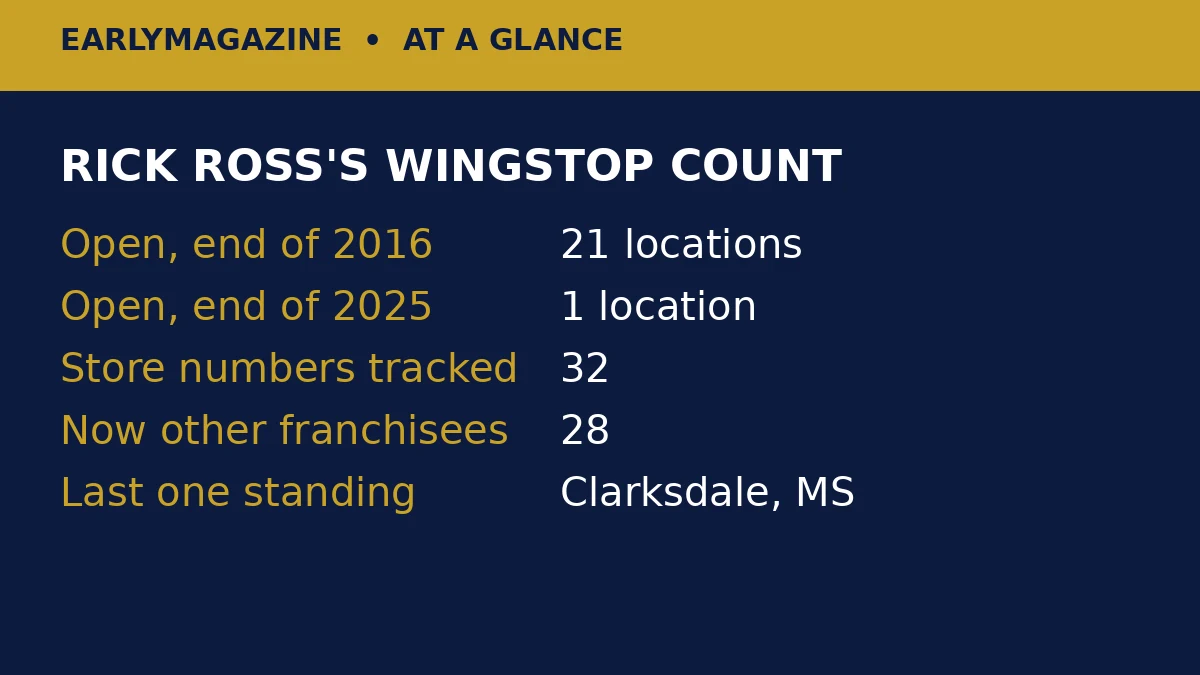
But a recent review of Wingstop franchise filings by investor Eric Jackson revealed an eye-opening change. According to Jackson’s findings, the Boss Wings companies associated with Ross’s family went from 21 operating locations at the end of 2016 to just one at the end of 2025. That was more than enough for 50 Cent, who greeted the report with the enthusiasm you would expect from Ross’s longtime rival.
How Rick Ross Became the Wingstop Guy
Ross’s relationship with Wingstop began with an actual development agreement. On 4 August 2011, the company announced he had signed a deal to bring locations to Memphis, with the first scheduled to open that fall at 7706 Winchester Road. Ross traced his interest to trying the chain’s lemon-pepper wings in Miami, and Wingstop noted he was already promoting the brand in his music.
As the business expanded, Ross talked about the work behind the locations. In a 2017 interview about his Wingstop investments, he described buying a struggling Miami restaurant and bringing in a team to improve its management. He credited his mother and sister with helping run the operation, making the restaurants a family project as well as a personal investment.
By September 2021, the portfolio had become a regular topic in conversations about his wealth. During an interview with Trapital’s Dan Runcie, the host asked whether 25 remained the correct restaurant count. Ross answered: “I’ma be honest, I don’t even know now. I don’t know.” He recalled the excitement of buying each location and opening one in Clarksdale, his mother’s hometown, while thanking his mother, sister and team. He also offered aspiring franchisees practical advice: having enough money to buy a restaurant was only the beginning. Finding employees, choosing managers and deciding whom to trust with the cash were the harder questions.
What the Franchise Report Found
Jackson’s 22 October review followed 32 store numbers that had appeared over time under the family’s Boss Wings companies, using Wingstop’s franchise disclosure documents filed with the State of Minnesota. As AllHipHop reported, 28 of those historical store numbers subsequently appeared under other franchisees. The reviewed filings did not disclose transaction prices or explain the changes.
Those numbers describe two different things, and the distinction matters. The 21 restaurants were a snapshot at the end of 2016 (Jackson’s own account adds 4 signed agreements at that point, the highest open count in the filings he obtained). The 32 store numbers represented locations associated with the companies across the whole period tracked. The 28 transfers therefore should not be treated as 28 restaurants disappearing from a portfolio of 21. A restaurant appearing under a different franchisee can continue serving customers under its new operator. The reported change in ownership does not establish that 20 restaurants closed. Jackson’s review also concerns the particular family companies he followed, rather than a complete inventory of every restaurant interest Ross might hold.
One part of the ownership shift had been public for years. In August 2022, Mississippi Today reported that Wingstop’s corporate office had confirmed Boss Wings transferred its Memphis locations to another operator. The same reporting covered a federal labor investigation involving five Mississippi restaurants: authorities recovered $51,674 for workers and assessed $62,753 in civil penalties, a combined $114,427, after finding wage and other violations. Company records identified Ross’s mother and sister, but the reporting did not establish that the enforcement action caused the Memphis transfers.
50 Cent Was Happy to Help Spread the News
For 50 Cent, the attraction was obvious: one of his favorite rivals had spent years associating himself with a restaurant empire, and now a report offered a much less impressive number. He responded on Instagram: “See this fool only has one location, LOL.”
Ross’s answer was that his investment priorities had changed. “My game went from more franchising to stocks,” he said, adding that he still loved Wingstop and always would. Then came the bigger boast: “And the way I went into the stocks, you could have 200 franchises and not play at that level.” He had been talking about shares as far back as the 2021 Trapital interview, suggesting promotional work could open a conversation about taking stock instead of cash.
But the financial bridge between those two chapters remains missing. Ross has not supplied the consideration received for the restaurant interests, a stock portfolio value, or the purchase dates and returns needed to assess his comparison. His comments also do not establish that all of the money went into Wingstop shares specifically. Like Britney Spears with her catalog deal and Michael Jackson with his, Ross’s story is a reminder that the asset matters more than the anecdote — and unlike John Paul DeJoria, who kept his equity in the brands he built, Ross’s restaurant equity quietly changed hands.
For now, the available reporting describes a much smaller restaurant operation under the tracked Boss Wings entities, with at least some ownership transfers publicly acknowledged years ago. Ross describes himself as an investor who moved on to a bigger opportunity, while the financial results of that move remain undisclosed.
Sources and notes: Franchise figures from Eric Jackson’s review of Wingstop franchise disclosure documents (Minnesota Department of Commerce filings, 2014–2025), as reported by AllHipHop and Baller Alert; Memphis transfer and labor investigation from Mississippi Today (August 2022); 50 Cent and Ross quotes from their public Instagram/video responses (October 2026). Filings show ownership changes only — no sale prices, retained interests or reasons are disclosed. Ross’s stock-market comparison is his own claim, unverified by any disclosed portfolio.
