

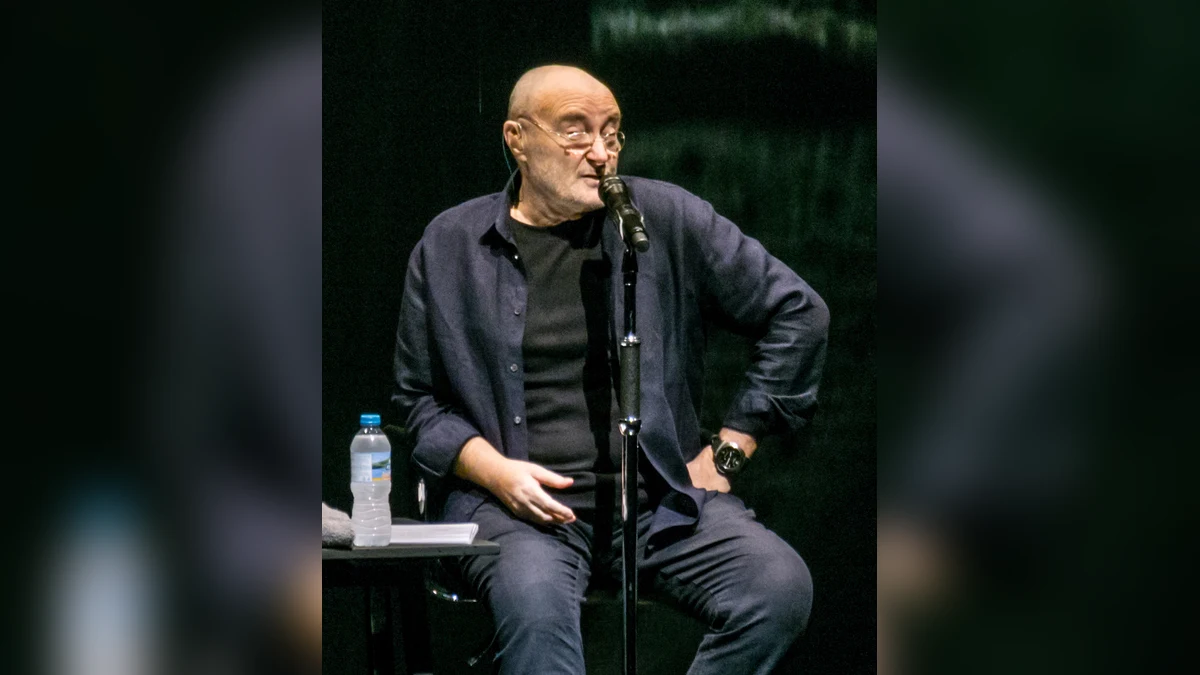








Phil Collins has an estimated net worth of $350 million, built on one of the most successful dual careers in music history: more than 100 million records sold as a solo artist, and more than 100 million more as the drummer and lead singer of Genesis.
Quick Facts
| Full name | Philip David Charles Collins |
| Born | 30 January 1951, Chiswick, Middlesex, England |
| Age | 75 |
| Net worth | $350 million (estimate) |
| Occupation | Singer, drummer, songwriter, producer, actor |
| Band | Genesis (1970–1996; reunions 2007, 2021–2022) |
| Records sold | 100M+ solo, 100M+ with Genesis |
| Awards | 8 Grammys, 6 Brit Awards, 2 Golden Globes, 1 Oscar |
| Rock & Roll Hall of Fame | With Genesis (2010); solo (2026) |
| Children | Simon, Joely (adopted), Lily, Nicholas, Matthew |
Early Life
Philip David Charles Collins was born on 30 January 1951 in Chiswick, Middlesex, England. His father, Greville, worked in insurance, and his mother, Winifred, worked as a theatrical agent. He grew up with two siblings in a household that encouraged his interest in performing.
Collins received a toy drum kit when he was five and progressed to a full-size instrument as his enthusiasm grew. He learned by playing along with records and was particularly inspired by the Beatles and Ringo Starr. His attention to rhythm developed alongside an interest in acting, rather than through a conventional conservatory education.
He attended the Barbara Speake stage school and worked as a child actor, including a stint as the Artful Dodger in the London production of “Oliver!” Music eventually became his priority. He played in young bands before joining Flaming Youth, whose 1969 album “Ark 2” gave him recording experience but did not produce a lasting commercial breakthrough.
Genesis
Collins joined Genesis in 1970 after answering an advertisement for a drummer. The group was then led by Peter Gabriel, whose theatrical performances complemented the band’s elaborate compositions. Collins initially supplied drums and backing vocals, although his lead performances on “For Absent Friends” and “More Fool Me” offered early evidence of his ability as a singer.
Albums such as “Nursery Cryme,” “Foxtrot,” “Selling England by the Pound” and “The Lamb Lies Down on Broadway” established Genesis as a major progressive-rock band. Collins’ drumming helped the group move through long compositions without losing momentum: shifting meters, precise accents and rapid changes of feel were central to the music.
Gabriel left in 1975, prompting a search for a replacement singer. Collins ultimately took the job himself, making his first full album as Genesis’ frontman with “A Trick of the Tail” in 1976. After guitarist Steve Hackett departed, Collins, Tony Banks and Mike Rutherford became the band’s core trio. “…And Then There Were Three…” produced “Follow You Follow Me,” and subsequent albums increasingly balanced extended arrangements with concise pop songs.
The 1986 album “Invisible Touch” made Genesis a stadium-level pop attraction, producing hits including its title track, “Land of Confusion,” “Tonight, Tonight, Tonight” and “Throwing It All Away.” “We Can’t Dance” followed in 1991 with songs such as “I Can’t Dance” and “No Son of Mine.” Collins was simultaneously fronting one of the world’s biggest bands and selling enormous quantities of records under his own name.
He left Genesis in 1996, later reuniting with Banks and Rutherford for the 2007 “Turn It On Again” tour. The trio returned once more for “The Last Domino?” in 2021 and 2022, with Collins’ son Nic playing drums. Their final concert took place at London’s O2 Arena on 26 March 2022.
Solo Breakthrough
Collins released his first solo album, “Face Value,” in 1981. Its songs reflected the breakup of his first marriage, and its musical approach differed from the elaborate group compositions associated with Genesis. “In the Air Tonight” became its defining recording, building from a restrained vocal and ominous atmosphere to one of popular music’s most recognisable drum entrances.
“Hello, I Must Be Going!” followed in 1982 and included his hit version of the Supremes’ “You Can’t Hurry Love.” In 1984, “Against All Odds (Take a Look at Me Now)” became a major soundtrack hit, and Collins also joined Philip Bailey for “Easy Lover.”
His 1985 album “No Jacket Required” sold more than 20 million copies worldwide, placing it among the best-selling albums of all time. “Sussudio,” “One More Night,” “Don’t Lose My Number” and “Take Me Home” kept him prominent on radio and television, and the album won the Grammy for Album of the Year.
That same year, Collins performed at both Live Aid concerts, travelling by Concorde from London to Philadelphia. Between solo recordings, Genesis, collaborations and television exposure, he was rarely absent from mainstream popular music during the decade.
Later Albums, Films and Disney
Collins starred in the 1988 film “Buster” and contributed the hits “Two Hearts” and “A Groovy Kind of Love” to its soundtrack. He followed with “…But Seriously” in 1989, whose “Another Day in Paradise” addressed homelessness and became another signature song.
“Both Sides,” released in 1993, was a more introspective project on which Collins handled the instrumental performances himself. “Dance into the Light” followed in 1996, reaching No. 4 in Britain and No. 23 in the United States.
His work for Disney introduced his music to a different generation. Collins wrote and performed songs for the 1999 animated film “Tarzan,” recording material in English, French, German, Italian and Spanish. “You’ll Be in My Heart” spent 19 weeks atop the adult contemporary chart and won both an Academy Award and a Golden Globe. He returned to Disney for “Brother Bear” in 2003, supplying songs including “Look Through My Eyes.”
Collins released “Testify” in 2002 and revisited the soul music of his youth on the 2010 covers album “Going Back.” His other musical outlets included jazz-oriented work with the Phil Collins Big Band. In 2015, he signed a deal with Warner Music to remaster his solo catalogue, and his 2016 memoir, “Not Dead Yet,” preceded his return to touring.
Across his career, Collins has won eight Grammy Awards, six Brit Awards, two Golden Globes and an Oscar. He entered the Songwriters Hall of Fame in 2003 and the Rock & Roll Hall of Fame with Genesis in 2010. His selection for a separate solo induction in 2026 recognised the substantial career he had built outside the band.
Music Rights Sale and Touring Earnings
In September 2022, Concord acquired the publishing and recorded-music interests of Collins, Mike Rutherford and Tony Banks in a deal valued at $300 million. The transaction covered their interests in Genesis, Collins’ solo work and music from the other members’ projects. It did not include the separately owned interests of former Genesis members Peter Gabriel and Steve Hackett.
Importantly, the $300 million was the value of the combined deal — the individual proceeds received by Collins, Banks and Rutherford were not disclosed, and the headline price cannot be divided into three assumed equal payments.
During major touring years, Collins has earned as much as $50 million. Forbes placed his earnings at $45 million on its 2020 Celebrity 100 list, following the commercial success of his “Not Dead Yet” comeback. Pollstar reported that Collins sold 890,846 tickets and grossed $115 million across 2017 and 2018, including $75.5 million in 2018 alone. Demand remained strong even though his physical condition required him to sing seated and leave the drumming to others.
Marriages and Divorce Settlements
Collins has been married and divorced three times, with his divorce settlements reported to total $84 million. His marital history includes two of the music industry’s most widely publicised payouts.
He married Andrea Bertorelli in 1975, and they divorced in 1980. Their family included son Simon and Andrea’s daughter Joely, whom Collins adopted. The deterioration of the marriage became important subject matter for his earliest solo work.
Collins married Jill Tavelman in 1984. They had a daughter, actress Lily Collins, before divorcing in 1996. Collins paid Tavelman a $25 million settlement.
His third marriage, to Orianne Cevey, began in 1999 and ended in divorce in 2008. They have two sons, Nicholas and Matthew. Cevey received a $45 million settlement, one of the largest publicly reported British celebrity divorce payouts at the time.
Collins later had a long relationship with television journalist Dana Tyler before reuniting with Cevey in 2016. The reconciliation did not lead to a second marriage, and their relationship ended again in 2020. Their subsequent dispute over his Miami Beach mansion became a separate legal conflict from the original divorce settlement.
Real Estate
In 2015, Collins paid $33 million for an 11,000-square-foot waterfront mansion in Miami Beach that had previously belonged to Jennifer Lopez. The property became the centre of a contentious dispute after his renewed relationship with Cevey broke down. Collins sought to regain possession while Cevey and her new husband were living there.
Cevey asserted that she was entitled to an interest in the home and sought $20 million. Her demand was a disputed legal claim, not an established additional settlement. Collins listed the estate for $40 million in December 2020; Cevey agreed to leave, and in January 2021 he sold the property to billionaire Orlando Bravo for $39.25 million. In 2022, a judge dismissed Cevey’s lawsuit seeking a share of the proceeds after repeated failures to comply with court orders.
Collins has also maintained homes in England and Switzerland, including in Féchy. An earlier family residence in nearby Begnins, subsequently associated with Cevey, was offered for 60 million Swiss francs in 2012 and remained unsold at that asking price in 2013 — an asking price, not evidence of a completed sale or money received by Collins.
Later Life and Health
An interest in the Alamo that began with childhood television developed into a serious collecting pursuit. Collins assembled weapons, documents and other artefacts connected to the Texas Revolution, then donated his collection to the State of Texas in 2014. Pieces from the collection became part of the Alamo’s expanded museum presentation.
His later concert appearances were shaped by nerve damage, back problems and other health difficulties that prevented him from playing drums as he once had. Nic Collins took over the instrument for his father’s solo comeback and the final Genesis tour. In a 2026 interview, Collins said he did not expect to perform live again, although he remained open to working on music in a less physically demanding setting.
Net worth figures are estimates only, based on public sources.
Related: Roger Taylor Net Worth: $425M, Queen’s Drummer, John Lennon Net Worth: $200M at Death in 1980, Richest Singers in the World in 2026, Ranked by Net Worth
